
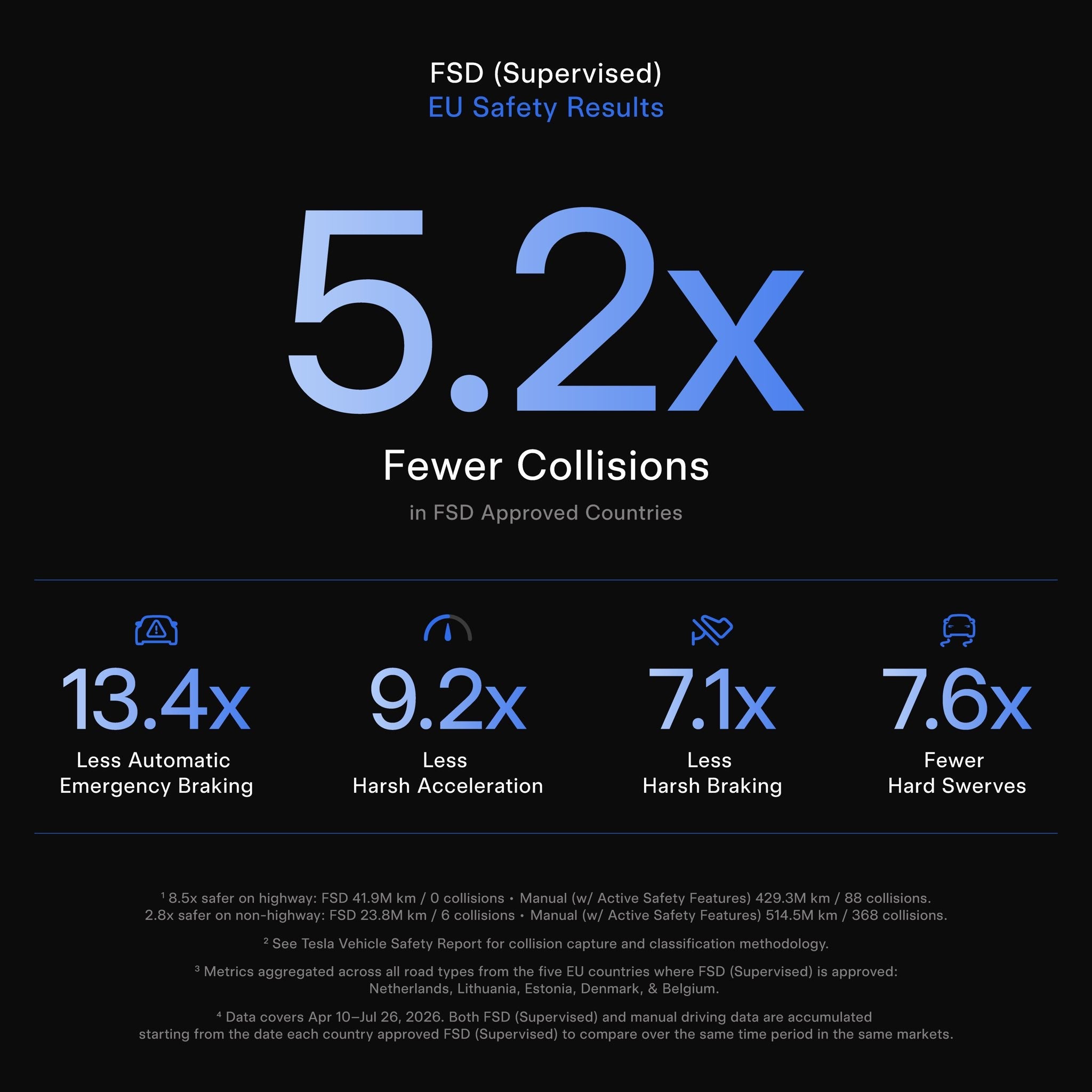
Tesla Europe has published its boldest regional safety claim yet for Full Self-Driving (Supervised). The company said four months of driving in five European Union countries produced 65 million kilometers of FSD Supervised data and a collision rate more than 5.2 times better than manual driving. The five markets currently listed by Tesla are the Netherlands, Lithuania, Estonia, Denmark and Belgium.
"In the last 4 months, FSD Supervised has been over 5.2x safer than manual driving – across 65 million kilometers in 5 EU countries."
That is a meaningful amount of real-world exposure, especially for software that only entered public European use this spring. It is not, however, the same thing as an independent finding that FSD is universally 5.2 times safer than a human driver. The number is Tesla's own comparison, built from Tesla vehicles, Tesla telemetry and Tesla's collision definitions.
How Tesla counts a collision
Tesla's published methodology counts an event when a deployable restraint activates or when the vehicle records a specified rapid change in velocity. It classifies a collision as involving FSD Supervised if the feature was active at any point during the five seconds before the event. That rule is sensible because a driver may take over just before impact, but it also shows why readers need the definition before comparing Tesla's figure with police reports or insurance databases. Tesla also reports events without assigning fault, so a collision can enter the dataset even when another road user caused it. That improves consistency, but it does not explain how well the software handled the moments before impact.
The strongest comparison is within the same connected fleet. Both FSD and manually driven Teslas can be observed through similar telemetry systems, reducing some reporting differences. Even then, route mix matters. People may activate FSD more often on roads, in weather and at times when they expect the system to perform well. City streets, highways and parking areas carry different baseline risks, and a single ratio can hide those differences.
Europe adds a regulatory reality check
The Netherlands Vehicle Authority, RDW, approved FSD Supervised after an extended test program, but it describes the software as driver-controlled assistance—not autonomous driving. RDW says the driver must remain responsible, watch the road and be ready to take control immediately. It also cautions that European and U.S. versions are not directly comparable because functions and regulatory requirements differ.
This distinction is easy to lose when a safety multiple travels through social media. A lower observed collision rate can support the case that supervised assistance is helping, while still not granting the system responsibility for the drive. The word "Supervised" is doing real legal and practical work in the name.
What the next update should include
Tesla can make the European result more persuasive by publishing the underlying collision counts, country-by-country mileage, road type, vehicle mix, software versions and confidence intervals. Independent access to anonymized data would matter even more. A 65-million-kilometer sample is useful, but transparency determines whether outsiders can separate software performance from where and when customers choose to engage it.
For now, the result is encouraging evidence from a manufacturer, not a final verdict from the safety community. The better story is that Europe is beginning to produce measurable FSD Supervised experience under local rules. If the ratio holds as mileage grows and reporting becomes more detailed, Tesla will have something stronger than a viral statistic: a repeatable safety case.
Related EVBASE links
Sources
Tesla Europe - 5.2x FSD Supervised safety claim on X
Tesla - Full Self-Driving (Supervised) Vehicle Safety Report
RDW - European type approval explanation for Tesla FSD Supervised
Share:
Tesla Megapack Powers New Zealand's First Utility-Scale Battery
Starship Flight 13 Splashdown: Why the Landing Burn Matters