
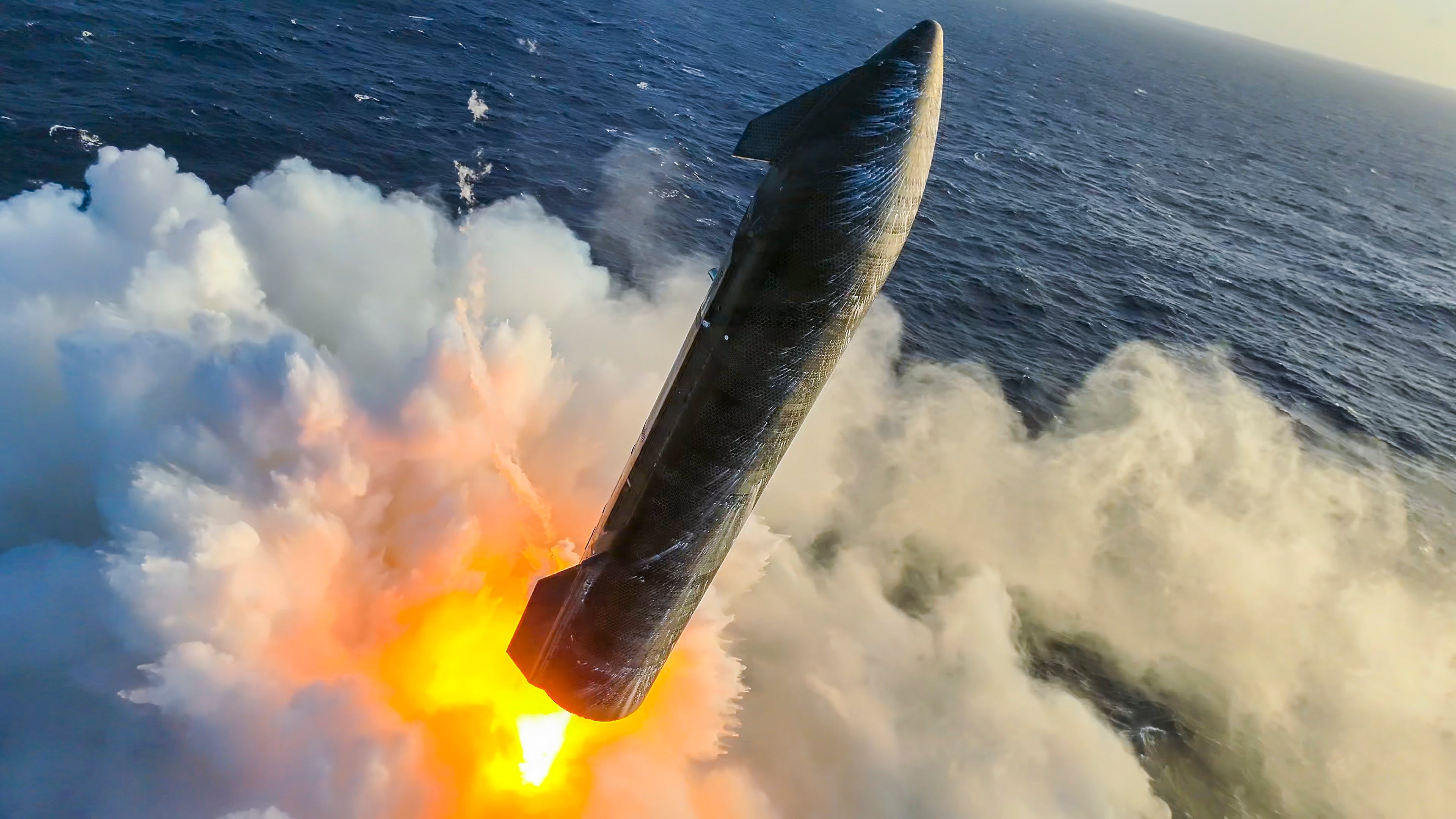
SpaceX has released a close view of Starship Flight 13's final seconds, showing the upper stage rotate from a belly-first descent, ignite its Raptor engines and settle into the Indian Ocean. The video is brief, but it captures one of the hardest transitions in the entire Starship profile: turning a 124-meter launch system's ship from an atmospheric glider into a vertical landing vehicle.
"Landing burn and splashdown of Starship on Flight 13."
Flight 13 launched from Starbase on July 24 and completed a roughly hour-long suborbital trip. The mission carried next-generation Starlink payloads and ended with the ship upright and afloat, a cleaner outcome than many earlier test flights. SpaceX's recovery team was able to gather additional imagery after the splashdown, giving engineers evidence that telemetry alone cannot provide.
The landing maneuver in three steps
During reentry, Starship uses four large flaps to control its fall while presenting its heat shield to the atmosphere. Near the ocean, the ship commands a rapid flip to bring its engines beneath it. A landing burn then removes the remaining downward speed before the vehicle reaches the surface. Each step depends on accurate guidance, propellant settling and engines that relight after spending most of the flight shut down.
That final relight is not just spectacle. Starship must manage liquid methane and oxygen while its orientation changes quickly. The engines also need enough control authority to arrest the fall without creating a hard impact. Flight 13's gentle arrival and continued flotation suggest that the ship reached the water with low vertical velocity and maintained substantial structural integrity through reentry.
Why an ocean landing still advances reuse
SpaceX does not intend to make ocean recovery the operational end state. The company's long-term plan calls for the launch tower to catch both stages, avoiding landing legs and enabling faster reuse. A controlled splashdown is the lower-risk rehearsal. It lets teams evaluate navigation, flap authority, heat-shield survival, engine relight and touchdown timing without putting a tower or ground crew beside an experimental vehicle.
The intact ship is especially valuable because engineers can compare post-flight photographs with temperature, pressure and vibration data. Visible tile loss, deformation or local scorching can reveal which parts of the vehicle need changes before a tower catch is attempted. SpaceX moves quickly, but a reusable spacecraft cannot be judged only by whether it completes the webcast. It must return in a condition that supports inspection and, eventually, another flight.
The booster keeps the result from being perfect
Flight 13 was not a complete recovery demonstration. Reporting from the launch indicated that Super Heavy did not ignite every planned engine during its own landing sequence and reached the Gulf hard. That leaves SpaceX with different results for the two stages: a ship that delivered an unusually controlled finish and a booster recovery system that still needs work.
The new video matters because it isolates the successful half of that story. Starship's flip and burn are becoming repeatable rather than novel, and Flight 13 moved closer to the precision needed for a catch. The next milestone is not a more dramatic splash. It is demonstrating the same control with enough margin, consistency and vehicle health that SpaceX can bring the ship back to hardware on land. Before that decision, engineers will need to understand how much fuel margin remained, how accurately the ship met its target and whether heat-shield damage would have made an immediate second flight unrealistic. A soft arrival is the start of a reuse review, not the end of one.
Related EVBASE links
EVBASE EV and technology news hub
More EVBASE space and technology coverage
Sources
SpaceX - Flight 13 landing burn and splashdown footage on X
SpaceX - Starship Flight 13 mission page
Associated Press - Starship Flight 13 launch and splashdown report
Share:
Tesla FSD Supervised Safety Data in Europe: What Makes Fewer Collisions
New Challenge For SpaceX AI Satellites and Orbital Data Centers