
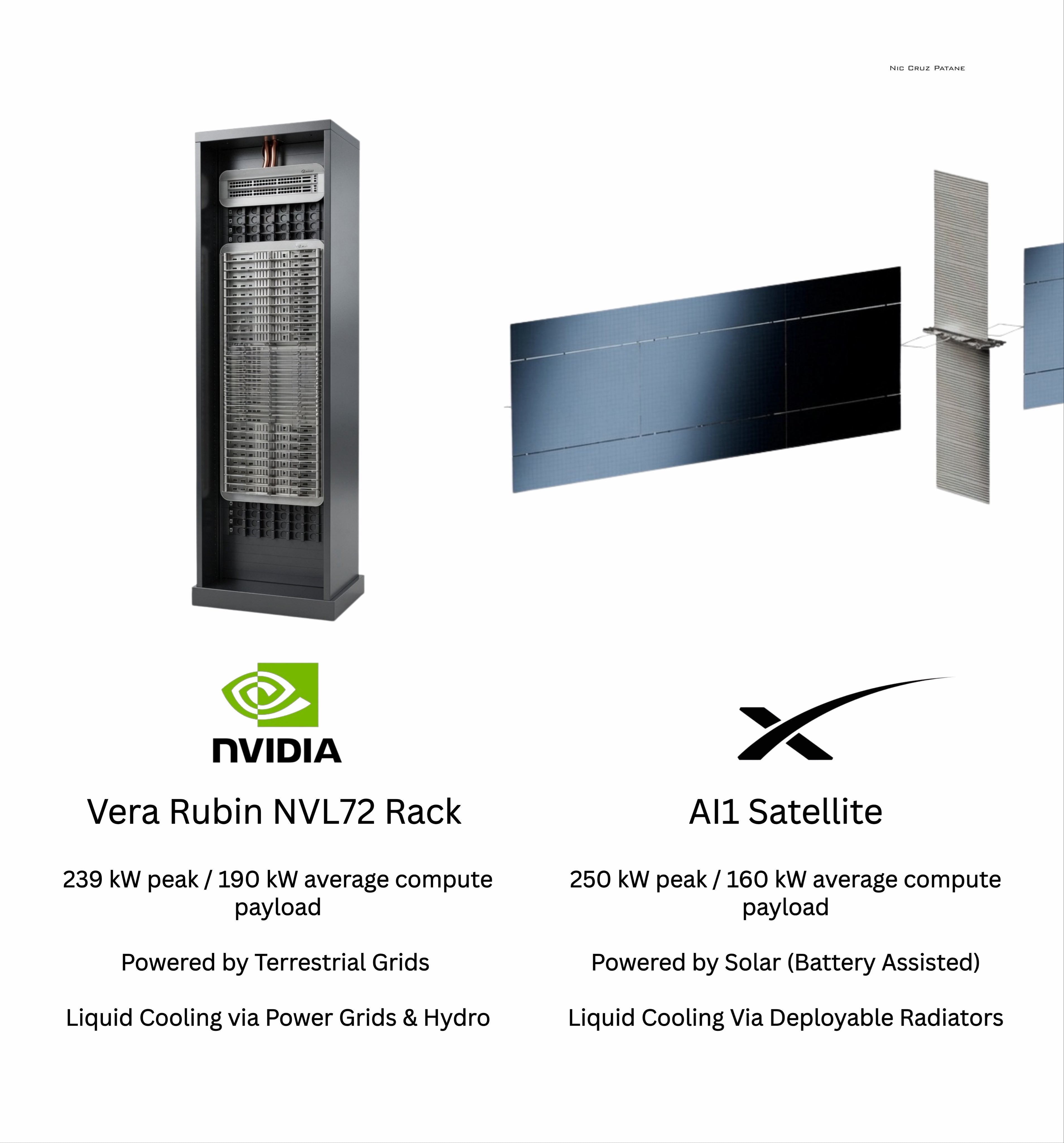
A new wave of discussion around SpaceX AI satellites is asking a provocative question: what if the next giant AI factory is a fleet of spacecraft instead of a building beside a power plant? Tesla and SpaceX watcher Nic Cruz Patane argued that future satellites could carry rack-scale compute comparable to NVIDIA's Vera Rubin systems, using sunlight in orbit rather than hundreds of megawatts from a terrestrial grid.
"Millions of these satellites at scale will provide more compute than what's even possible on Earth."
The comparison is timely. NVIDIA says Vera Rubin NVL72 systems are ramping into production, with major cloud providers deploying them as power-constrained AI infrastructure. SpaceX also has two assets that most orbital-compute startups lack: a high-volume satellite manufacturing program and a launch system designed around very large payloads. Those advantages make the idea worth examining. They do not make it solved.
Solar power is the attractive part
Low Earth orbit can offer long periods of sunlight, and a large constellation could spread computing across many nodes. Processing images or communications data near the sensor could also reduce the amount of raw information sent to Earth. The U.S. Government Accountability Office says orbital data centers could eventually reduce demand for land, grid electricity and water used by facilities on the ground.
The commercial logic becomes stronger if Starship lowers the cost of placing heavy solar arrays, radiators and computing hardware in orbit. A company that owns launch, satellite buses, optical links and an AI customer could integrate the stack in a way that resembles SpaceX's approach to Starlink. That is the credible core behind the excitement.
Vacuum does not provide free cooling
The most important correction is thermal. Space feels cold, but a vacuum cannot carry heat away through moving air or circulating water. A satellite must conduct waste heat to radiators and emit it as infrared energy. High-performance AI chips create enormous thermal loads, so the radiator area and mass can become defining constraints rather than small support systems.
GAO calls cooling at data-center scale unproven and notes that proposed solar arrays would be larger than any assembled in orbit as of April 2026. Radiation can also corrupt data and degrade electronics. Shielding, redundancy and repair capability add mass, while replacing short-lived compute satellites too frequently could worsen debris and reentry risks.
A constellation creates network and policy limits
Training a frontier model is not merely a pile of independent GPUs. Processors exchange huge volumes of data with predictable latency. NVIDIA's rack design relies on extremely fast links inside and between systems; distributing those workloads across moving satellites adds distance, handoffs and optical-link complexity. Early orbital compute may therefore be better suited to processing data already collected in space than reproducing a tightly coupled training cluster.
Scale also has a public cost. Thousands or millions of additional satellites would raise collision-management, radio-frequency and astronomy concerns. Regulators will ask not only whether the business works, but how it changes a shared orbital environment. The smart conclusion is neither dismissal nor inevitability. SpaceX is unusually positioned to test orbital AI hardware, yet the first useful systems will probably be specialized, expensive and far smaller than the viral vision. A credible roadmap would begin with power and thermal demonstrations, followed by radiation-tolerant compute and optical networking tests. Only after those results should anyone translate a satellite count into the equivalent of terrestrial AI racks. Launch capacity is an advantage; sustained computing performance is the proof.
Related EVBASE links
EVBASE EV and technology news hub
More EVBASE technology analysis
Sources
Nic Cruz Patane - SpaceX AI satellite commentary on X
Share:
Starship Flight 13 Splashdown: Why the Landing Burn Matters
A Must-Have Tesla Model Y Juniper Glass Roof Accessory for Summer