
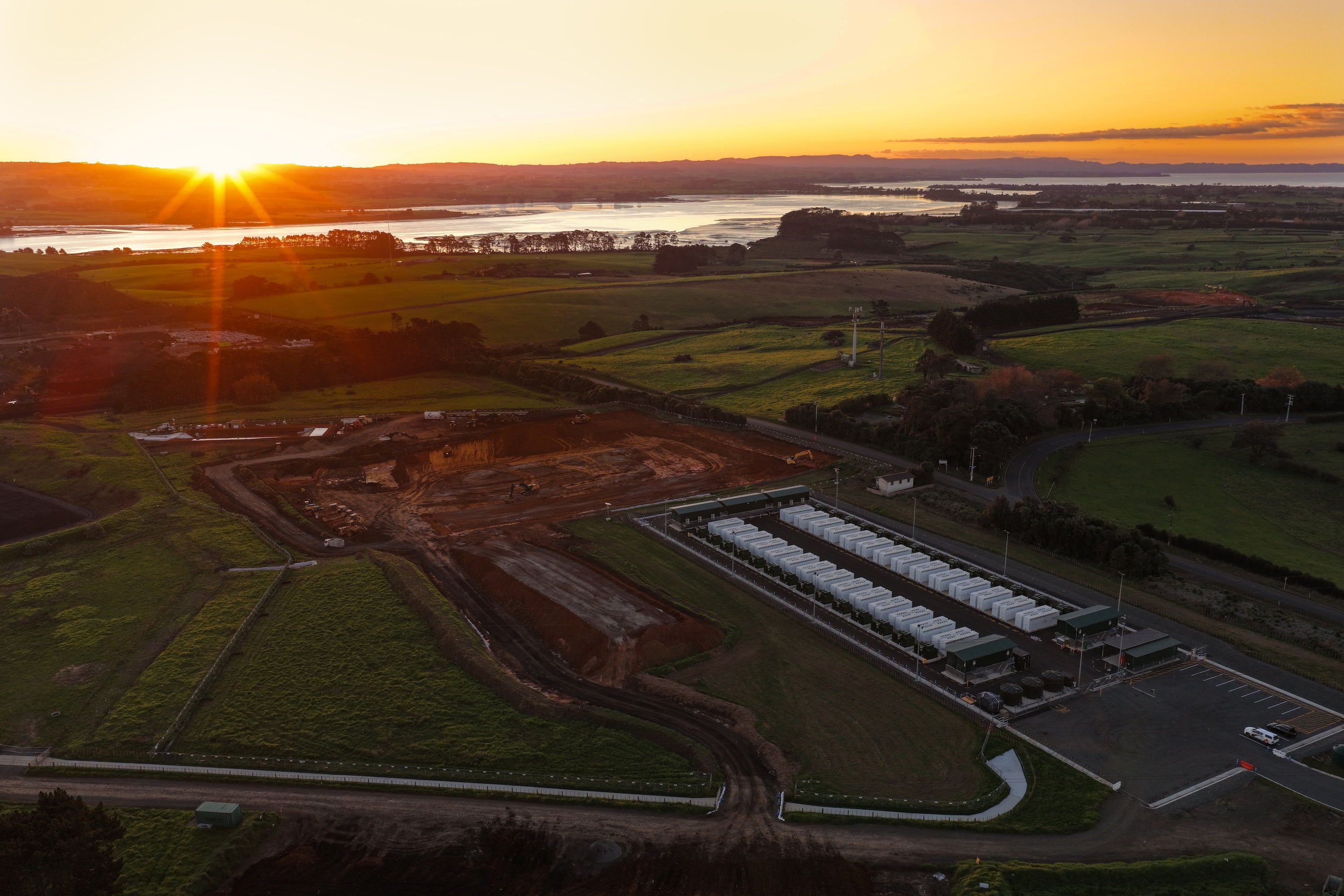
Tesla says New Zealand's first utility-scale Megapack project is now operating at Glenbrook, south of Auckland. Contact Energy's Glenbrook Ohurua Battery 1 uses 56 Megapack 2 XL units to deliver 100 megawatts of power and store 200 megawatt-hours of energy. The project began trading on April 1 and was officially opened on May 21.
"The first utility-scale Megapack project in New Zealand is now operating!"
Why the numbers matter
Power and energy describe different jobs. The 100 MW rating shows how much electricity the battery can deliver at one moment, while 200 MWh indicates roughly two hours of output at that maximum rate. Contact says the system can supply the equivalent of about 44,000 homes for up to two hours during peak demand.
The battery does not generate electricity. It stores power when demand is lower and returns it when demand rises or the grid needs fast support. That function is particularly valuable in a system with large amounts of hydro, geothermal, wind and solar. Renewables can produce abundant energy, but production and demand do not always arrive at the same hour.
Contact says the NZ$151 million project can respond to changes in demand in a split second and support the network during peaks, outages and unexpected events. The company describes Battery 1 as its first grid-scale battery and says construction began in July 2024, finishing on time and under budget. Tesla's July 27 post characterized commissioning as ahead of schedule.
Battery 2 changes the scale
The first site's opening is only half of the Glenbrook plan. Contact is progressing Glenbrook Ohurua Battery 2 beside it, a 200 MW project representing a further NZ$235 million investment. Contact expects the second battery online in early 2028.
Together, the two projects would provide up to 300 MW of capacity. Contact estimates that combined output could serve the equivalent of 132,000 homes for up to two hours at peak demand. The second battery is not merely a duplicate: doubling down at a location near major Auckland demand and transmission can turn the site into a much more important balancing asset.
What it says about Tesla Energy
For Tesla, Glenbrook demonstrates the less visible side of its energy business. A Megapack project is not sold to a driver and does not create the same consumer attention as a new vehicle. Its value comes from standardized battery units, power electronics and controls being assembled into utility infrastructure that can shift energy across time.
The project is also a better signal than inventory photographs or delivery rumors because it is operating within a real electricity market. The important next evidence will be availability, response performance, revenue from grid services and how Battery 1 behaves during high-demand periods. Battery 2 will add a second test: whether Contact and Tesla can repeat the build at twice the power rating without losing schedule or cost discipline.
Grid operators will ultimately judge the system by response speed, availability and performance during the hours when flexibility is most valuable.
The bottom line
Glenbrook does not solve every challenge in New Zealand's energy system, but it supplies a fast, flexible buffer between renewable production and customer demand. Fifty-six Megapacks now turn that idea into a 100 MW / 200 MWh operating asset, and the adjacent expansion would lift the location to 300 MW. The story is no longer about a proposed battery. It is about measurable grid performance and whether a successful first project can become a repeatable part of New Zealand's energy strategy.
Related EVBASE links
EVBASE EV and clean-technology news hub
More EVBASE energy and technology coverage
Sources
Tesla Megapack - Glenbrook project announcement on X
Share:
Tesla Solar Roof Case Puts a $9 Utility Bill Claim in Context
Tesla FSD Supervised Safety Data in Europe: What Makes Fewer Collisions