
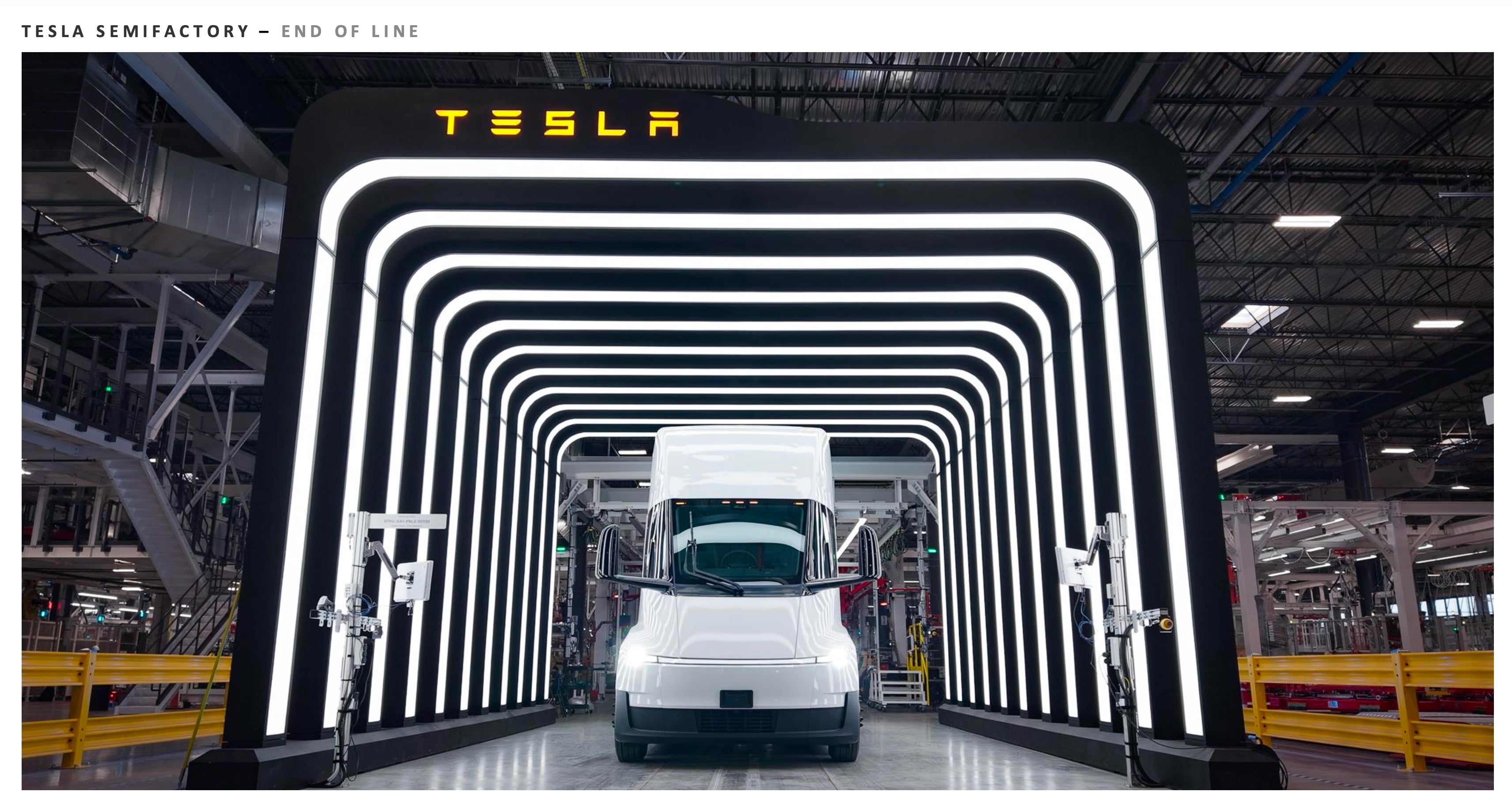
Tesla has started production of Cybercab at Gigafactory Texas, turning one of the company’s most closely watched autonomy programs from a factory promise into a physical production effort. In its Q2 2026 shareholder update, Tesla also said its Robotaxi service is now live in seven major U.S. metro areas.
That is a meaningful threshold. Cybercab is Tesla’s purpose-built autonomous EV, designed without the conventional controls expected in a privately owned passenger car. Production means the company can begin learning from the actual vehicle it wants to use at scale, rather than relying only on Model 3 and Model Y vehicles adapted for ride-hailing service.
Production is real, scale is not yet proven
Tesla lists more than 125,000 units of installed annual Cybercab capacity in Texas. The same document immediately warns that installed capacity is not the current production rate. Output still depends on equipment uptime, parts supply, factory changes and regulatory conditions. That distinction matters because the word “production” can describe anything from a slow validation run to a mature high-volume line.
The company said engineering test drives of production Cybercabs began on public roads during the quarter. In July, employees also began taking Cybercab rides on the Gigafactory Texas campus. Those are practical milestones, but they are still precursors to broad commercial deployment. Tesla did not disclose how many Cybercabs it has built or how many are carrying paying riders.
Why Tesla is spreading Robotaxi across cities
The current service map shows unsupervised operations ramping in Austin, Dallas, Houston, Miami, Orlando and Tampa. The San Francisco Bay Area remains a separate case, operating with a safety driver under a California permit. Phoenix and Las Vegas are listed as markets in preparation rather than active service.
The network is also being built on top of a growing paid software base. Tesla reported 1.48 million active FSD customers at quarter-end, up 56% from a year earlier. That does not make the supervised customer product equivalent to an unsupervised Robotaxi service, but it gives the company a large source of real-world driving data and recurring software revenue while the commercial fleet remains small.
During Tesla’s Q2 earnings call, executives said the company is intentionally building a wider geographic footprint before placing a large fleet in any one city. Different road layouts, operating procedures and local rules expose different failure modes. Management said Robotaxi miles have been growing by more than 10% week over week, but declined to turn that growth rate into a fleet-size forecast.
Cybercab adds another reason for restraint. Elon Musk said Tesla needs chassis-specific driving data before it can deploy the new vehicle in large numbers. Early test vehicles can be equipped with temporary controls so engineers can calibrate steering, braking and vehicle behavior. Only after that evidence accumulates does Tesla expect Cybercab deployment to accelerate.
The next proof point is operational
Tesla’s near-term Robotaxi story is therefore less about a dramatic launch day and more about repeated, uneventful operation. The company must show that Cybercab can be manufactured consistently, maintained economically and introduced city by city without compromising safety.
Battery packs remain another constraint. Tesla called pack capacity the main limitation on near-term vehicle-production growth, while its 4680 program is being asked to support Cybercab, Semi and higher Model Y output at the same time.
The Q2 update moves Cybercab forward, but it does not close the case. Production has started. What investors, regulators and riders need next is evidence that Tesla can convert early vehicles and fast-growing miles into a dependable commercial fleet.
|
Use code ev9999 to get 20% off any product at EVBASE. |
Sources
• Tesla — Q2 2026 shareholder update post
• Tesla Investor Relations — Q2 2026 Update
Share:
Do You Know the Tesla Model Y Financing Widens the Monthly Gap With Rivian R2?
Tesla’s Q2 Update Reveals an Industrial Bet on Energy, Batteries and Optimus