
Tesla’s Q2 2026 update reads less like the report of a conventional automaker and more like a map of an industrial buildout. Cars still produced most of the quarter’s revenue, but the company’s next layer of investment stretches from battery-grade lithium and solar cells to AI chips, grid storage and humanoid robots.
The unifying idea is control. Tesla wants more of the materials, components, compute and factory capacity needed to scale its products under its own roof. That could reduce long-term supply dependence. It also creates a demanding execution problem because many of these projects are entering construction, commissioning or early ramp at the same time.
Energy storage is already carrying real volume
Tesla deployed 13.5 GWh of energy-storage products in Q2, up 41% from a year earlier and the company’s second-highest quarterly result. Megafactory Shanghai continued to ramp, while the new Megafactory Texas moved into commissioning. Tesla expects the Texas facility to begin producing Megapack 3 and the integrated Megablock system this year.
The storage business is not immune to pressure. On the earnings call, Tesla said industrial-storage prices are falling as competition increases, and energy gross margin declined sharply from the previous quarter. The more important operational signal is that Tesla is adding factories while demand from grid projects and power-hungry data centers is still developing.
Battery capacity connects the entire plan
Tesla described battery-pack capacity as the main constraint on near-term vehicle growth. Its response spans several layers: 4680 cell production in Texas, lithium refining and cathode-material output in the state, LFP cells ramping in Nevada and pack capacity under construction in Berlin. Those lines must support Cybercab, Semi, Model Y and stationary storage, so progress in one program can compete with another for cells and packs.
The company is also preparing a vertically integrated solar-manufacturing chain. During the Q2 earnings call, Elon Musk said the plan reaches from silicon refinement through solar cells, panels and deployment. Tesla’s shareholder deck confirms that site work and equipment procurement advanced during the quarter, but it does not yet provide a production date or audited capacity figure for the solar project.
Fremont is being repurposed for Optimus
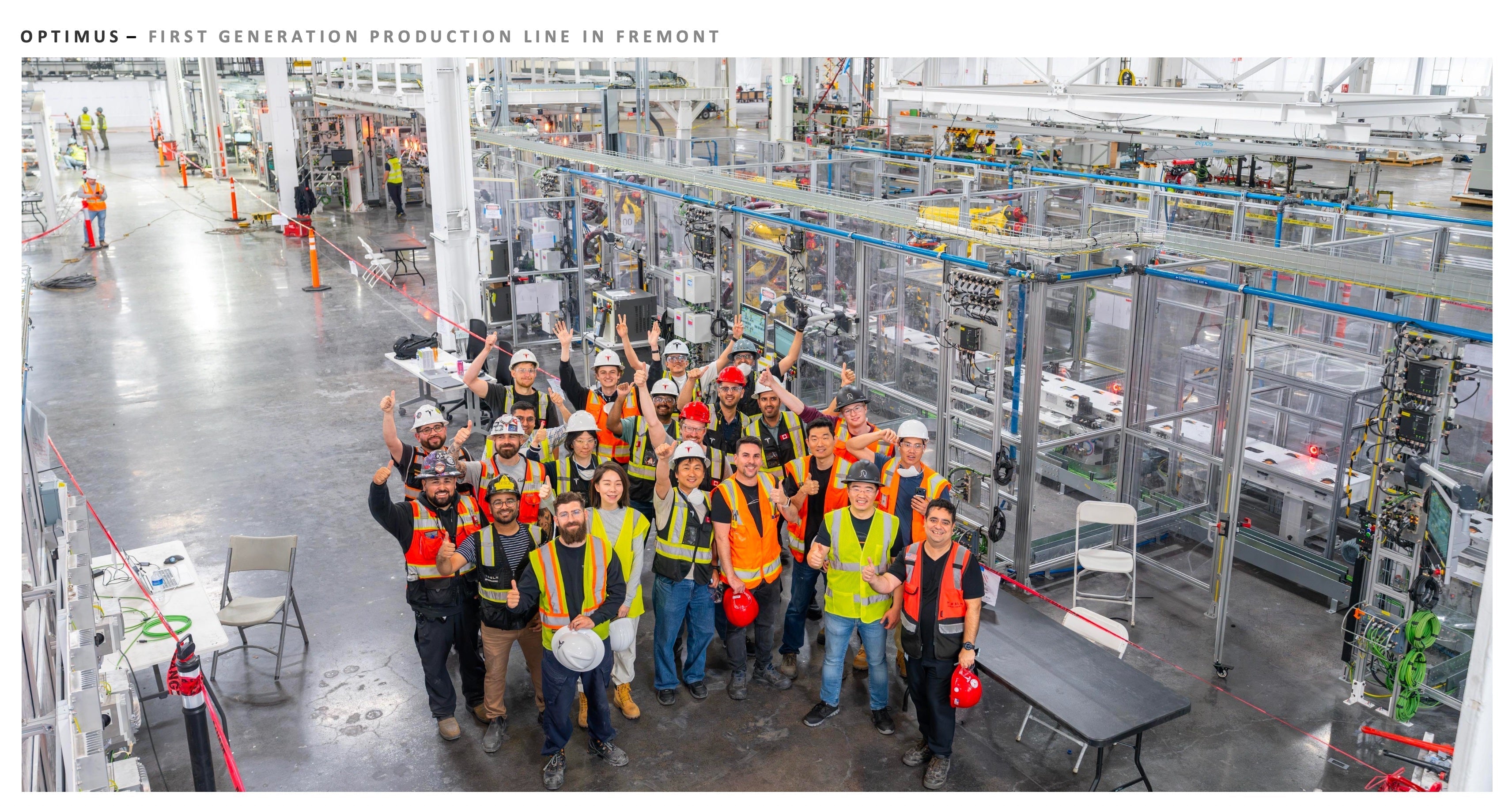
Tesla has removed the former Model S and Model X production lines in Fremont and is installing its first-generation Optimus lines. Initial robots are intended for the company’s Optimus Academy, where they will collect training data and help engineers expand functionality. A second site is under construction at Gigafactory Texas.
The transportation side is expanding in parallel. Tesla Semi’s Nevada factory is in commissioning, with production still scheduled to begin this year. The Supercharger network added more than 2,400 net new stalls in Q2 and reached 82,357 connectors worldwide, a 17% year-over-year increase. These are less speculative assets than Optimus: factories, chargers and storage systems can support revenue before the most ambitious autonomy targets are reached.
That is an important evidence boundary. Tesla expects production to begin this year, but early Academy units are development tools, not proof of a mature commercial robot business. The same caution applies to the planned Austin semiconductor fab and to Tesla’s more than doubling of on-site AI compute in Texas during the first half.
Tesla’s industrial strategy is coherent: energy supplies the machines, batteries store it, compute trains the software, and factories turn the stack into products. Its risk is equally coherent. Building everything at once magnifies delays, capital needs and supply-chain conflicts. Q2 shows the pieces moving. The next test is whether they begin reinforcing one another rather than competing for the same money, engineers and materials.
|
Use code ev9999 to get 20% off any product at EVBASE. |
Sources
• Tesla — Q2 2026 shareholder update post
• Tesla Investor Relations — Q2 2026 Update
Share:
Tesla Starts Cybercab Production as Robotaxi Network Reaches Seven U.S. Metros
France Says Tesla FSD Is Not Ready for Approval—Here’s What Must Change