
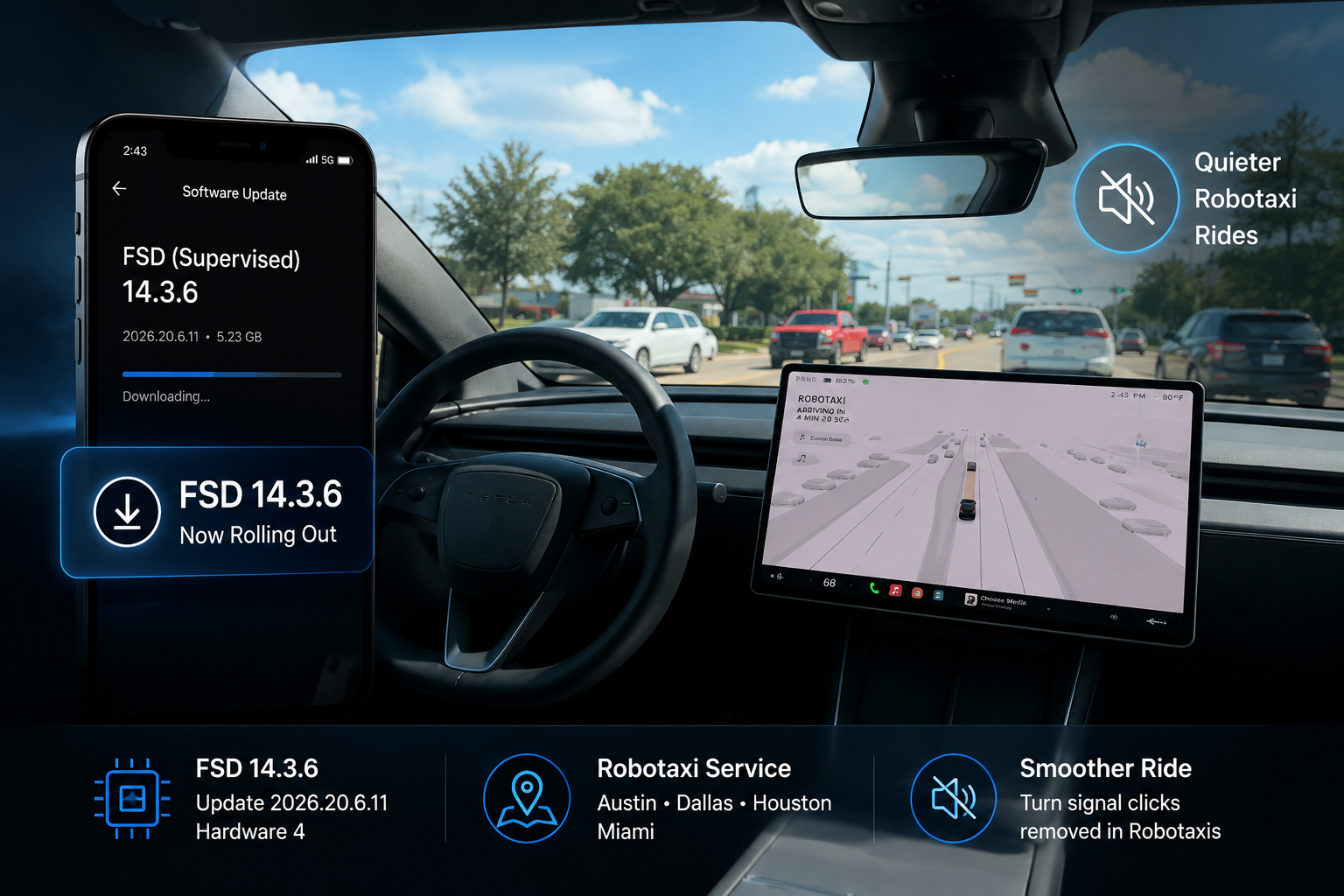
Two small Tesla software signals landed within hours of each other on July 27. A Model Y Robotaxi rider reported that Tesla had removed the cabin's turn-signal clicking sound, while owner Dylan, who posts as @dkmitc, showed FSD (Supervised) 14.3.6 downloading to his car. One change is aimed at passengers; the other continues Tesla's owner-fleet software rollout.
"Tesla has finally turned off the blinker/turn signal noises in their Model Y Robotaxis."
"FSD 14.3.6 downloading!"
Why the quiet Robotaxi detail matters
The report concerns the audible clicking inside the cabin, not the external turn indicators. In a human-driven vehicle, the sound confirms that the driver activated a signal and reminds that person to cancel it. An unsupervised ride has no driver who needs that reminder, so repeating the noise for every automated lane change can become unnecessary passenger feedback.
Removing it is not a breakthrough in autonomy, but it shows that Tesla is beginning to treat the Robotaxi as a service experience rather than merely a car that can navigate. Riders judge an automated trip through acceleration, braking, route choice, cabin sound and the clarity of the app. A technically correct maneuver can still feel awkward if the cabin delivers signals designed for a missing driver.
Tesla's official Robotaxi page says autonomous rides are currently offered in Austin, Dallas and Houston, Texas, and Miami, Florida. The company still uses Model Y vehicles in the service while planning for Cybercab to take a larger role over time. That makes over-the-air refinements the fastest way to standardize the existing fleet's behavior.
FSD 14.3.6 reaches more owner cars
The separate download report adds evidence that software update 2026.20.6.11 is still widening. Release tracking lists FSD 14.3.6 for Hardware 4 vehicles and FSD 14 Lite for supported Hardware 3 Model 3 and Model Y vehicles. Availability can vary by hardware, region and software branch, so one owner's download does not mean every eligible Tesla receives it immediately.
Published release notes attribute several technical changes to 14.3.6, including reinforcement-learning updates, a revised vision encoder and a rebuilt compiler and runtime that Tesla says improves reaction time by 20 percent. The notes also describe less lane biasing and tailgating, more decisive parking behavior and stronger handling of unusual objects and temporary system degradation.
Those are broad claims, not an independent performance test. Owners still need to supervise FSD, remain attentive and be ready to take control. Robotaxi operation and consumer FSD also should not be treated as identical simply because Tesla can share models, training methods or interface ideas between them.
The different operating environments also change what counts as success. A Robotaxi fleet can use a controlled software branch, known service area and centralized monitoring, while a customer car must operate across a much wider mix of roads and personal settings. A cabin-sound adjustment can be validated quickly; a driving-model change requires exposure across many scenarios. That is why visible rollout reports are useful evidence of distribution but not proof of safety or performance.
The bottom line
Together, the two updates show Tesla working at different levels of the same software-defined system. FSD 14.3.6 targets driving behavior and model execution, while the silent blinker targets what a passenger hears during a successful maneuver. The next useful evidence will be broader owner feedback, intervention data and rider reports across Tesla's operating cities. Small changes deserve small claims, but repeated small changes are how an automated service begins to feel finished.
Related EVBASE links
Browse EVBASE Tesla news coverage
Sources
Sawyer Merritt - Model Y Robotaxi turn-signal sound report
Dylan - FSD 14.3.6 download report
Share:
Starlink Mobile Expands From Texting to Apps With Telstra
SpaceX Flight 13 Shows Starship in Space After Major Test Milestones