
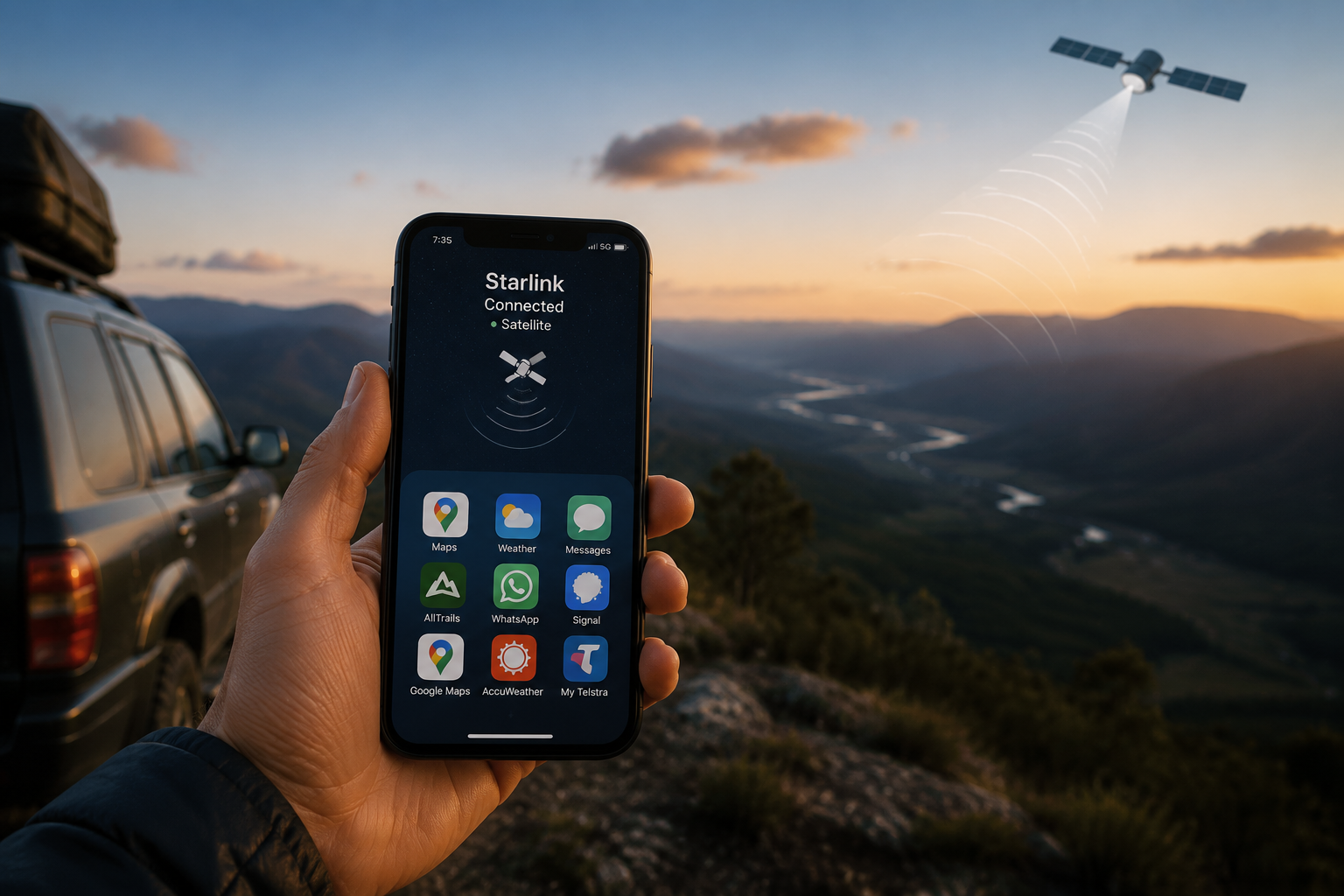
Starlink and Telstra have moved satellite-to-phone service in Australia beyond basic texting. Eligible Telstra customers can now use a limited group of navigation, weather, messaging, fitness and light social apps when they are outside the carrier's terrestrial mobile footprint, according to Telstra's July 28 announcement and a matching post from Starlink.
"With Starlink Mobile, Telstra customers in remote locations can now use apps to chat, navigate trails, check directions, and more."
Why it matters
The practical jump is larger than the word "apps" suggests. A text message can confirm that someone is safe, but a map can help that person find a road, a weather app can show a changing forecast, and a group chat can coordinate a pickup. That makes the service more useful for regional travel, farm work, remote communities and long drives where conventional towers disappear.
Telstra lists Apple Maps, Google Maps and AllTrails among the navigation options. Messaging support includes iMessage, WhatsApp, Facebook Messenger, Signal and Google Messages, while weather choices include Apple's Weather app, AccuWeather and Google Weather. Google Fitness and the My Telstra app are also included. The rollout is therefore selective, not open internet access for every application on a phone.
How the satellite connection works
Starlink's Direct to Cell satellites carry an advanced modem that functions like a mobile base station in orbit. The network connects through participating carriers in a roaming-style arrangement, so customers do not need a separate dish. Telstra says a compatible phone will look for a satellite automatically when the user is outdoors, beyond mobile coverage and has a clear view of the sky.
At launch, supported hardware includes the Samsung Galaxy S26 family and iPhone 13 or newer on eligible Telstra Upfront Mobile and Business Mobile plans. Devices need current software, and users should install, update and sign into needed apps before leaving normal coverage. Additional devices are expected later.
The limits are just as important. Telstra says messages or maps may load more slowly than on 4G or 5G, performance can vary with location, environment, latitude and satellite position, and not every feature inside a supported app will work. Voice or video features may appear intermittently but are not meant to be relied on. App-based services such as WhatsApp also cannot place Australia's Triple Zero emergency calls.
That makes preparation part of the product experience. A traveler should still download offline maps, carry backup power, share a route and avoid treating a satellite app as guaranteed emergency coverage. The new service adds another communications path, but terrain, foliage, buildings and a blocked sky can interrupt it. Telstra's own instructions place responsibility on the user to keep software current and understand which features are actually supported before entering a coverage gap.
What North American users should watch
Telstra's rollout is Australian, but it offers a useful preview for North American customers. Starlink lists T-Mobile and Rogers among its Direct to Cell partners, and the same progression from texting to carefully managed data is the likely path elsewhere. Carrier rules, supported devices and emergency-service limits will still differ by country.
The next test is not whether a satellite icon appears. It is whether selected apps remain dependable enough to help when a road, trail or work site loses tower coverage. Telstra is careful to call the service an extension rather than a replacement for its mobile network. That restraint is appropriate: Starlink Mobile has opened a useful new layer of connectivity, but the real value will be measured in ordinary remote moments, not in peak-speed claims.
Related EVBASE links
EVBASE EV and technology news hub
Sources
Starlink - Telstra satellite-app announcement on X
Share:
Tesla Plans to Open-Source Model S and Model X Designs
Tesla Model Y Update Target Robotaxi Comfort and FSD Control