
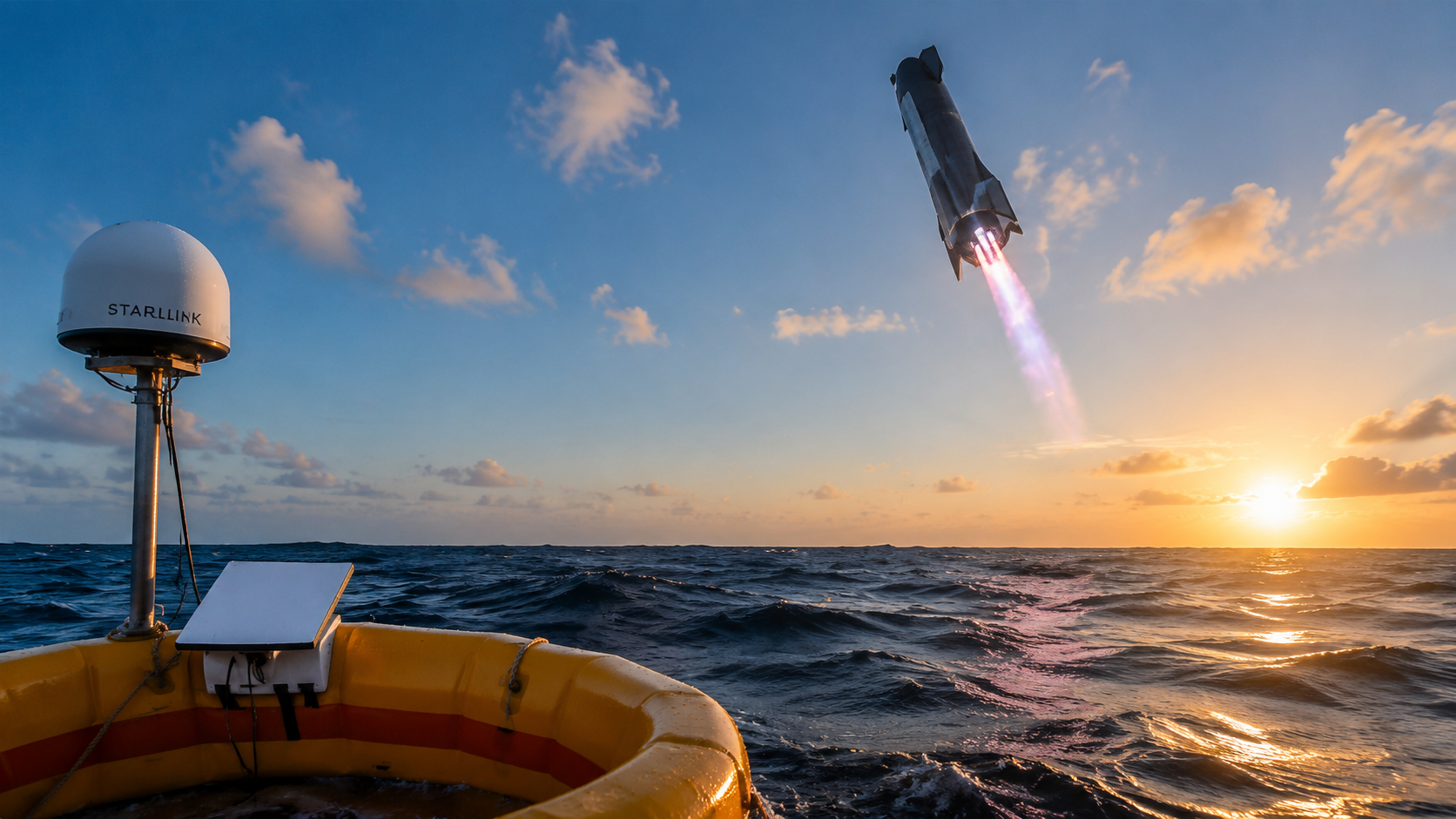
Starship Flight 13 produced more than a clean splashdown video. SpaceX placed Starlink-equipped buoys in the Indian Ocean and used them to stream real-time footage from a part of the planet where conventional communications would be awkward, expensive or unavailable. The result was a recovery operation that looked less like waiting for a ship to return and more like monitoring a remote industrial test site.
"Starlink-equipped buoys provided real-time video streaming in the Indian Ocean during Starship's thirteenth test flight."
That communications layer matters because a reusable rocket is also a data system. Engineers need imagery, position, weather and vehicle telemetry before, during and after touchdown. A buoy that can send video immediately may shorten the time between an event and an engineering decision, particularly when the vehicle comes down far from normal terrestrial networks.
The $100-per-kilogram claim is conditional
Soon after the recovery footage appeared, Elon Musk connected Starship's progress to a much larger economic claim. He said launch cost could fall well below $100 per kilogram if Starship achieves immediate and complete reusability and if liquid methane and oxygen can be produced locally. Every word after "if" matters. This is a target built on several difficult systems working together, not a price that customers can buy today.
"The cost would drop well below $100/kg to orbit for Starship if it achieves immediate and complete reusability."
SpaceX's own 2026 prospectus provides useful scale. It cites roughly $2,700 per kilogram for the first Falcon 9 and about $1,400 for the first Falcon Heavy, then describes Starship as the route to a reduction of 99% or more from the historical average. Moving below $100 would therefore require more than recovering hardware. It would require a ship and booster that return with limited damage, need little inspection, fly frequently and avoid long refurbishment queues.
Recovery infrastructure is part of the business model
 The Starlink buoys do not solve heat-shield durability, engine life or propellant handling. They do show how SpaceX can use one business to support another. Starlink supplies the link, the ocean platform supplies the observation point and Starship supplies the test. That vertical integration can reduce dependence on specialist communications providers and make each flight more observable.
Local propellant production is an even bigger requirement. Methane and oxygen must be produced, stored and transferred at the cadence Musk imagines, including at destinations where a conventional supply chain does not exist. On Earth, that is an infrastructure and energy problem. On Mars, it becomes a survival requirement for any return journey.
What Flight 13 actually proved
Flight 13 did not prove the final price. It demonstrated a more controlled end to the mission and a better way to watch that end unfold. The next evidence should be less cinematic: post-flight condition, tile loss, engine inspection hours, parts replaced and time until the same hardware can fly again. Those numbers determine whether reuse is merely possible or economically immediate.
For now, the live feed and the cost claim belong in the same story only with that distinction intact. Starlink-connected recovery is a practical step toward faster learning. A sub-$100 launch economy remains the destination, and the distance will be measured in turnaround time rather than views of the splashdown. The decisive test will be whether recovered hardware can return to the pad with airline-like regularity while the ground system produces propellant, processes payloads and maintains safety at the same pace.
Related EVBASE links
Sources
Elon Musk - conditional Starship cost claim on X
Starlink - Flight 13 buoy video statement on X
Share:
A Must-Have Tesla Model Y Juniper Glass Roof Accessory for Summer
SpaceX Wins 18-Launch Space Force Order as Falcon 9 Anchors National Security