
Approval Triggered a Trust Question
The Dutch vehicle authority RDW approved Tesla Full Self-Driving Supervised for use in the Netherlands, then faced criticism over whether the decision relied too heavily on Tesla’s own safety claims.
That criticism gets to the center of modern vehicle regulation. Advanced driver-assistance systems are built from software, neural networks, and rapidly changing data. Regulators cannot evaluate them only through traditional mechanical checks. But they also cannot simply trust manufacturers to define their own safety.
RDW’s response is important because it explains what an approval process can look like when a regulator tries to close that trust gap.
The agency says it did not rubber-stamp Tesla’s application. It reviewed the company’s methodology, independently examined the statistical analysis, collected its own data, conducted road and track tests, and created a stricter monitoring schedule after approval.
That is more meaningful than a press release saying the technology is safe.
The Numbers Behind the Decision
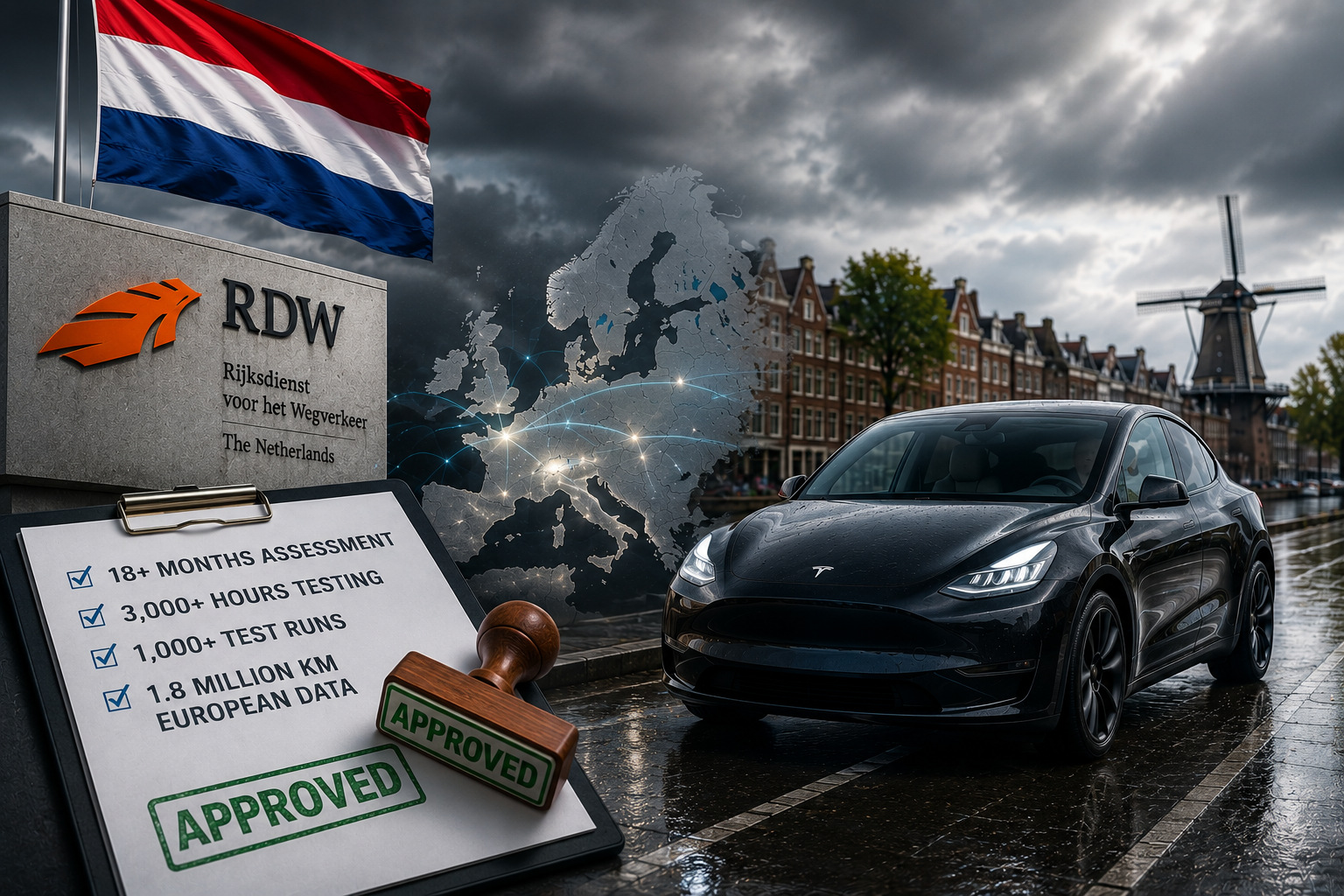
RDW says the assessment lasted more than 18 months. Its own testing exceeded 3,000 hours and included more than 1,000 test runs. Tests took place on tracks and public roads across different road types, busy urban environments, and extreme weather.
The process also included 1.8 million kilometers of European driving data from vehicles equipped with FSD Supervised.
These figures do not automatically prove that the system is safe in every situation. No practical test can cover every possible road event. But they show that the approval was based on more than a short demonstration or a manufacturer presentation.
The European context matters. Road markings, signs, traffic behavior, bicycle density, urban geometry, and weather differ from the United States. A system performing well in California or Texas cannot simply be assumed to behave the same way in Amsterdam.
Local and regional evidence is therefore essential.
Independent Verification Matters More Than Tesla’s Claims
Tesla publishes safety data and frequently argues that its technology improves road safety. Critics question whether those comparisons use appropriate control groups, equivalent vehicles, and transparent definitions.
RDW says it addressed that problem by checking how Tesla collected and analyzed data. Its experts evaluated whether the data was complete, verifiable, and accurate. The agency compared recent Tesla models without FSD Supervised with test vehicles using the system in Europe.
This approach is important because a regulator should not merely ask, “Does the manufacturer have data?” It should ask, “Is the comparison valid?”
An older national vehicle fleet may have different crash risk than a newer Tesla fleet. Highway-heavy mileage may not compare fairly with urban driving. Different reporting thresholds can distort results. Independent validation cannot eliminate every methodological debate, but it makes the decision more defensible.
RDW also used its own test equipment. That separation matters. The regulator was not only reviewing Tesla’s homework; it was conducting its own exam.
Approval Is Not the End of Oversight
Perhaps the strongest part of the Dutch approach is what happens after approval.
RDW says it increased Tesla’s required reporting frequency from the European standard of once per year to once per month. The agency will continue collecting and analyzing safety and performance data and can conduct further investigations or impose measures if problems emerge.
This reflects how software-defined vehicles should be regulated. Approval cannot be a permanent judgment on a product that changes through updates. A system may improve, regress, or behave differently as its user base expands.
Since approval, RDW says nearly 40,000 Teslas equipped with FSD Supervised have driven approximately 24 million kilometers in the Netherlands without relevant incidents. That is encouraging, though the definitions and detailed data remain important.
The larger point is that real-world operation becomes part of the regulatory process.
A Regulatory Model Other Countries Can Study
The Dutch decision does not require everyone to agree that FSD is ready. It provides a framework for disagreement based on evidence.
Regulators can demand local testing, review manufacturer statistics, run independent trials, require strict driver monitoring, and continue surveillance after launch. That is more useful than either extreme: banning advanced systems because they are unfamiliar or approving them because the manufacturer promises progress.
Tesla’s official materials continue to state that FSD Supervised does not make the vehicle autonomous. The driver must remain attentive and ready to take over. RDW evaluated the system inside that supervised category.
That boundary matters. The approval is not permission for unsupervised robotaxis. It is recognition that a more capable driver-assistance system can operate under defined conditions with active human supervision.
As other countries evaluate similar systems, the Dutch process may become more influential than the approval itself. It shows that advanced software can be regulated with independent evidence rather than fear or faith.
That is what serious autonomy policy should look like.
Share:
Why Removing Brake Pedals Makes Robotaxis Harder, Not Easier
Does Tesla Need a Larger Family EV After Model Y?