
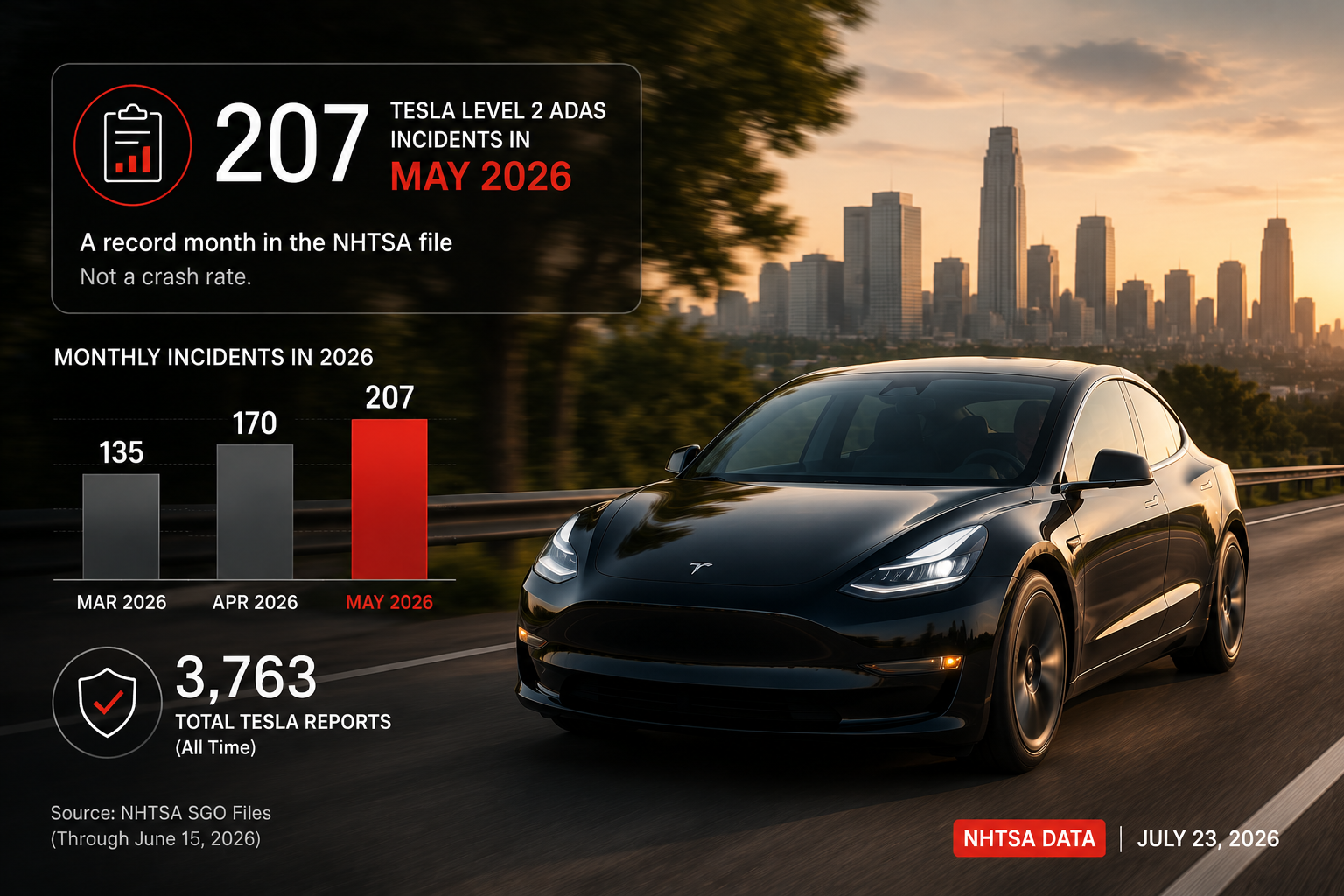
Tesla’s Level 2 driver-assistance crash reports reached a new high in the latest public federal data. Electrek reported 207 Tesla incidents dated May 2026 after merging NHTSA’s current and archived files and keeping the newest version of each report. EVBASE repeated the process and obtained the same May total. The number is real; its meaning is less simple.
A record count is not a scoreboard proving that Tesla’s Autopilot or Full Self-Driving (Supervised) became more dangerous. NHTSA explicitly warns that its Standing General Order data are not normalized by fleet size or vehicle miles traveled. The May figure matters as system use and reports rise, but it cannot answer whether the technology is safer or less safe per mile.
A Record Month in the NHTSA File
Under NHTSA’s Standing General Order, identified manufacturers must report certain crashes when Level 2 ADAS was engaged within 30 seconds before impact. Current rules cover a struck vulnerable road user, fatality, airbag deployment, or hospital transport. These are qualifying reports, not every Tesla scrape and not findings that software caused the crash.
The public snapshot runs through June 15, 2026. After keeping the highest Report Version for every Tesla Report ID, the combined archive shows 135 incidents dated March, 170 in April, and 207 in May. It contains 3,763 unique Tesla report IDs overall, including 1,043 incidents dated in 2025 and 826 dated from January through June 2026. June is partial, and earlier years span different versions of the reporting order, so simple year-over-year projections should be treated cautiously.
|
Verified measure |
Value in merged Tesla Level 2 files |
|
March 2026 |
135 incidents |
|
April 2026 |
170 incidents |
|
May 2026 |
207 incidents |
|
Tesla total |
3,763 unique Report IDs |
Method: EVBASE merged the current and archived Level 2 ADAS CSV files and retained the latest version of each Report ID.
Why 207 Is Not a Crash Rate
A crash rate needs a numerator and a denominator. The SGO provides reported qualifying incidents, but it does not require manufacturers to disclose fleet size, engaged miles, or the road and operating conditions behind those miles.
Scale matters. Tesla has a large connected fleet, and greater FSD use creates more opportunities for reportable events even if risk per mile is declining. Detection matters too: NHTSA says richer telemetry may produce more reports because a manufacturer learns about more crashes. Tesla makes the same argument. That does not invalidate 207; it makes cross-company totals a poor proxy for system quality.
The honest conclusion is deliberately narrow. The May count can coexist with an improving per-mile safety rate, and it can coexist with a worsening one. Raw totals cannot distinguish between those possibilities. They are a signal of expanding real-world exposure and a reason for closer oversight—not a standalone verdict on whether FSD is safer than a human driver.
Two Safety Stories, Two Different Measurements
Tesla’s Vehicle Safety Report supplies different evidence. It uses telemetry, classifies a collision as FSD-related if the system was active within five seconds before the event, and publishes rolling 12-month miles-per-collision comparisons. Tesla says FSD (Supervised) is associated with seven times fewer major and minor collisions and five times fewer off-highway collisions than its estimated U.S. averages, while acknowledging methodological assumptions.
Those metrics should not be placed directly against the SGO count. Tesla’s five-second engagement window differs from NHTSA’s 30-second rule. Tesla’s collision definitions use deployment and change-in-velocity thresholds, while SGO Level 2 reporting is triggered by specified outcomes. One dataset estimates rates; the other is designed as an incident-alert system for regulators. Tesla’s report is useful company evidence, but it is not an independent audit. Likewise, 207 SGO reports do not disprove Tesla’s claimed per-mile improvement.
Transparency Is the Strongest Missing Link
The most consequential finding may be how little context the public can inspect. EVBASE found 3,761 of Tesla’s 3,763 narrative fields marked as confidential business information—about 99.95%. Feature versions are also commonly withheld, preventing reliable separation of Autopilot and FSD or comparisons among software releases.
NHTSA permits confidential-treatment requests for the feature version, operational-design-domain status, and narrative, and the agency cannot publish protected information while requests are considered. Tesla may have legitimate proprietary concerns. The tradeoff is a public record showing volume without enough context to explain patterns, severity, or causation.
Reporting quality is itself under scrutiny. In August 2025, NHTSA opened an audit query after identifying reports submitted months after the crashes. Preliminary discussions pointed to a data-collection issue Tesla said it fixed. The review did not establish a vehicle defect or intentional underreporting; it showed why reporting timing and completeness matter when reading a monthly trend.
What Tesla Drivers Should Take Away
For owners, the practical response is neither panic nor complacency. Tesla’s own support page says FSD (Supervised) remains an advanced driver-assistance system for a fully attentive driver. Smoother behavior and longer hands-off intervals do not transfer responsibility from the person in the seat. Drivers should monitor the road, stay ready to steer or brake, and disengage when the system behaves unexpectedly.
|
“It does not make your vehicle autonomous. Do not become complacent.” |
If an incident or serious malfunction occurs, owners can preserve the time, location, vehicle software version, and any available footage, then report the issue to Tesla and NHTSA. No aftermarket accessory can replace attentive supervision or remedy a regulated software or vehicle-safety concern. The relevant safeguards here are clear instructions, responsible use, transparent data, and effective regulatory follow-up.
What Better Evidence Would Look Like
Tesla could narrow the argument by publishing auditable monthly exposure data alongside incident counts: engaged miles by software version, road class, region, and relevant operating condition, paired with consistent severity definitions. NHTSA could improve public analysis by adding normalized exposure measures where legally and technically possible, while continuing to publish raw incident files for investigation and trend detection.
Until then, 207 is best understood as a verified record in a limited dataset. It says Tesla’s reported Level 2 incident volume is rising as deployment expands. It does not say how often those incidents occurred per mile, who was at fault, whether Autopilot or FSD was active in each case, or whether the software’s underlying safety rate improved. The serious position is not to dismiss the number or sensationalize it. It is to demand the denominator and the context needed to make the number genuinely useful.
Related EVBASE Reading
Can You Trust Tesla FSD More Than Yourself?
Tesla FSD Approval Faced an 18-Month Reality Check
Tesla FSD V14.3.5 Adds Camera Preview Outside Park
EVBASE Reader Offer
This store-wide reader offer is separate from the safety analysis above. Browse EVBASE for Tesla and EV ownership accessories, and always confirm vehicle compatibility before ordering.
|
Use code ev9999 to get 20% off any product at EVBASE. |
Sources
NHTSA — Standing General Order on Crash Reporting
NHTSA — Level 2 ADAS Incident Report Data
NHTSA — Tesla SGO reporting audit query AQ25002
Tesla — Full Self-Driving (Supervised) Support
Tesla — FSD (Supervised) Vehicle Safety Report and Methodology
Share:
Tesla Model Y L Review Highlights Space for Six Adults