
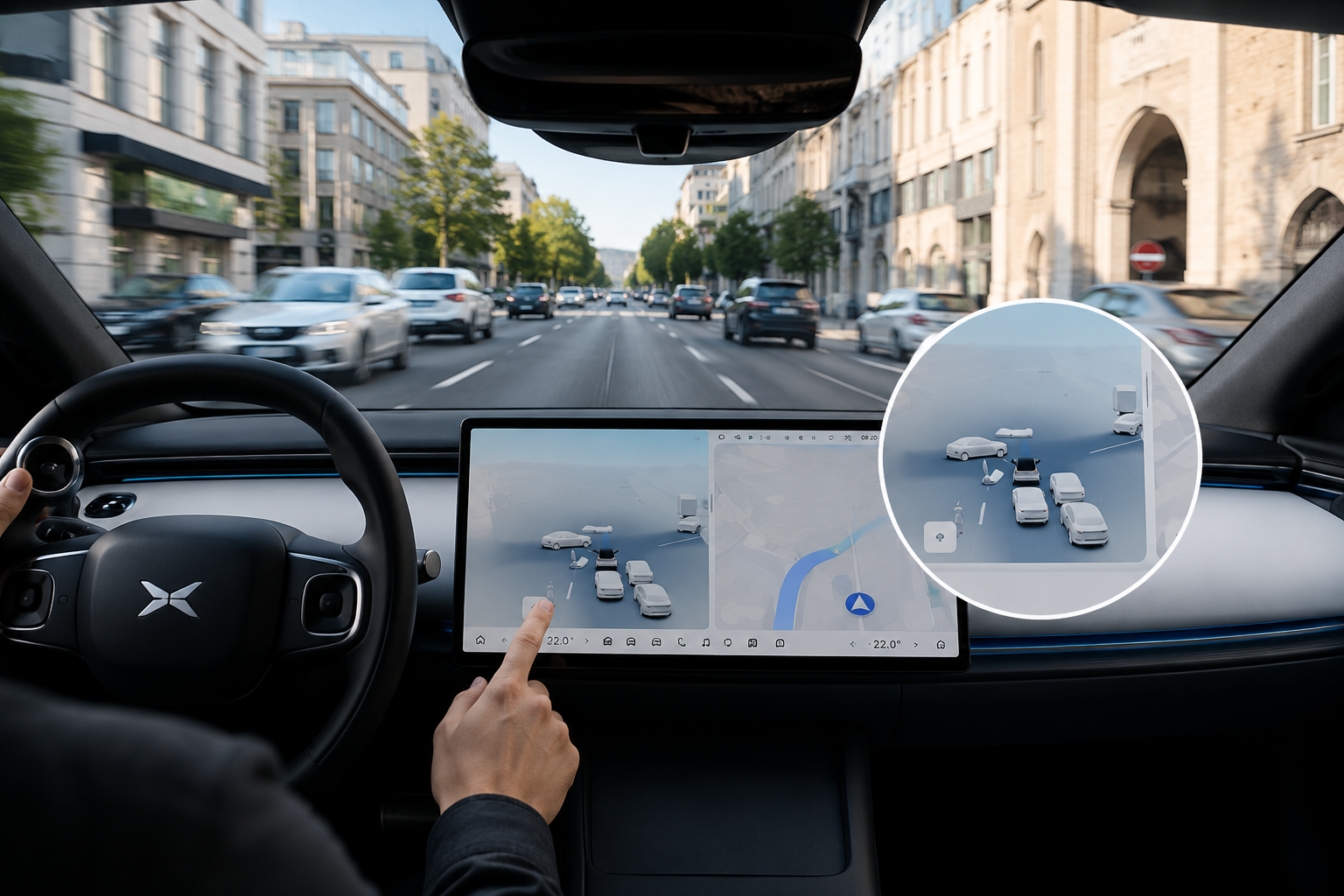
The XPENG L03 Europe launch is scheduled for July 16 in Munich, where the company plans to reveal the SUV-coupé's specifications, technology, pricing, and regional availability. XPENG is also teasing how its Navigation Guided Pilot, or NGP, is evolving around the new model.
The more useful clue came from Xianming Liu, head of XPENG's General Intelligence Center. He said his team had been road-testing the L03 and its VLA 2.0-powered NGP system in Munich. That turns the launch into more than a product teaser: XPENG is validating its Chinese smart-driving architecture in a different European traffic environment.
XPENG describes the L03 as an SUV-coupé that will enter 64 markets, making this the brand's first global vehicle launch on that scale. The car will be the focus on stage, but the software may be the more important story. XPENG is trying to show that one smart-driving stack can adapt across markets without being rebuilt from zero each time.
Why XPENG is testing VLA 2.0 in Munich
Munich is a good place to make that case. It is one of Europe's major automotive cities, home to BMW and closely tied to German engineering credibility. If XPENG wants European buyers, regulators and rivals to take its smart-driving claims seriously, showing progress there is a direct way to do it.
European roads are not just China with different signs. Lane markings, intersections, cyclists, roundabouts, speed habits, signage, roadworks and driver expectations can change quickly from one country to another. A system that feels smooth in Guangzhou, Beijing or Shanghai still has to prove itself on German city streets and highways.
That is why Liu's wording matters. He said the same model is being taken from China to Europe, and that while it still does not get everything right, it already handles most urban scenarios with surprising stability. It is careful language. XPENG is not claiming the job is finished, but it is saying cross-market transfer looks possible.
How XPENG VLA 2.0 is used in China
The number that stands out is 50.44%. According to Liu, XPENG's VLA 2.0 has been live in China for nearly half a year and reached a company-reported 50.44% assisted-driving mileage share. He framed it as the first time XPENG had seen assisted mileage overtake human-driven mileage at scale.
That figure matters because it moves the conversation from availability to use. Many automakers can say they offer advanced driver assistance. Fewer can say customers use it for about half of their miles.
Mileage share is a rough measure of trust, convenience and coverage. If drivers only turn on assistance for easy highway stretches, the feature is still limited. If use spreads across daily trips and urban driving, the software starts to become part of why people buy the car.
XPENG has been working toward this through XPILOT, XNGP and now VLA 2.0. The company's recent materials also talk about a wider "Physical AI" plan covering world-model research, autonomous driving, robotaxis, humanoid robotics and flying cars. In that frame, NGP is no longer just another driver-assistance feature. It is one piece of XPENG's physical-world AI push.
Can XPENG NGP adapt to European roads?
The phrase "same model, from China to Europe" is the core of the story. Traditional automotive software often needs heavy localization. Rules, maps, signs, driver behavior and infrastructure vary by market. A more general AI driving model is supposed to reduce that work by learning driving logic that transfers.
That also explains why the European test is hard. Europe is fragmented. Germany, France, the Netherlands, Norway, Spain, Italy and the United Kingdom all have their own road habits and regulatory expectations. If XPENG can build one smart-driving architecture that adapts across those markets, it would scale much more easily.
The problem is not only technical. European regulators and consumers tend to be cautious about automated-driving claims. XPENG will need clear limits, plain messaging and enough reliability that drivers understand exactly what the system can and cannot do.
That is where the launch messaging matters. XPENG can impress early adopters with an urban driving demo, but it has to avoid sounding like it is selling autonomy before the product is ready. A system that "handles most urban scenarios" is still not a fully autonomous car.
How robotaxi testing fits XPENG's AI strategy
Liu also said XPENG has put the same model into its L4 Robotaxi fleet in China, with internal robotaxi testing starting this month. That makes the L03 launch part of a wider autonomy plan rather than a one-off NGP update.
On one side is consumer NGP, where the driver remains responsible. On the other is L4 robotaxi operation, where the system eventually has to drive without a human behind the wheel in defined conditions. XPENG appears to be trying to use the same core model family for both.
There are obvious advantages if that works. Consumer vehicles can provide data that improves the model. Robotaxi testing can push the same architecture through harder cases. If the foundation model gets better, both private cars and future robotaxis could benefit.
It also raises expectations. If XPENG eventually wants to bring robotaxi technology to Europe, the L03 road testing in Munich becomes an early sign of how its AI stack behaves outside China.
What XPENG L03 must prove in Europe
The L03 launch has three basic questions to answer.
First, what will the European-spec XPENG L03 include? XPENG has confirmed that it is an SUV-coupé intended for 64 markets, but buyers still need the final price, WLTP range, charging specifications, safety equipment, cabin technology, and country-by-country availability.
Second, how much of VLA 2.0's China performance can carry over to Europe? A Munich road test helps, but XPENG currently targets global delivery of VLA 2.0 in 2027, subject to regulatory approval. Real credibility will depend on repeatable road behavior, clear supervision rules, and customer access.
Third, how will XPENG position NGP against Tesla FSD, Mercedes Drive Pilot, BMW driver assistance and other European ADAS systems? XPENG is entering a market where software can change how buyers see a brand very quickly.
So the L03 launch is also a test of XPENG's global identity. Is it another Chinese EV brand expanding into Europe, or an autonomy company trying to prove its cars are the delivery system?
Munich should provide the first real clue.
Sources
XPENG Global, L03 launch and NGP evolution post: https://x.com/XPENG_Global/status/2076935302866682224
Xianming Liu, XPENG L03 Munich road testing and VLA 2.0 post: https://x.com/liuxianming/status/2076924656997777910
XPENG, official news page with VLA 2.0, Robotaxi and Physical AI updates: https://www.xpeng.com/news
Investor's Business Daily, XPeng robotaxi and vision-only autonomy report: https://www.investors.com/news/tesla-rival-xpeng-elon-musk-self-driving/
XPENG, official L03 global launch announcement: https://www.xpeng.com/pressroom/news/019f280d849c9f1d20ff8a028d550090
XPENG UK, VLA 2.0 European deployment plan: https://xpengcars.co.uk/2026/03/xpeng-accelerates-intelligent-driving-in-europe-with-ai-driven-vla-2-0-deployment-and-ota-updates/
Share:
Tesla Model YL Appears in Chicago Showroom With Premium Three-Row Details