
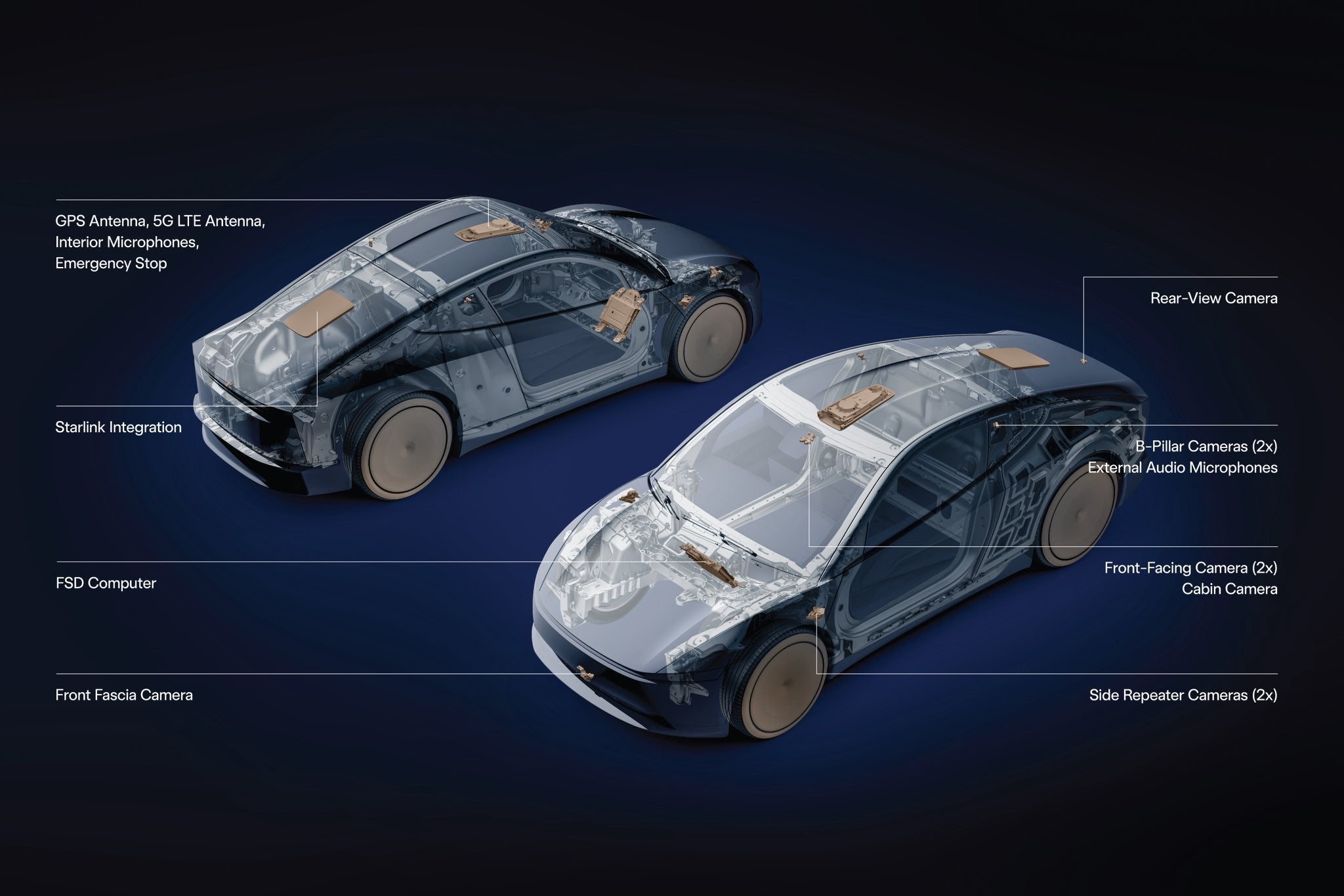
Tesla says Starlink V5 is directly integrated into Cybercab. The company announced the connection in a short July 20 post accompanied by a vehicle image, but offered no technical specifications, service details or deployment timeline. The confirmed fact is therefore narrow: Tesla is designing its purpose-built robotaxi with Starlink hardware built into the vehicle rather than treating satellite connectivity only as an aftermarket accessory.
That matters because Cybercab is not being presented as a conventional personal car. Tesla’s Robotaxi program is built around vehicles that operate through software, remote fleet management and rider requests. Connectivity is not merely a passenger convenience in that model. It is part of the system that keeps vehicles visible, updated and reachable.
Why it matters
A driverless fleet produces a continuous stream of operational needs: trip assignment, map and software updates, vehicle diagnostics, safety events, cleaning and charging coordination, and support when a rider reports a problem. Cellular networks can handle most of that work in covered areas. An integrated satellite option could add resilience where cellular service is weak, congested or temporarily unavailable.
The word “could” is essential. Tesla did not describe whether Starlink V5 will provide an active data path during normal operation, serve as a backup connection, support passengers, or handle specific telemetry. It also did not explain antenna placement, power use, data rates or geographic limits. Direct integration signals intent, not a complete communications architecture.
Why integration is different from carrying a terminal
Vehicle-level integration allows Tesla to consider the antenna, power supply, thermal management, software and body design together. That can reduce loose hardware and simplify fleet deployment, but it creates engineering tradeoffs. A moving vehicle changes orientation, passes under structures and operates in rain, snow and heat. A production system must manage those interruptions without confusing the autonomy stack or leaving passengers without support.
Evidence boundary: Tesla confirmed “Starlink V5” integration but did not define the hardware generation in public detail. It should not be confused automatically with Starlink V3 satellites, and no performance claims should be inferred from the name alone.
A communications layer is not an autonomy system
Starlink does not make Cybercab drive. Vehicle perception, planning and control remain separate from the network carrying fleet data. A robust autonomous vehicle should also fail safely when connectivity is interrupted rather than depend on a constant remote link for moment-to-moment steering. Satellite service may improve fleet supervision and recovery, but it does not resolve the harder questions around unattended driving, regulation and incident response.
The announcement also strengthens the strategic connection between Tesla and SpaceX. Starlink gains a potential high-volume mobile platform, while Tesla gains access to a communications network designed to operate beyond the normal reach of terrestrial infrastructure. Whether that advantage becomes meaningful will depend on cost, reliability and how often the satellite path solves a problem cellular service cannot.
What to watch next
Tesla now needs to turn a one-line announcement into verifiable operating detail. The most useful evidence would include supported regions, antenna specifications, data roles, fallback behavior, service pricing and demonstrations during real robotaxi operation. Until then, the integration is best understood as infrastructure preparation. Cybercab is being designed not only as an electric vehicle that drives itself, but as a connected fleet asset expected to communicate wherever its business takes it.
Related EVBase reading
· Why would Tesla give the Cybercab front-wheel drive?
· Starlink V3 satellites add six high-capacity space lasers
· EVBASE Tesla and technology news hub
Share:
Starlink Sends 1,600 Kits After Venezuela Earthquakes
Some New Tesla Model 3 Owners Report an FSD Version Reversal