
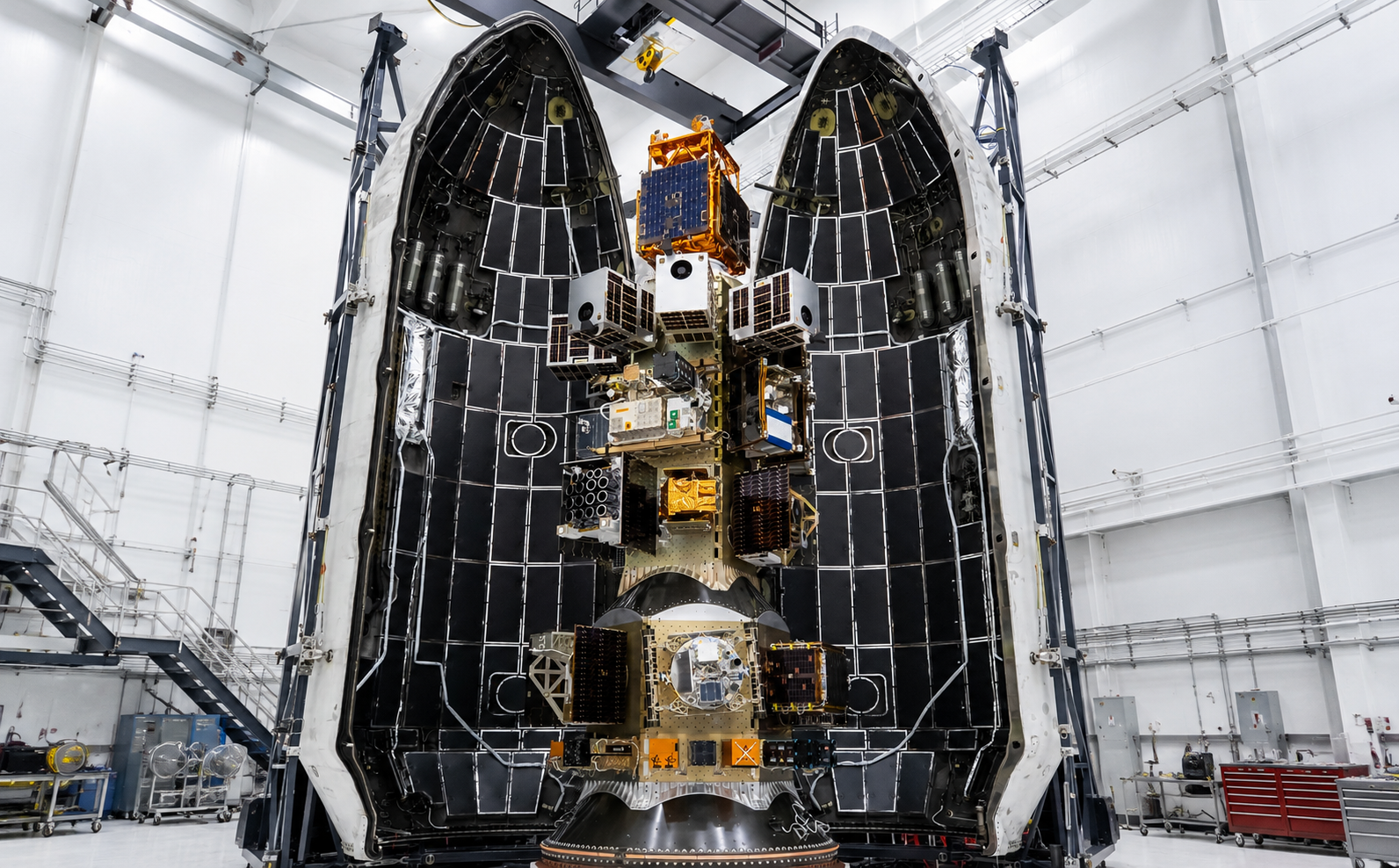
VANDENBERG SPACE FORCE BASE, California - SpaceX is preparing the 17th dedicated flight in its Transporter rideshare program. A Falcon 9 will carry dozens of small spacecraft whose operators share the same launch.
Liftoff is scheduled for July 7 at 12:12 a.m. Pacific Time from Space Launch Complex 4 East. SpaceX plans to land the Falcon 9 first stage on a droneship in the Pacific Ocean.
The launch time can still change because of weather, range availability or technical issues.
Transporter-17 carries 81 payloads
SpaceX lists 81 payloads on the mission, including CubeSats, larger microsatellites, hosted payloads and orbital transfer vehicles. Eight spacecraft riding on transfer vehicles will be deployed later rather than directly from Falcon 9.
The payloads cover Earth observation, communications, research, government work and technology tests. The target sun-synchronous orbit lets satellites pass over the same locations at roughly the same local solar time, which provides consistent lighting for Earth imaging.
Rideshare missions depend heavily on integration companies. Dozens of spacecraft must fit inside one fairing and separate in the correct order without interfering with one another.
SEOPS said it integrated 10 spacecraft ranging from 3U to 16U for customers in France, India, the Netherlands, Spain and the United States. It used Equalizer deployers and an ISISPACE QuadPack to arrange the payloads and manage separation.
Spire Global also delivered 10 satellites to Vandenberg. The company uses its constellation to collect space-based data for weather, aviation, maritime and other analytics services.
Many customers share one Falcon 9
SpaceX's SmallSat Rideshare Program allows an operator to buy part of a Falcon 9 mission instead of funding an entire rocket. Customers share the flight and deploy into the same general orbital region.
The arrangement can lower launch costs and give small spacecraft a more regular schedule. SpaceX prices capacity by payload mass and uses standardized mounting plates and integration procedures.
Customers give up some control over timing and destination compared with a dedicated launch. Orbital transfer vehicles can partly solve that problem by moving satellites from Falcon 9's deployment orbit to another altitude or position.
Transporter flights now run on a regular schedule
Small-satellite operators once had to wait for unused room on another customer's mission. The Transporter program gives them flights designed specifically for shared payloads, making launch planning more predictable.
That schedule supports Earth-imaging and communications constellations, university research missions and startups testing hardware in orbit. It has also created business for payload integrators, deployer manufacturers and companies that move satellites after launch.
Transporter-17 shows how large these shared missions have become. Releasing 81 payloads requires standard hardware, a detailed sequence and coordination among SpaceX, integration providers and every spacecraft team.
What happens after launch
Falcon 9's second stage will follow a planned sequence to release satellites and transfer vehicles without collisions. Each customer will then try to contact its spacecraft and begin commissioning.
Reaching orbit does not guarantee that every payload will work. Each satellite must separate properly, communicate with ground stations and pass its own checkout process.
SpaceX's job is to place the rideshare stack in the planned orbit and complete the separation sequence. For the 81 payload teams, operations begin once their spacecraft leave the rocket.
Share:
Hundreds of Tesla Model Y L Vehicles Reach Japan After Record June Registrations
Rivian Plans 75 Million-Share Offering to Raise Cash and Meet DOE Funding Commitments