
Rivian’s robotaxi agreement with Uber is back under scrutiny after Whole Mars Catalog argued that exclusivity now looks like a strategic mistake. The criticism followed reporting on Uber’s effort to shape autonomous-vehicle policy around “hybrid networks” that combine human drivers with robotaxis, potentially slowing independent AV platforms in some markets.
“Going exclusive with them feels like a strategic blunder.”
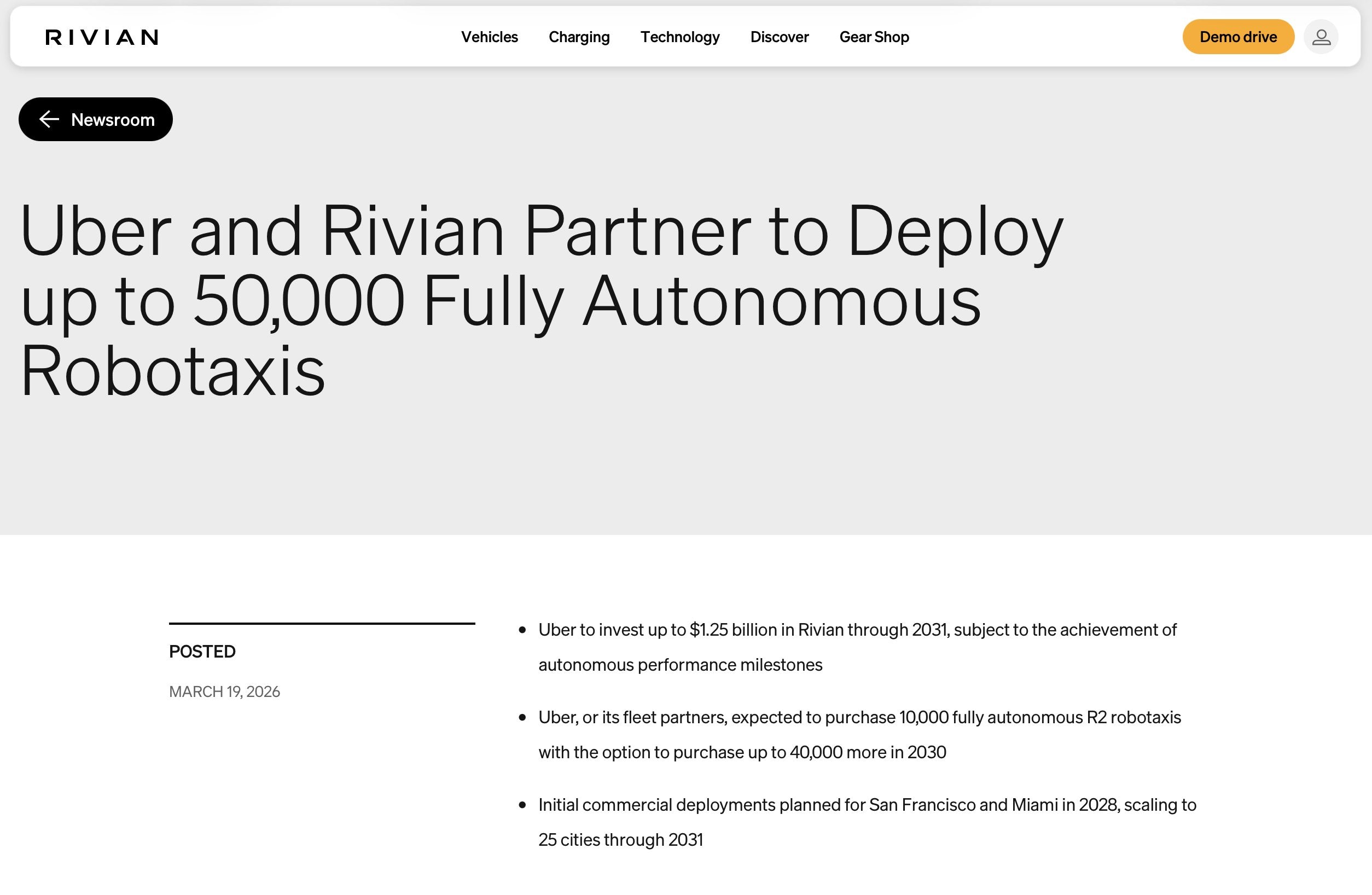
That is an opinion, not a new change to the contract. The underlying deal was announced in March. Uber committed to invest up to $1.25 billion in Rivian through 2031, subject to autonomous-performance milestones. Uber or its fleet partners expect to buy 10,000 fully autonomous R2 robotaxis in the first deployment phase, with an option to negotiate up to 40,000 more beginning in 2030.
Why it matters
For Rivian, the agreement offers three things that are difficult to build at once: capital, guaranteed fleet demand and access to a global ride-hailing marketplace. Initial commercial deployments are planned for San Francisco and Miami in 2028, with expansion to 25 cities by 2031. The vehicles are expected to be available exclusively through Uber’s platform during the agreement’s relevant period.
That exclusivity creates the platform-control question. If riders book, pay and rate the trip inside Uber, the customer relationship belongs largely to Uber. Pricing, demand allocation, service tiers and much of the trip experience can be shaped by the marketplace. Rivian supplies the vehicle, compute and autonomy stack, but risks becoming less visible than the app through which the ride is ordered.
Axios has described a similar brand risk for new robotaxi manufacturers: fleet orders create revenue, but the automaker may become a white-label hardware provider. The Jaguar I-Pace’s long association with Waymo is a useful warning. Riders often remember the Waymo experience more clearly than the vehicle beneath it. Rivian believes Uber can introduce its vehicles to millions of people, which is the optimistic version of the same dynamic.
Uber’s policy position complicates the partnership
WIRED reported in July that Uber lobbyists promoted hybrid-network rules in New Jersey and Washington, DC. Proposed language circulated in New Jersey would have required human drivers to account for 85 percent of rides on a platform for three years, a structure that could disadvantage companies operating their own driverless networks. That language was not part of the bill at the time of the report.
Uber told WIRED it supports autonomous-vehicle expansion and viewed the New Jersey proposal as a compromise with labor opposition. The company also argued that some AV-industry proposals would reduce competition. That position is not the same as opposing autonomy; Uber has agreements with more than 25 AV players. It does show that Uber’s interests are those of a marketplace operator, not necessarily those of any single vehicle partner.
Rivian’s deal is also conditional. The investment depends on milestones, the R2 robotaxi is not yet in commercial service and deployment plans extend over years. Exclusivity can be valuable when it secures financing and volume before a product exists. It becomes dangerous if the platform later controls access to riders while competing vehicles can appear beside Rivian in the same app.
The bottom line
Calling the agreement a blunder is premature. Rivian receives capital, a launch customer and a path to scaled operations; Uber receives another vertically integrated AV partner. The strategic test will be whether Rivian preserves its brand, data rights and bargaining power as the fleet grows. If it can, exclusivity may look like disciplined market entry. If riders know only that an Uber arrived, the criticism will age much better.
Related EVBASE reading
New Jersey Robotaxi Bill Puts Tesla’s Camera-Only Strategy Under Pressure
Sources
Whole Mars Catalog—Rivian and Uber exclusivity critique
Uber Investor Relations—official Rivian robotaxi agreement
Share:
Tesla Roadster Turns 20: The EV That Changed the Market