
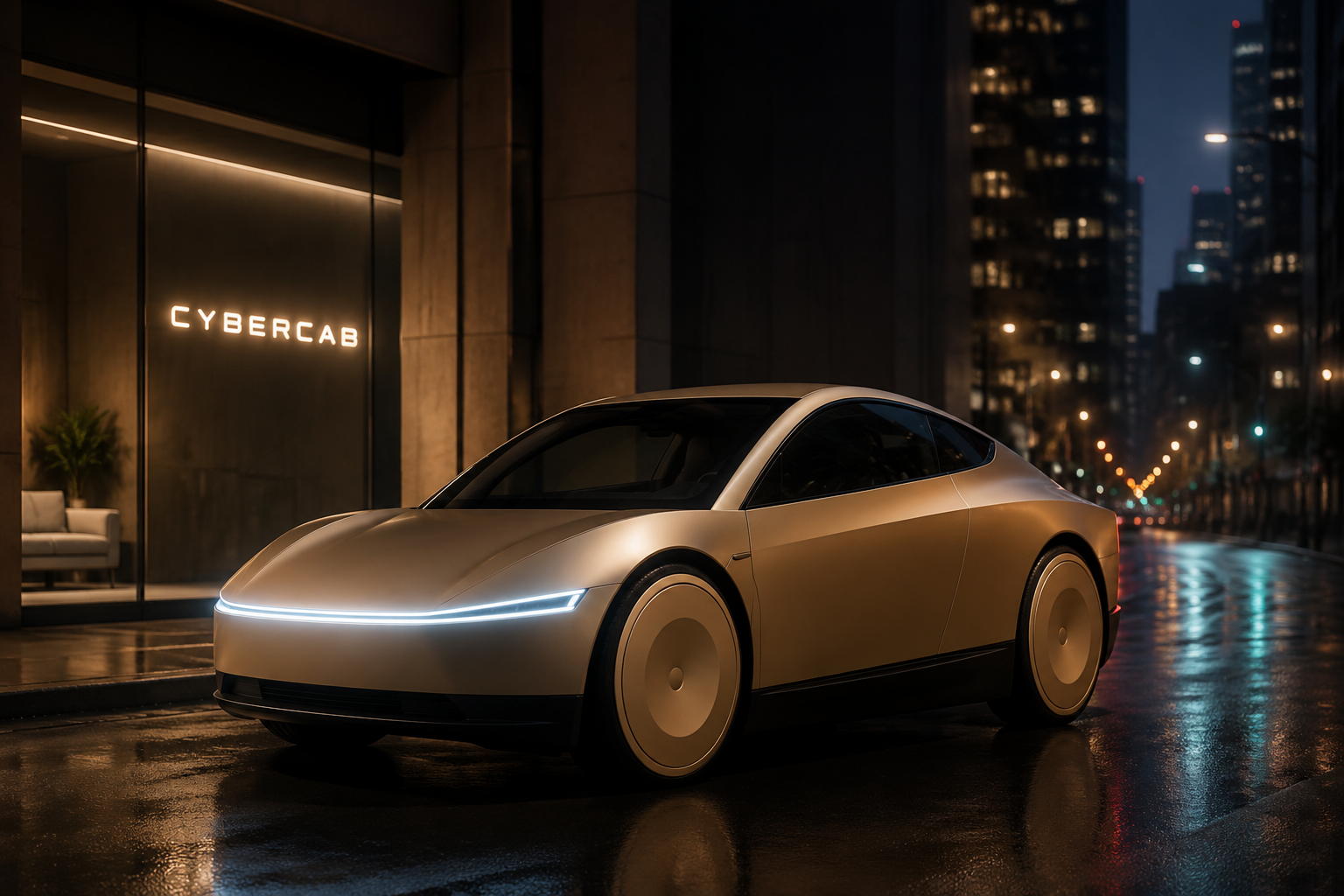
A Cybercab fitted with a steering wheel and pedals looks like a contradiction. Tesla unveiled the two-seat vehicle as a purpose-built robotaxi with no traditional driver controls, yet prototypes have appeared on public roads with exactly those parts. Elon Musk has now offered a practical explanation: Tesla needs vehicle-specific driving data before it can deploy the new chassis at scale.
“We need to accumulate driving data that is specific to the Cybercab before we can put a lot of them on the road.”
— Elon Musk, quoted by Nic Cruz Patane on X
That matters because autonomy software does not control an abstract car. It controls a physical platform with its own wheelbase, steering ratio, braking response, tire behavior, sensor placement and weight distribution. A maneuver that is comfortable in a Model Y may require different timing in a Cybercab. Tesla already has millions of miles from established models; the new vehicle starts with a much thinner chassis-specific record.
The controls are test equipment, not a design reversal
Retrofitting manual controls lets an engineer or safety operator drive the same platform through ordinary traffic, gather baseline behavior and intervene when necessary. The data can help calibrate acceleration, braking and steering, while autonomous runs reveal how the software handles the vehicle’s dimensions and dynamics. In that context, the steering wheel is closer to a development instrument than a consumer feature.
Manual controls can also support direct comparisons between human-driven and autonomy-controlled runs on the same roads. Engineers can examine whether braking points, steering inputs and ride responses diverge, then decide whether the software or the vehicle-control calibration needs adjustment.
It would be a mistake, however, to treat the explanation as proof that Cybercab is ready for broad driverless service. Data collection is an input to validation, not validation itself. Tesla still has to demonstrate repeatable performance across weather, road design, traffic behavior and rare events. It must also show that remote support, charging, cleaning and incident response can keep a commercial fleet operating reliably.
The regulatory path is moving too
The timing is notable. In June, the National Highway Traffic Safety Administration opened rulemaking that would remove the manual brake-pedal mandate for vehicles designed exclusively around automated driving systems, while preserving braking-performance requirements. NHTSA has also continued crash-reporting rules for vehicles using automated driving systems. Removing a hardware requirement does not remove safety oversight.
Tesla’s first-quarter 2026 shareholder update listed Cybercab in pilot production and said volume production was expected this year. Musk’s latest explanation adds an important qualifier to that manufacturing story: a vehicle can move down a pilot line before Tesla has enough real-world data to expand its use in cities. Production readiness and driverless operating readiness are related, but they are not the same milestone.
What to watch next
The most useful signals will be operational. Watch for more Cybercabs testing without temporary controls, a wider set of test locations, clearer disclosure of safety-operator roles and an increase in paid public rides using the purpose-built vehicle.
For now, the steering wheel and pedals tell a straightforward story: Tesla is still teaching its autonomy stack the physical language of a new car. That is normal engineering work, not evidence that the control-free Cybercab concept has been abandoned. It is also a reminder that the dramatic product reveal was the easy part. The harder task is converting a gold prototype into a vehicle that can operate safely, predictably and cheaply every day.
EVBASE reader offer
Use code ev9999 to get 20% off any product at EVBASE.
Browse EVBASE Tesla and EV accessories and confirm model-year compatibility before ordering.
Related EVBASE links
· EVBASE Tesla and robotaxi news
Sources and further reading
· Nic Cruz Patane—Cybercab chassis-calibration quote
· Tesla Investor Relations—Q2 2026 documents and webcast
· Tesla Q1 2026 shareholder update—Cybercab pilot production
· NHTSA—rulemaking on brake-pedal requirements for ADS vehicles
Share:
Elon Musk’s USAID ‘Zero Deaths’ Claim Meets a Hard Evidence Test
Tesla FSD V14 Lite Gives the 2018 Model 3 a Real Upgrade