
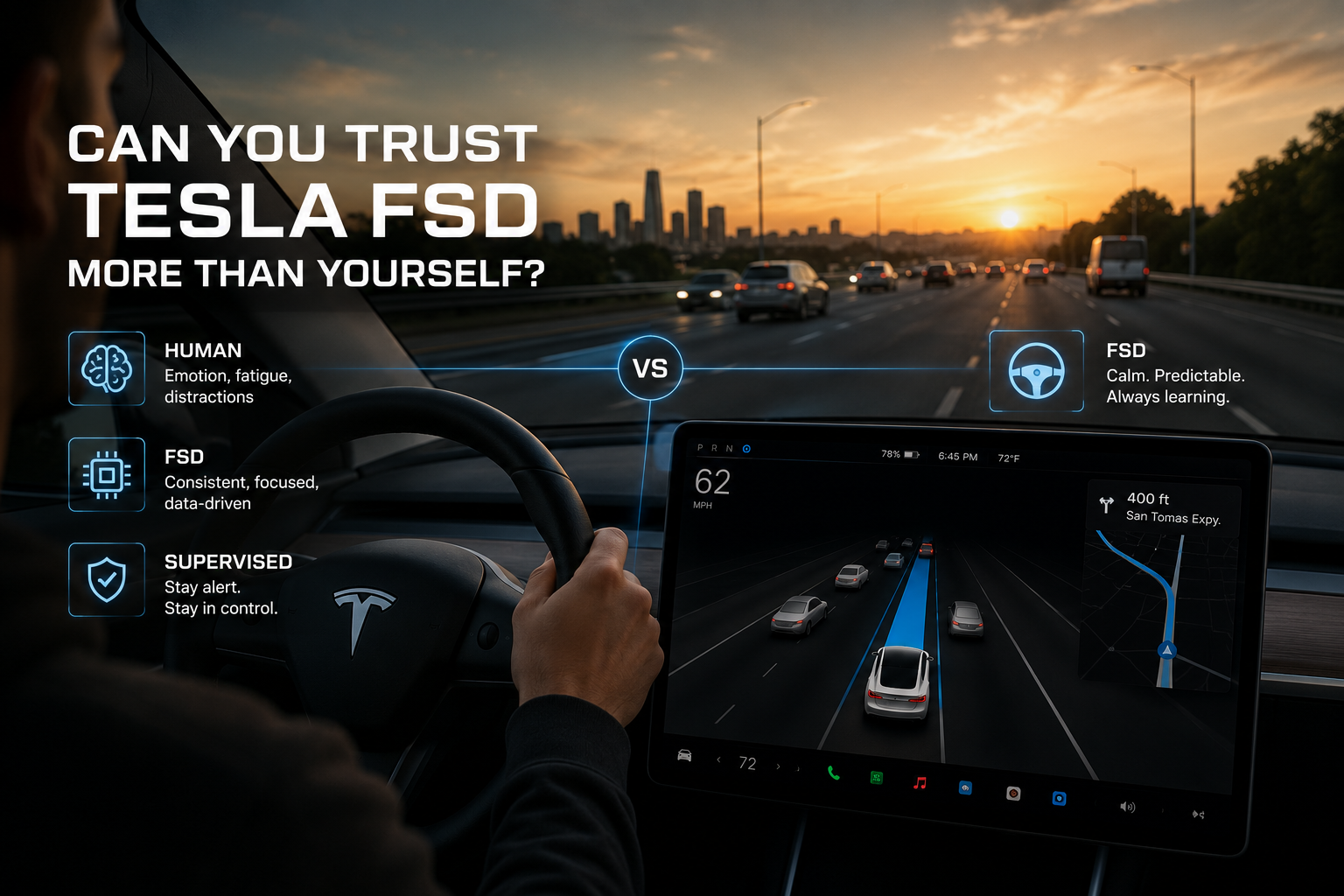
Tesla's Full Self-Driving (Supervised) has reached a strange psychological point for some experienced users. They no longer describe it only as a driver-assistance feature. They describe it as something that often feels calmer, more consistent, and less impulsive than a human driver.
That sentiment appeared again in a recent post from Nic Cruz Patane, who wrote that Tesla FSD V14 on HW4 can feel "unsupervised in some ways" and that he trusts FSD more than himself. His comment also noted that the driver-monitoring "nag" feels more relaxed than before.
The important part is not whether every driver agrees. It is that this reaction reflects a pattern among heavy FSD users. After thousands of miles, the system can become familiar enough that the driver stops seeing it as a novelty and starts treating it as a partner. If it handles merges, turns, lane changes, roundabouts, and stop-and-go traffic smoothly, trust builds through repetition.
What FSD Appears to Be Improving
This kind of trust usually comes from three perceived improvements.
First, FSD has become smoother. Drivers often respond strongly to jerkiness, hesitation, awkward lane placement, or unnatural braking. When those behaviors improve, the system feels less like beta software and more like a trained driver.
Second, it appears more anticipatory in some situations. Long-time users often point to earlier slowing, better lane choice, more natural turns, and fewer abrupt corrections. Those changes can make the car feel as if it is reading the road rather than merely reacting to it.
Third, HW4 vehicles have more capable camera hardware and processing headroom than older configurations. That does not make them autonomous, but it can contribute to a more confident user experience when paired with newer FSD versions.
The Danger of Comfort Turning Into Overtrust
The risk is that comfort can become overtrust. A system that behaves well for hundreds of miles can still fail in one unusual scene. Construction zones, emergency vehicles, unclear lane markings, low sun, pedestrians, cyclists, debris, police direction, and local driving customs can all create situations where human supervision matters.
There is also a human-factors problem. The better a partially automated system gets, the easier it is for the driver to relax too much. If the car usually handles everything, the human may become slower to notice when it does not.
That is why "I trust FSD more than myself" is an interesting emotional statement, but not a safe operating rule.
What Tesla Officially Requires
Tesla's official position remains clear: FSD is supervised. The driver must remain attentive, keep hands ready, and be prepared to take over at any time. Tesla's support materials describe Autopilot and Full Self-Driving features as driver-assistance systems, not a substitute for an alert driver.
This is the line that matters legally and practically. FSD may steer, accelerate, brake, and navigate complex routes, but the human is still responsible for monitoring the road and the vehicle's behavior.
Regulators have also continued to scrutinize Tesla's automated-driving claims and driver-assistance safety. That scrutiny exists precisely because the gap between perceived capability and official responsibility can be dangerous.
The Right Way to Think About Trust
The best way to trust FSD is not to treat it as a chauffeur. It is to treat it as a capable but fallible second driver whose work must still be checked.
For long-time users, the growing confidence is real and worth noting. It suggests Tesla has improved smoothness, predictability, and route handling enough that some owners now feel less stressed with FSD engaged than driving manually. That is meaningful progress.
But the correct conclusion is not that supervision can fade away. The correct conclusion is that supervision becomes more important precisely because the system is good enough to make drivers comfortable.
FSD may increasingly feel trustworthy. The driver still has to earn that trust every mile by paying attention.
Sources
Nic Cruz Patane, Tesla FSD V14 trust and driver monitoring post: https://x.com/niccruzpatane/status/2076823338890981759
Tesla, Autopilot and Full Self-Driving Capability support page: https://www.tesla.com/support/autopilot
Tesla, Active Safety Features and Traffic-Aware Cruise Control support page: https://www.tesla.com/support/active-safety-tacc
Associated Press, NHTSA says Tesla public statements imply that vehicles can drive themselves: https://apnews.com/article/6ca8e2880af87361f3148b7e78718d52
Share:
Does Tesla Need a Larger Family EV After Model Y?
Tesla Model Y L Review Highlights Space for Six Adults