
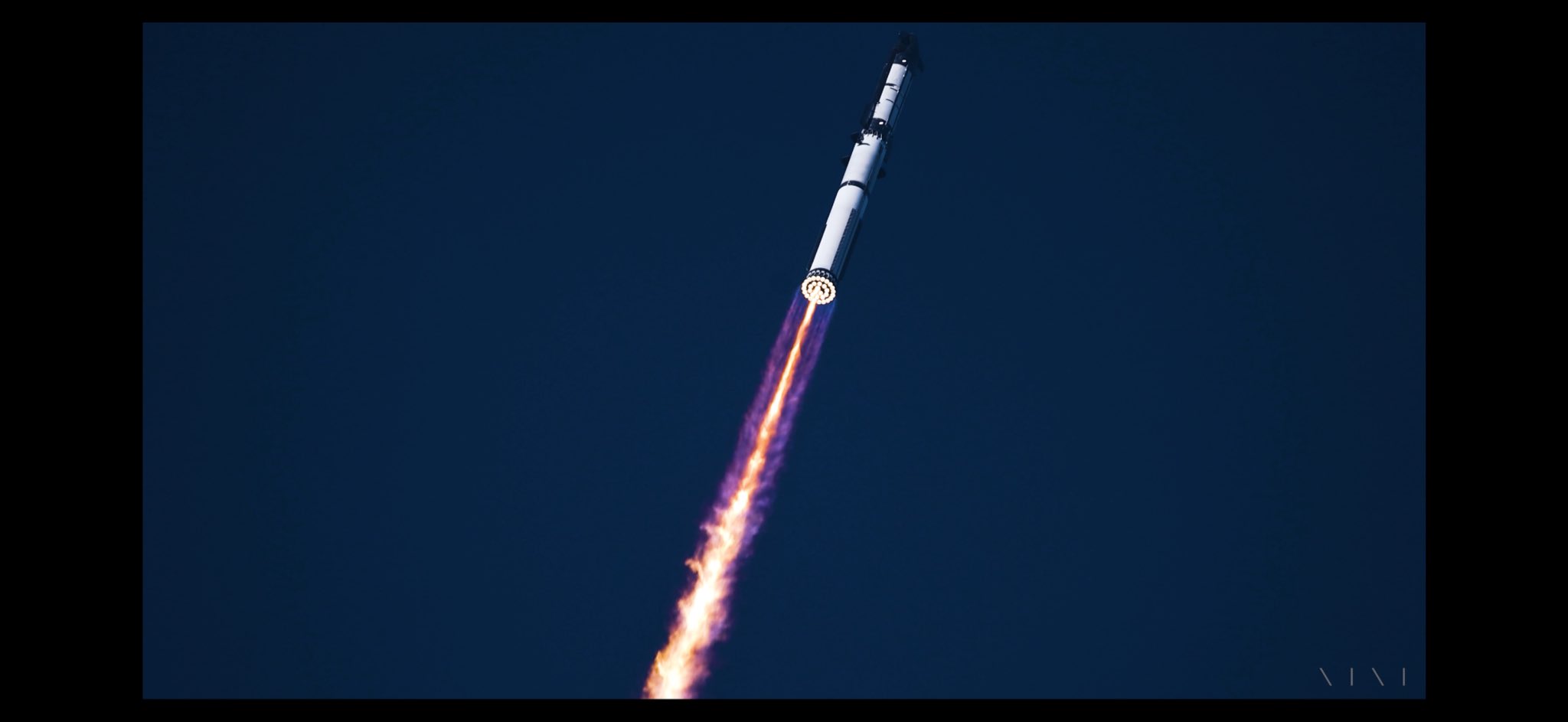
A new video from photographer Adan Guajardo gives SpaceX’s Starship Flight 13 the treatment it naturally invites. Fire, sound and a stainless-steel rocket climbing over South Texas. The footage was captured from Rocket Ranch on July 24. The spectacle is real, but the more important result came about an hour later, when the upper stage completed its test sequence and remained intact after an exceptionally gentle Indian Ocean splashdown.
“Starship is intact, floating in the ocean.”
Flight 13 launched from Starbase at 5:51 p.m. Central Time, according to SpaceX’s mission account. It was the second flight of the company’s new Starship and Super Heavy V3 vehicles and the first Starship mission to release next-generation Starlink V3 hardware. All 33 booster engines ignited for ascent, the stages separated, and the ship continued on a suborbital path.
Why it matters
The mission connected three programs that SpaceX ultimately needs to work together: a high-capacity reusable rocket, larger Starlink satellites and a heat shield that can survive return. The ship deployed 20 Starlink V3 test satellites, then successfully relit a Raptor engine in space. That relight is a basic requirement for future orbital missions, because Starship must be able to maneuver after reaching space rather than simply coast to reentry.
The satellite release was a deployment test, not the beginning of an operational constellation. The vehicles followed a suborbital trajectory and were expected to reenter rather than remain in service. That distinction matters because “deployed” can sound like the satellites entered their final working orbits. What SpaceX demonstrated was the mechanics of carrying, releasing and briefly operating the new hardware in the flight environment.
Starship then gathered heat-shield data through atmospheric entry, performed its flip and landing burn and touched the ocean softly enough to stay afloat while still transmitting. An intact vehicle gives engineers a better view of how tiles, flaps, structure and propulsion behaved together. A recovered-looking ship on a webcast is not the same as a reusable vehicle, but it is a much richer data point than losing contact before splashdown.
It also lets SpaceX compare post-flight imagery with telemetry from the same vehicle.
The booster left unfinished work
Super Heavy did not complete an equally clean return. The booster performed the high-thrust portion of its boostback with all 33 engines, but the burn ended early and the ocean landing was harder than planned. Flight tests can produce a successful ship sequence and a booster problem at the same time; calling the entire mission either flawless or a failure would hide the engineering value.
That mixed outcome is why Flight 13 matters more than its number. SpaceX is developing a two-stage system in which both giant vehicles are supposed to return, be inspected quickly and fly again. Each clean handoff—engine start, stage separation, payload release, relight, reentry and landing—removes one more unknown. The remaining gaps determine whether Starship becomes operational infrastructure or stays an impressive test program.
What comes next
Elon Musk said SpaceX may attempt to catch the ship with the launch tower on the next flight if the data review finds no serious problems. The condition is crucial. Engineers must first understand tile performance, navigation accuracy, landing-burn control and why the booster return ended badly. Flight 13 earned the program a stronger case for moving forward, but the next milestone is not a prettier video. It is repeatable recovery backed by hardware that can fly again.
Related EVBASE reading
SpaceX to Use Starlink V3 Satellites as Heat-Shield Inspectors
EVBASE Tesla and technology news hub
Sources
Adan Guajardo—original Flight 13 video and photographs
SpaceX—Starship’s Thirteenth Flight Test
Share:
Waymo Los Angeles Crash Sends Two to Hospital, The Fault Still Unclear
Tesla Plans to Open-Source Model S and Model X Designs