
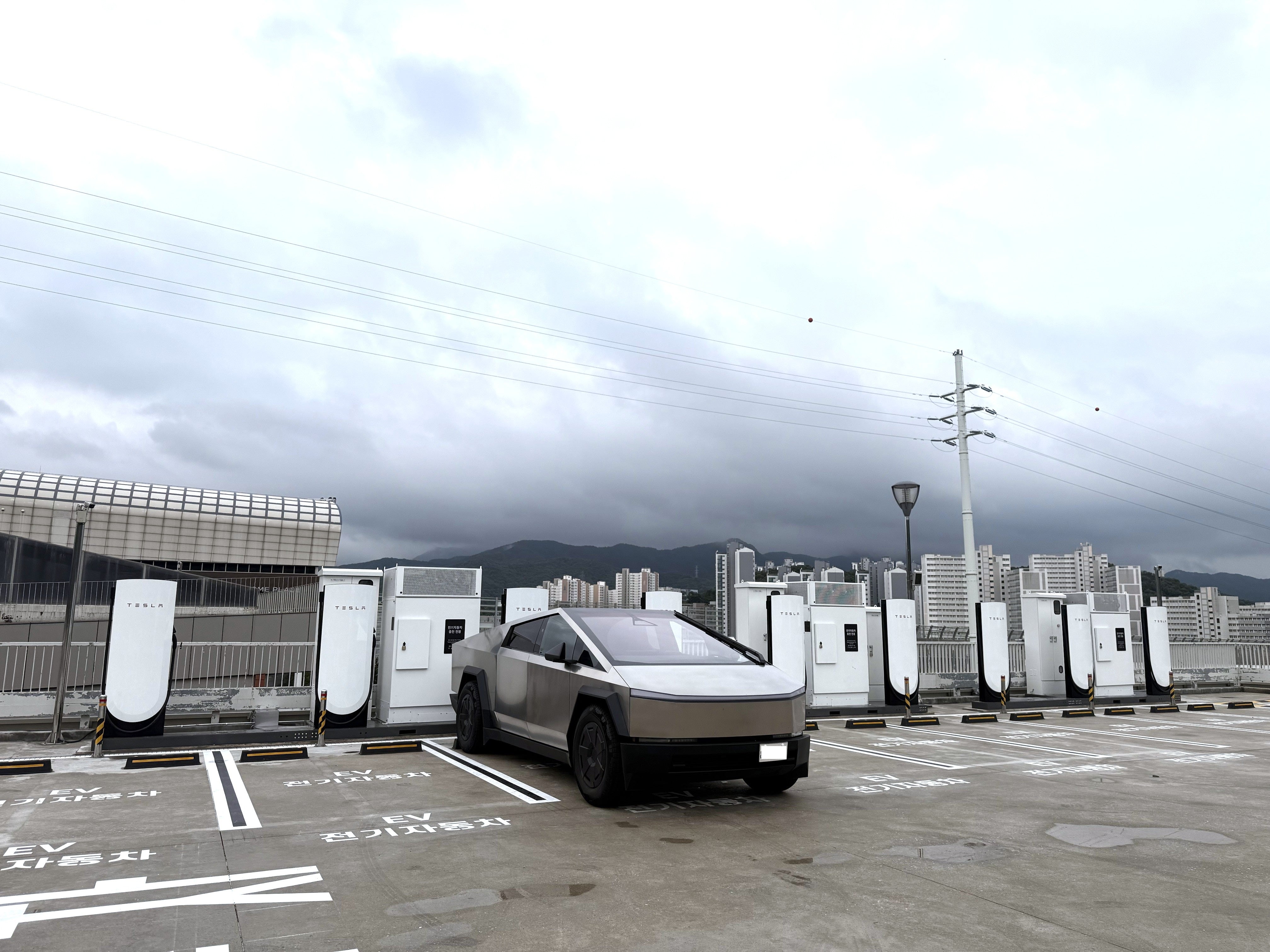
Tesla has opened a new Supercharger site in Siheung, South Korea, according to a Tesla Charging post published on July 15, 2026. The site is listed as “Expressway No.100, PanGyo” and includes 9 stalls, with a Tesla Find Us location page attached to the announcement.
On paper, this is a straightforward charging-network update. A new station, one city, 9 stalls. But for drivers, Supercharger expansion is rarely about one location in isolation. Each site changes the confidence level of the whole route around it. That is especially true in South Korea, where long-distance travel, dense metro traffic and highway rest-stop behavior make charger placement as important as charger count.
Siheung sits in the Seoul metropolitan region, a dense and strategically important area for EV use. A Supercharger linked to an expressway corridor near PanGyo gives Tesla drivers another fast-charging option where daily commuting, regional travel and weekend trips can overlap. The result is not just more plugs. It is more flexibility.
Why 9 Stalls Is More Than a Small Opening
Nine stalls may not sound dramatic next to Tesla’s largest global charging hubs, but it is meaningful for an expressway-oriented site. Small sites can become bottlenecks if they are underbuilt, especially in areas where charging demand spikes around holidays, commuting peaks or weekend travel. A 9-stall layout gives Tesla more breathing room than a minimal 4-stall deployment while still keeping the site compact enough for constrained urban or highway-adjacent real estate.
The number also reflects how Tesla tends to build charging capacity incrementally. The company often fills gaps, reinforces busy routes and adds redundancy near major corridors. That strategy has helped the Supercharger network become a major part of Tesla ownership rather than a simple accessory.
Tesla’s official Supercharger page says the network now has more than 80,000 global Superchargers. The same page emphasizes fast stops, automatic plug-and-charge behavior, app-based stall visibility and route planning. Those features matter because public fast charging is not only about electrical output. It is about whether the driver trusts the stop before arriving.
South Korea Is a Dense Charging Market
South Korea is not an empty charging landscape. It has a mature and competitive EV charging industry with domestic operators, government support and a large public charger base. That makes Tesla’s Supercharger buildout different from expansion in an underserved rural market.
In a dense charging market, Tesla’s job is not simply to prove that chargers exist. It has to prove that its charging experience is reliable, convenient and placed where Tesla owners actually travel. South Korea also has its own infrastructure quirks. Many charging stations are located underground, and public concern around EV battery and charging safety has pushed more attention toward monitoring, insurance and regulation.
That context makes corridor-based Superchargers valuable. Highway and expressway charging reduces dependence on apartment parking, underground chargers and slower local chargers. It also fits the way many EV owners judge practicality: not by whether they can charge somewhere, but by whether they can charge quickly at the right point in a trip.
Tesla’s Advantage Is Still the Charging Experience
Tesla’s Supercharger network has always been more than hardware. The company’s main advantage is the integrated experience: navigation suggests charging stops, the car preconditions the battery, the user plugs in, and payment happens automatically. Tesla says drivers can view stall availability, monitor charging status and receive notifications through the Tesla app.
That matters in South Korea because charging competition is not just about speed. Drivers also care about payment friction, station uptime, location clarity, parking access and whether the charger is blocked or out of service. A charger that is theoretically fast but hard to activate creates the kind of frustration that slows EV adoption.
The new Siheung site should be viewed through that lens. It is one more node in a network designed to reduce decision-making. A Tesla owner approaching the PanGyo corridor does not need to compare multiple third-party apps if the car can route directly to a known Supercharger.
Why Corridor Sites Matter More Than Total Counts
EV charging headlines often focus on total plugs. That number is useful, but it can be misleading. Ten chargers in the wrong place do less for drivers than four chargers at the right highway stop. The most valuable fast-charging sites are the ones that remove uncertainty from routes people already drive.
That is why this Siheung update belongs in a Supercharger series. Each new location helps answer a practical question: where is Tesla reinforcing its network, and what kind of travel does that support?
In South Korea, a new expressway-linked station supports three overlapping needs. It helps commuters who need fast backup charging. It helps regional travelers who want a predictable stop. And it helps Tesla defend its ownership experience in a country where Hyundai, Kia and domestic charging providers are strong.
The station also reflects a global pattern. Tesla is no longer just building charging infrastructure to support early EV adopters. It is maintaining a network that has to serve a larger, more mainstream user base. That means more sites, more stalls, better routing and fewer weak points.
What to Watch Next in the Supercharger Series
The next question is whether Tesla continues to add capacity along Korean expressway routes, dense metro edges and high-demand commercial corridors. A single 9-stall site is useful. A pattern of new sites around travel bottlenecks would be more important.
For this update series, the key signals to watch are stall count, corridor relevance, whether the site appears in Tesla’s Find Us map, and whether new stations reduce gaps between major urban regions. The more Tesla fills those gaps, the more charging becomes invisible to the ownership experience.
That is the real value of the Siheung Supercharger. It is not a landmark project. It is a practical piece of infrastructure in a place where it can make daily and regional travel easier. In charging, that is often the update that matters most.
Sources
Tesla Charging, new Siheung South Korea Supercharger post: https://x.com/TeslaCharging/status/2077195821888725074
Tesla, Siheung Supercharger Find Us listing: https://www.tesla.com/findus?location=463020
Tesla, official Supercharger page: https://www.tesla.com/supercharger
Wikipedia, electric vehicle charging industry of South Korea overview: https://en.wikipedia.org/wiki/Electric_vehicle_charging_industry_of_South_Korea
Share:
Starlink V5 Is Here: What’s New With the Starlink Gen 5 Terminal?
Tesla Is Scaling Megapack Production Infrastructure in Texas