
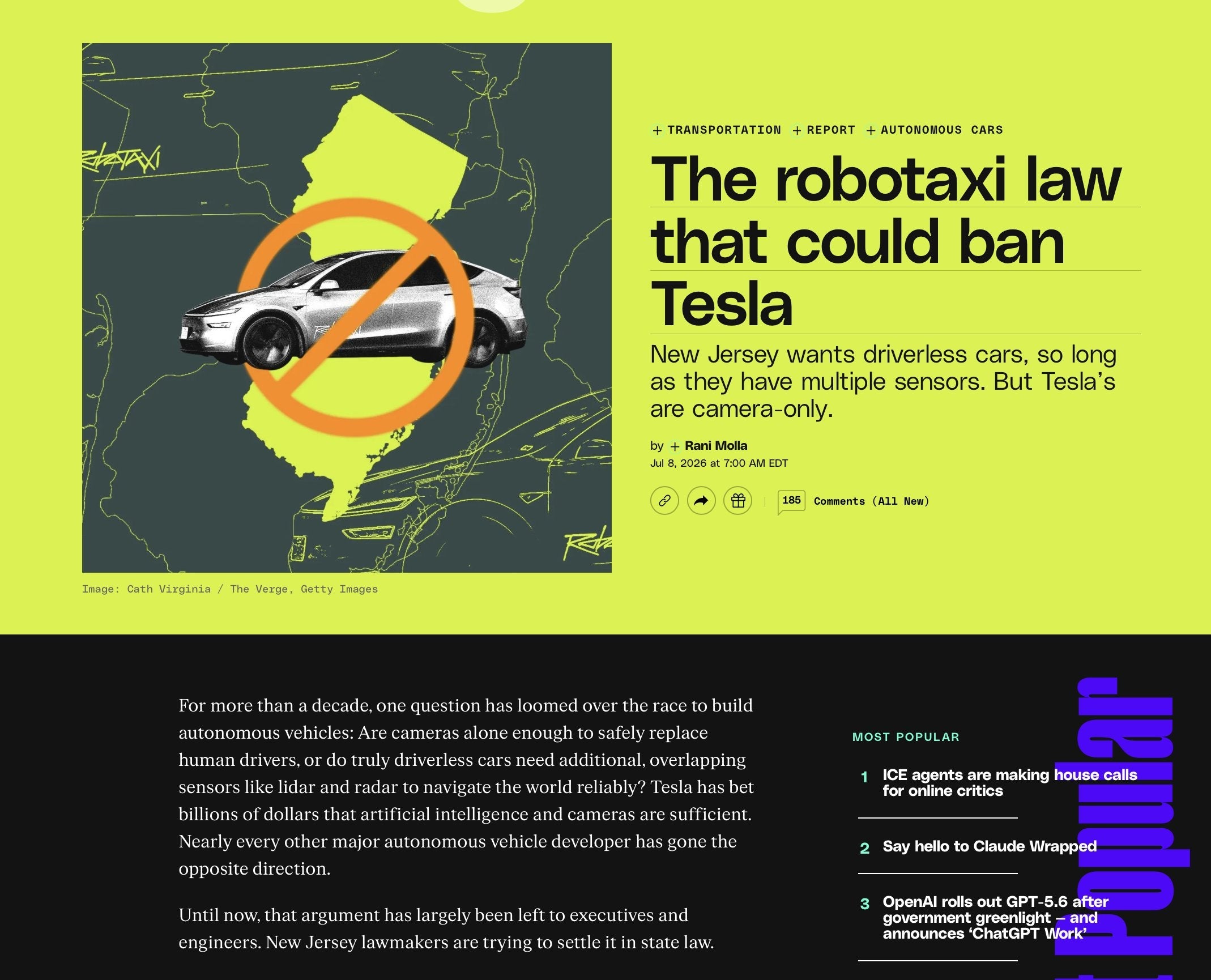
A state-level fight over robotaxi hardware
New Jersey is becoming a test case for how states may regulate robotaxis. In a post on X, Sawyer Merritt highlighted comments from Democratic state Senator Andrew Zwicker about a proposed bill that would require autonomous vehicles to use cameras plus two additional sensor types, likely lidar and radar.
If passed in that form, the bill could create a serious barrier for Tesla Robotaxi operations in the state. Tesla's autonomy strategy relies on cameras and software rather than a lidar-heavy sensor suite. The issue is not only whether Tesla can drive safely. It is whether a state should be able to mandate the hardware architecture before a company can operate driverless vehicles.
What Senator Andrew Zwicker is arguing
Merritt quoted Zwicker as saying the bill is "not anti-Tesla" but pro-New Jersey safety. Zwicker's stated concern is that the evidence is not yet strong enough to show that one sensor type plus software can handle the situations human drivers face.
That argument follows a common regulatory instinct: redundancy feels safer. If cameras are blocked by glare, dirt, fog, heavy rain, or unusual road conditions, another sensing system may still detect obstacles. Waymo, Zoox, Nuro, and many other autonomous-vehicle developers use multiple sensor types partly for that reason.
Supporters of Tesla's approach see the bill differently. They argue that performance should matter more than hardware prescription. If an autonomous system can prove it meets safety requirements, they say regulators should not force every company into the same lidar-and-radar stack.
Why Tesla is the obvious target
Even if the bill is not written as a Tesla-specific measure, Tesla is the company most affected. Its Robotaxi strategy depends on scaling autonomy through camera-based AI across vehicles that are cheaper and simpler than sensor-loaded robotaxis.
A lidar and radar mandate would weaken that cost and scale argument. It could force Tesla to redesign vehicles for New Jersey, skip the state, or challenge the rule through political or legal channels. None of those options is simple.
Tesla also has a messaging problem. Its consumer product is called Full Self-Driving, but Tesla still tells drivers to supervise it. Robotaxi service needs a different level of public trust because passengers, pedestrians, cyclists, and other drivers did not personally choose to test Tesla software.
Uber's position complicates the debate
Merritt also noted that Uber argued New Jersey should continue requiring human drivers for most rides, a position he criticized as anti-autonomous vehicle. Uber's stance is notable because the company has also pursued robotaxi partnerships in other markets.
That tension shows how messy the transition could be. Ride-hailing companies may support autonomy in some places and resist fast regulatory change in others. Labor concerns, insurance risk, fleet economics, local politics, and competitive positioning all shape these arguments.
For New Jersey, the practical question is whether lawmakers want to encourage autonomous services now or slow them until the safety case is clearer.
The bigger regulatory question
The New Jersey bill raises a national question: should robotaxi rules define safety outcomes or specify the hardware needed to reach them?
Outcome-based rules would ask companies to prove performance through testing, reporting, disengagement data, crash transparency, and state oversight. Hardware-based rules are easier to explain, but they risk freezing one technical approach into law.
Tesla wants regulators to judge the driver, not the sensor list. Zwicker and supporters of the bill appear to want layered sensing before driverless deployment. That clash is likely to spread beyond New Jersey as robotaxis move from limited pilots into mainstream politics.
For Tesla, this is no longer only an engineering debate. It is a legislative one.
Share:
Tesla Vehicle Rental Program Expands to Four More States
Eight Tesla Cybercabs Spotted Outside Peabody Store in Massachusetts