
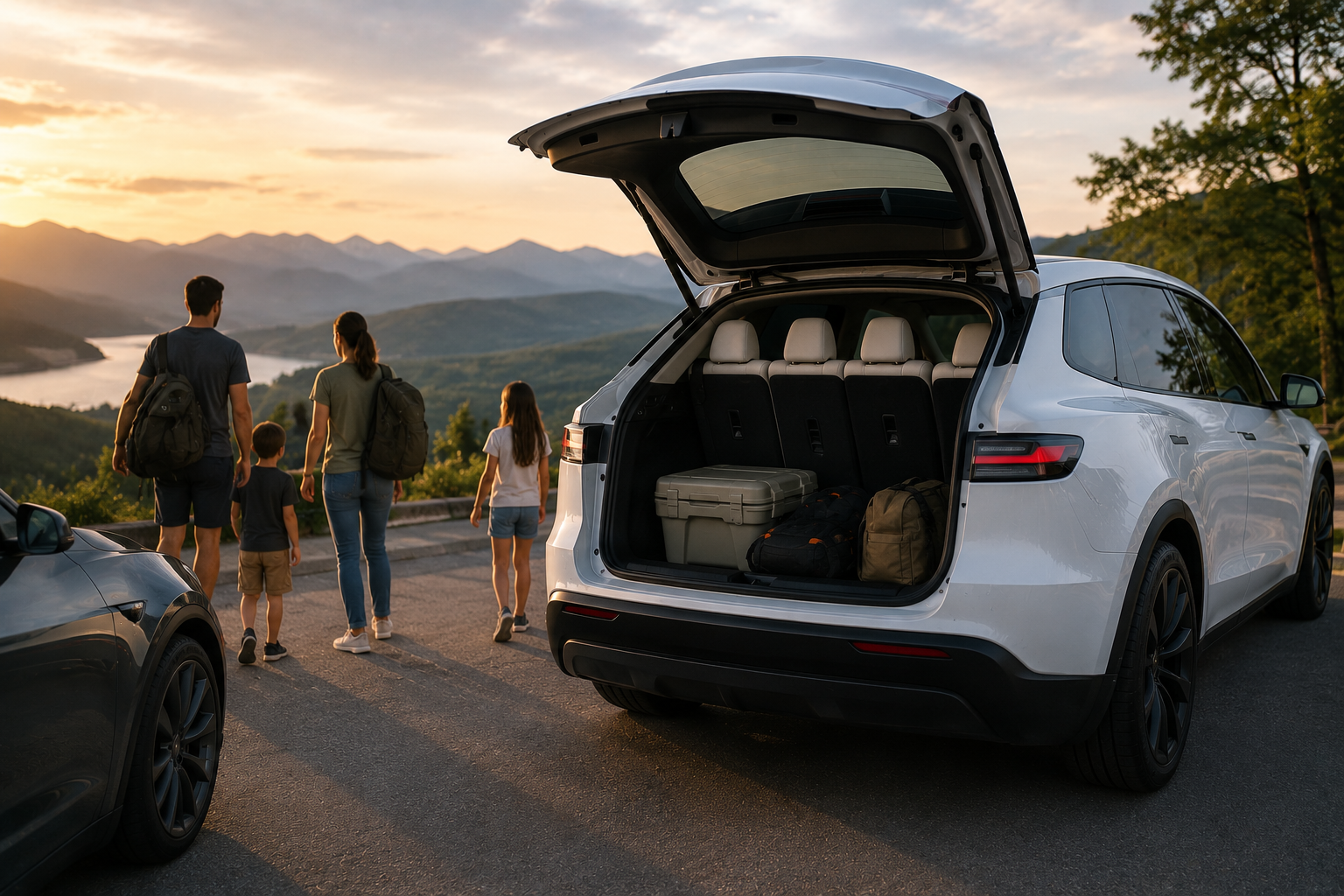
Ben Shapiro's July 12 post about Tesla is a small but useful market signal. Some buyers like Tesla's software, charging network, and operating costs, but still want a vehicle with more family capacity. That matters because Tesla's lineup has become heavily centered on Model 3 and Model Y.
Model Y is the obvious answer for many shoppers. It is efficient, familiar, quick enough, and supported by the Supercharger network. For larger families, though, car seats, dogs, sports gear, road-trip luggage, or real three-row needs can make the standard Model Y feel like a near miss rather than the right fit.
Tesla's current family options
Tesla's current U.S. family choices are narrower than they used to be. Model Y covers the mainstream crossover market. Cybertruck has size and utility, but it is not a traditional family SUV. Model X has historically been Tesla's larger premium people mover, but its price and complex design put it outside many family budgets.
That leaves a gap. Families that want a Tesla but need more space may compare the brand with three-row gas SUVs, plug-in hybrid SUVs, minivans, and newer EVs from Kia, Hyundai, Rivian, and others. Tesla still has the software and charging advantage, but space is not a small detail for these buyers.
Why Model Y may not be enough
The issue is not only the number of seats. A family vehicle has to work with the third row in use, not just folded away. It needs usable cargo space, easy entry, flexible child-seat placement, rear climate comfort, good visibility, and a cabin layout that does not make every trip feel like packing a suitcase.
Tesla's minimalist interior is a strength for many buyers, but families often reward practical details: cupholders, vents, storage bins, durable materials, charging ports, and easy folding seats. The Rivian R2 discussion, for example, has shown how closely buyers look at cargo volume, rear glass, outlets, and second-row comfort.
Model Y L points to the next step
The Model Y L appears to be Tesla's clearest near-term answer. Reports describe it as a longer, roomier six-seat version of the Model Y with a three-row layout. If Tesla brings it to more markets, it could give the company a lower-cost family option without requiring an entirely new vehicle platform.
That approach makes sense. A stretched Model Y keeps Tesla close to its strongest product while addressing the most obvious space complaint. It would not replace a full-size SUV or minivan, but it could win buyers who want more room without moving to Cybertruck or a luxury-priced Model X.
The bigger question: SUV or van?
The longer-term question is whether Tesla eventually needs something beyond Model Y L. A true larger-capacity Tesla could be a bigger SUV, a Robovan-style passenger vehicle, or a more conventional family hauler built around Tesla software and charging.
The demand is not imaginary. Large families already buy vehicles that are less efficient, less connected, or more expensive because those vehicles solve the space problem. If Tesla wants to keep those buyers inside its ecosystem, it may need to treat capacity as a main product feature rather than a side request.
Model Y built Tesla's mass-market EV business. The next growth step may depend on whether Tesla can build something for families that simply need more room.
Sources
Ben Shapiro, Tesla larger-family-vehicle demand post: https://x.com/benshapiro/status/2076343617375879326
Tesla, Model Y official page: https://www.tesla.com/modely
Tesla, Model X official page: https://www.tesla.com/modelx
Car and Driver, Tesla Model Y L coming to the U.S. as a more spacious three-row SUV: https://www.caranddriver.com/news/a71684316/tesla-model-y-l-america-report/
Share:
SpaceX to Use Starlink V3 Satellites as Heat-Shield Inspectors on Starship Flight 13
Paper Transport to Test Tesla Semi Long Range in Chicago Dedicated Operations