
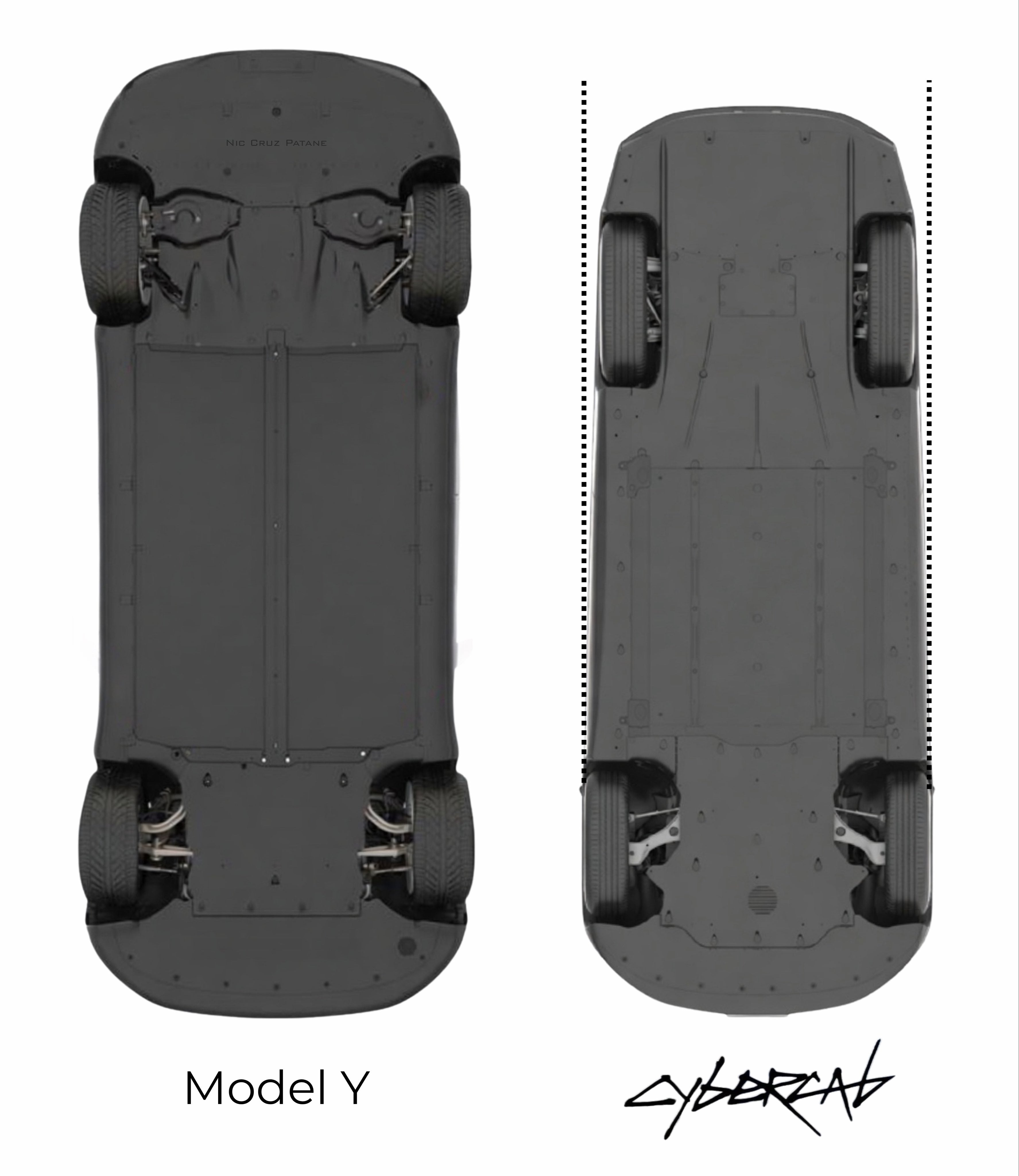
Tesla has trained buyers to think of its EVs as rear-wheel-drive, dual-motor, or Plaid-fast machines. The Cybercab breaks that pattern. Public EPA certification data reported in June identifies the two-seat robotaxi as a single-motor, front-wheel-drive battery-electric vehicle, making it Tesla's first confirmed FWD model.
The axle choice is only part of the story. Nic Cruz Patane noted that the Cybercab appears to have a wider front track than rear track, while certification reporting points to a 163 kW single motor. Front-wheel drive could simplify the rear of the vehicle and help Tesla preserve its tapered shape. For a robotaxi operating many hours a day, small efficiency gains can materially affect energy cost per mile.
Why Tesla chose FWD instead of rear-wheel drive
Rear-wheel drive makes emotional sense for Tesla fans. It feels familiar, clean, and tied to performance. A robotaxi has a different job. It does not need to impress a driver with throttle response. It needs to move people smoothly, cheaply, and again and again.
A rear-drive Cybercab would likely put more drivetrain hardware at the back, which is exactly where Tesla appears to want a narrow tail. A slimmer rear can help reduce drag if the body controls airflow well, and it also makes the car look more like a purpose-built mobility vehicle than a normal EV.
For a vehicle with no steering wheel and no driver-focused performance pitch, the usual RWD appeal matters less. Tesla can drop enthusiast logic if the payoff is better range per kilowatt-hour, simpler assembly, and cleaner packaging.
Why Cybercab may not need all-wheel drive
All-wheel drive is easy to sell: more traction, more motors, more capability. It also adds cost, weight, parts, software work, and energy use. In a consumer EV, that can be worth it. A family in snow country may want AWD. A performance buyer may expect it.
Cybercab is aimed at a different use case. It will likely spend most of its time in city and suburban service, not climbing mountain roads or serving as someone's personal status purchase. If Tesla wants very high volume and low operating cost, removing a second drive unit is an obvious place to save money.
That does not make AWD impossible. It may simply be unnecessary. In robotaxi economics, the cheapest reliable part is the one Tesla never has to install.
How front-wheel drive helps a robotaxi
Front-wheel drive can keep steering and propulsion hardware together at the front. That leaves the rear available for aerodynamic taper, cabin space, crash structure, cargo, or easier manufacturing. It can also place the main serviceable drive components at one end of the vehicle.
There are tradeoffs. FWD is not the layout most drivers would pick for a high-power performance car, and it asks the front tires to handle both steering and propulsion. But Cybercab is not built for smoky launches. It is built for predictable low- and medium-speed driving, smooth control, and lower energy cost per mile.
The steering piece matters. A robotaxi does not need to feel sporty. It needs to be stable, precise, and easy for the autonomy system to predict. A wider front track could help with front-end stability and packaging, while the narrower rear supports the vehicle's aerodynamic shape.
What FWD says about Tesla robotaxi economics
The Cybercab drivetrain debate says a lot about how Tesla may be thinking about the vehicle. It is being shaped around the operating model, not around the habits of private-car buyers. A normal EV is sold once. A robotaxi only works as a business if it keeps moving, uses little energy, and is cheap to build and maintain.
The confirmed Tesla Cybercab front-wheel-drive layout is more than an unusual specification. It shows Tesla cutting away familiar car-design assumptions when they do not improve robotaxi economics.
Tesla already removed the steering wheel from the Cybercab concept. It may also be dropping the idea that every Tesla has to feel like a driver's car. For a vehicle people summon rather than own, the smartest drivetrain may be the one passengers never think about.
Sources
Nic Cruz Patane, Cybercab front-wheel-drive observation: https://x.com/niccruzpatane/status/2074941448114368744
Tesla, Robotaxi official page: https://www.tesla.com/robotaxi
Tesla, Impact Report: https://www.tesla.com/impact
EVXL, EPA certification confirms Cybercab front-wheel drive: https://evxl.co/2026/06/15/tesla-cybercab-epa-certification-front-wheel-drive-219-hp/
Share:
Charges Dismissed Against Doctor in Tesla Model Y Cliff Crash After Mental Health Diversion
Tesla's Optimus Factory Buildout Looks Ahead of Schedule