
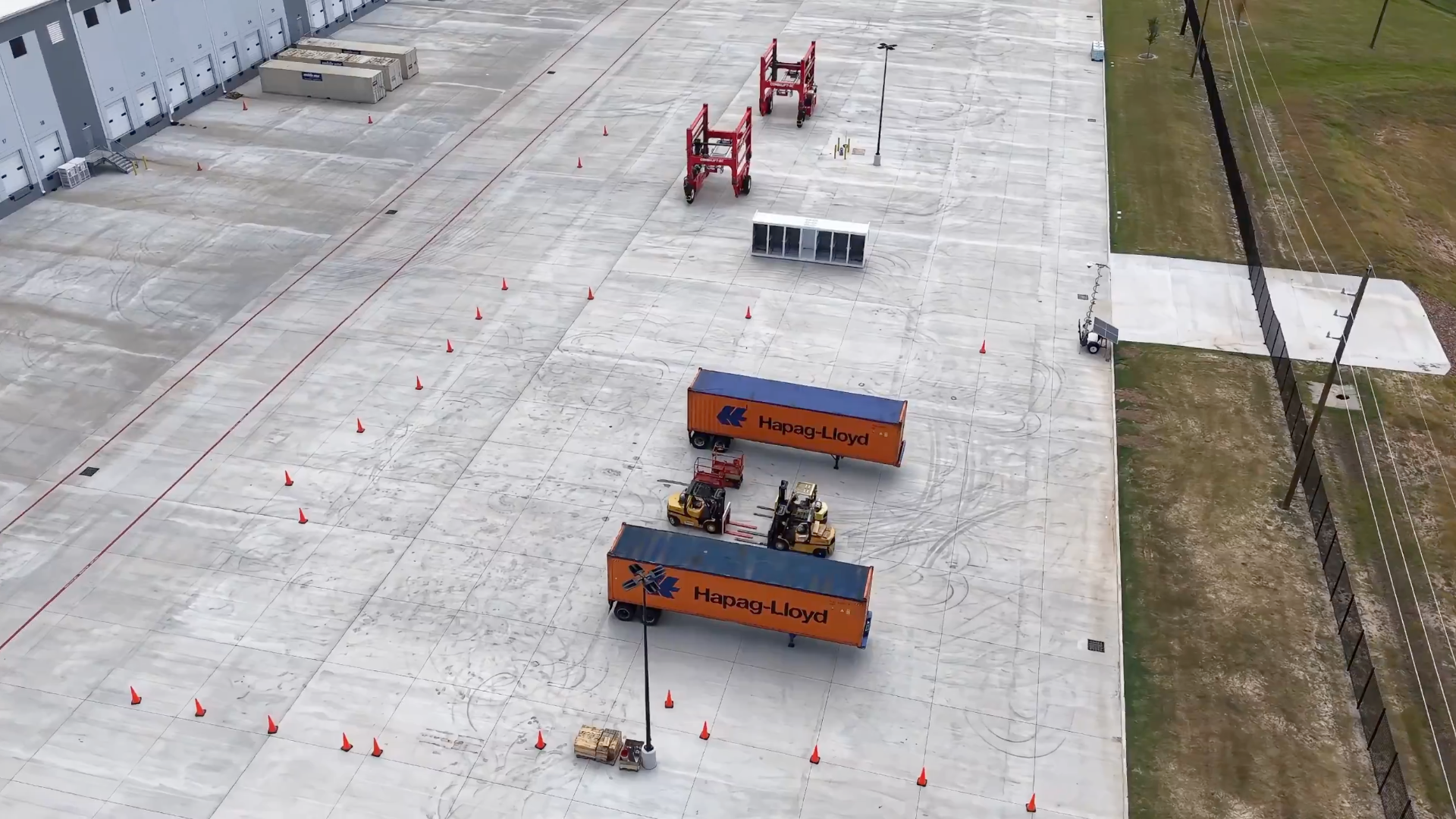
Tesla’s Megapack story is increasingly becoming a factory story. A new flyover update from Brookshire, Texas, shared by S.E. Robinson Jr., reports that Tesla has received a second 50-ton COMBiLIFT Megapack mover at the site and has staged both vehicles in a training area where employees can learn how to drive and navigate them. The same update also points to substantial foundation work around the perimeter of the roughly 1 million-square-foot factory, including work tied to five stainless tanks and entry points.
Those details may sound narrow, but they are exactly the kind of signs that matter when a factory is moving from construction toward serious production readiness. A Megapack is not a small consumer product. It is a utility-scale battery system built for grid operators, renewable developers, commercial facilities and increasingly data-center customers. Moving these units safely through a factory requires specialized equipment, trained operators and carefully planned logistics.
That is why the second COMBiLIFT is important. It is not just another vehicle on site. It is a sign that Tesla is thinking about parallel movement, redundancy and training before large-scale throughput arrives.
Why a Second COMBiLIFT Matters
In manufacturing, material handling can become a hidden bottleneck. A production line can have enough workers, robots and assembly stations, but if finished or partially finished products cannot move efficiently, output stalls. That is especially true for Megapack production because each unit is large, heavy and valuable.
A 50-ton COMBiLIFT-style mover suggests Tesla needs equipment capable of handling heavy battery products with precision. One mover can support early work. Two movers can support training, backup capacity and more complex routing inside or around the plant. If one unit is being used for instruction or maintenance, the other can remain available. If production ramps, two vehicles can reduce waiting time between assembly, inspection, staging and outbound logistics.
The training angle is just as important as the machine itself. Heavy industrial equipment is only useful if operators can use it safely and consistently. By creating a dedicated training area, Tesla appears to be preparing workers for repeatable Megapack movement before the factory reaches higher volume. That is how a facility turns a complex task into a standard operating process.
Training Areas Are Production Infrastructure Too
Factory watchers often focus on walls, foundations, cranes and equipment deliveries. Training areas are easier to overlook, but they are part of production infrastructure. A worker who can move a large Megapack safely on a controlled training path is one step closer to moving it reliably in a live production environment.
This matters because Tesla’s manufacturing culture depends on speed. But speed without training creates downtime, damage and safety risk. A dedicated area for COMBiLIFT navigation suggests Tesla is building operational muscle before the site is fully loaded.
It also hints at the type of factory Brookshire may become. Megapack output depends on large-scale repetition. The product must move through assembly, testing, staging and shipping in a rhythm. If Tesla wants Brookshire to become a major Tesla Energy production node, it needs more than battery cells and assembly tools. It needs trained people who can handle heavy equipment at industrial pace.
Brookshire Fits Tesla Energy’s Bigger Expansion
Tesla’s existing Megafactory in Lathrop, California, is already one of the company’s core energy assets. Tesla says that facility is capable of producing 10,000 Megapack units per year, equal to 40 GWh of clean energy storage. Brookshire is widely viewed as the next major step in Tesla Energy’s manufacturing footprint in the United States.
Local reporting has described the Brookshire project as a major Megapack manufacturing site west of Houston, with a large leased industrial space and additional manufacturing or distribution capacity. The site has also been connected to significant job creation and future Megapack 3 production.
The strategic reason is straightforward: Tesla Energy needs more capacity if demand keeps rising. Grid batteries are no longer a niche product for renewable demonstration projects. They are becoming a core tool for utilities, developers and large electricity users that need to manage intermittency, peak demand and grid constraints.
AI Data Centers Are Changing the Storage Market
The demand picture is also changing because of AI data centers. Artificial intelligence workloads are power-hungry, and large data centers can place sudden, concentrated stress on local grids. Recent academic work on AI data-center integration has emphasized that battery energy storage can help buffer fast power changes, support reliability and coordinate compute demand with grid limits.
That is exactly the kind of problem Megapack is designed to address at large scale. A battery system cannot create energy from nothing, but it can shift power across time, stabilize demand, support renewables and reduce stress during peak periods. For data centers, storage can become both a backup layer and a grid-interaction tool.
Tesla has also been publicly associated with the idea that Megapack can support data-center power needs. As AI infrastructure grows, the market for large battery systems could expand beyond traditional utility storage projects into private industrial and compute campuses.
That makes Brookshire more than another factory. It could become one of Tesla’s answers to a market where electricity infrastructure is now part of the AI race.
What Higher Megapack Output Would Mean
If Brookshire ramps successfully, the implications are significant for Tesla Energy. More Megapack production could shorten delivery timelines, support larger project bids, improve regional logistics and give Tesla more ability to serve U.S. demand without relying only on California or Shanghai capacity.
It could also change how investors view Tesla. The company is still primarily discussed as an EV maker, but energy storage is becoming a more visible part of the business. Megapack production growth gives Tesla a second industrial growth story tied to utilities, renewables, data centers and grid reliability.
The flyover update does not prove that full-scale production is imminent. It does, however, show the kind of groundwork that comes before it: specialized movers, training zones, foundation work, tank infrastructure and site preparation.
That is the subtle signal. Tesla is not only building Megapacks. It is building the factory system that can move, train, stage and eventually ship them at scale. For Tesla Energy, the production infrastructure may be the real headline.
Sources
S.E. Robinson Jr., Brookshire Texas Megafactory flyover update: https://x.com/SERobinsonJr/status/2077156338136654057
Tesla, official Megafactory page: https://www.tesla.com/megafactory
Tesla, official Megapack page: https://www.tesla.com/megapack
San Antonio Express-News, Tesla plans utility-scale battery plant in Texas: https://www.expressnews.com/business/article/tesla-battery-factory-brookshire-waller-county-20206798.php
Sina Mohammadi, Wayne Wang, Marcus Chen I Wada and others, Grid Integration of AI Data Centers review: https://arxiv.org/abs/2603.00415
Share:
Tesla Supercharger Update: New Siheung Site Adds 9 Stalls on South Korea’s Expressway Network
Tesla Model Y L Reaches Chicago Showroom With Six-Seat Cabin