
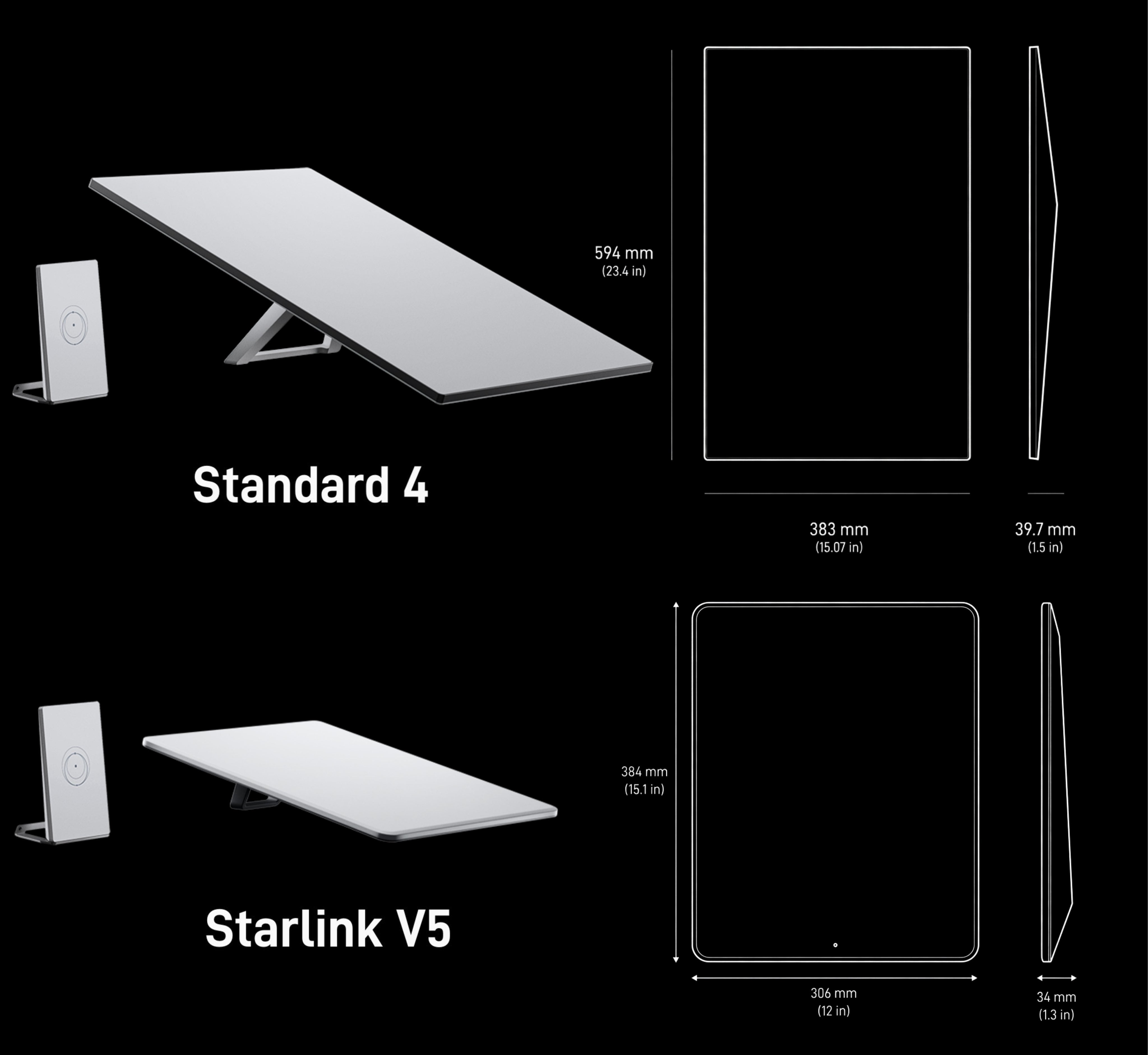
SpaceX appears to be moving Starlink into its next hardware phase with the Starlink V5 terminal, a new-generation kit that focuses less on visual drama and more on the kind of everyday improvements that matter after satellite internet becomes a normal household utility. According to details shared by Sawyer Merritt, the Starlink Gen 5 dish is about 35% smaller than the V4 terminal, weighs just 2.4 pounds, and is 62% lighter than the outgoing V4 dish.
That weight reduction is not just a nice spec-sheet detail. Starlink has always had a different installation challenge from cable or fiber internet. The service depends on a user terminal that needs a clear view of the sky, which often means rooftops, poles, RV mounts, balconies, cabins, remote worksites or temporary installations. A lighter dish is easier to carry, easier to mount, and less intimidating for users who do not want a professional installer.
The Starlink V5 terminal still keeps several core outdoor features from the previous generation. The reported specs include a 110-degree field of view, software-assisted manual orientation, IP67 Type 4 weather resistance, snow-melt capability of up to 40 mm per hour, and an operating temperature range from -30°C to 50°C. In other words, SpaceX did not simply shrink the dish by making it more fragile. The point seems to be making the standard residential hardware easier to live with while preserving the rough-weather identity that made Starlink useful in rural and off-grid settings.
The new integrated LED status indicator is also a quiet usability improvement. On V4, the primary status indicator sits on the router. Putting status feedback on the dish itself can make setup and troubleshooting easier, especially when the terminal is outside and the router is inside.
Why Lower Power Use Matters
The most important Starlink V5 upgrade may be power consumption. The new terminal is described as 50% more power efficient than V4, with average power use of roughly 35 to 50 watts.
For a normal suburban home, that may sound minor. For Starlink’s real edge cases, it is a big deal. Many Starlink users are in places where the power budget matters: RVs, boats, cabins, remote farms, construction sites, emergency response setups and solar-plus-battery systems. Cutting the dish’s power draw can make the difference between running all night on a small battery and needing extra power hardware.
Lower power also changes how people think about always-on connectivity. A satellite dish that pulls too much energy can feel like a device you turn on when needed. A dish that uses less power becomes more like a conventional router: something that stays running in the background. That matters for remote workers, security systems, smart-home devices and backup communications.
It also fits the broader direction of Starlink. SpaceX has been expanding from a niche rural broadband product into a wider connectivity layer covering homes, vehicles, ships, aircraft, emergency areas and direct-to-cell service. The more Starlink moves into mobile and semi-mobile use cases, the more every watt counts.
Peak Speeds and Real-World Expectations
The new Starlink Gen 5 terminal is listed with peak speeds of up to 375 Mbps or more. That number is useful because it places the V5 terminal closer to mainstream fixed broadband expectations, rather than the “good enough for remote areas” framing that surrounded early satellite internet.
Still, readers should treat peak speed carefully. Satellite internet performance depends on network capacity, local congestion, weather, obstructions, satellite density, gateway routing and service plan. A terminal can support higher peak performance without guaranteeing that every user will see that number every day.
That is not a weakness unique to Starlink. Cellular, cable and fixed wireless networks all advertise theoretical or peak rates that differ from real-world performance. The more relevant point is that SpaceX is improving both sides of the system: the constellation in orbit and the customer hardware on the ground. A better terminal cannot solve every network constraint, but it can reduce the hardware bottleneck for users in areas where satellite capacity is available.
For users who rely on video calls, cloud work, large downloads or multiple household devices, the combination of higher peak speed and better Wi-Fi hardware may matter more than the top-line Mbps number alone.
Wi-Fi 6 Makes the Router Part of the Upgrade
Starlink V5 includes the Router Mini with Wi-Fi 6, dual-band 2x2 MU-MIMO, two 1 Gbps Ethernet ports, up to 2,200 square feet of Wi-Fi coverage and support for up to 235 connected devices.
That makes the home-networking side of the kit more important. A satellite link can be fast, but the experience still suffers if the router is weak, coverage is poor, or users need extra adapters for basic wired connectivity. Two Ethernet ports are especially useful for people who want a hardwired connection to a desktop, mesh system, security hub or business equipment.
Wi-Fi 6 also matters because modern households are crowded. Phones, laptops, tablets, streaming devices, cameras, thermostats, game consoles and smart speakers can all compete for airtime. Starlink users in remote areas may not have fiber, but they still have the same device-heavy lifestyle as everyone else. Better local networking helps Starlink feel less like a special workaround and more like a normal broadband service.
Mesh compatibility with Gen 2 Router, Gen 3 Router, Router Mini and Starlink Mini also helps existing users expand coverage without rebuilding everything from scratch.
Wind Resistance Changes the Installation Story
One of the most striking claims is operational wind resistance of up to 165 mph, compared with a V4 rating described as 60 mph or more. If that figure holds across real installations, it changes the confidence level for roof, pole and exposed outdoor mounting.
Wind ratings matter because Starlink dishes often live in places where wired broadband is unavailable precisely because infrastructure is hard to build or maintain. Rural homes, coastal properties, mountain cabins and open work sites can face harsher conditions than a typical urban install.
A lighter dish with stronger wind resistance may sound contradictory, but it makes sense if the hardware has a smaller profile, better structural design and less surface area for wind to grab. This is one reason the V5 terminal could be more valuable than its speed number alone suggests.
Should Existing Starlink Users Upgrade?
For new customers, Starlink V5 looks like the obvious default if pricing and regional availability are reasonable. It is smaller, lighter, more efficient, faster on paper and better integrated with Wi-Fi 6.
For current V4 users, the answer depends on the use case. If your existing Starlink setup is fixed, powered by the grid, already fast enough and mounted securely, V5 may not be urgent. The real upgrade case is stronger for people who move their kit, depend on solar or battery power, need easier installation, live in windy areas, or want better local networking.
Starlink V5 is not just about a new dish. It shows SpaceX refining the customer side of satellite internet. The early Starlink story was about proving low-Earth-orbit broadband could work. The Gen 5 story is about making it lighter, simpler, more efficient and more ordinary to own.
Sources
Sawyer Merritt, Starlink V5 terminal specifications post: https://x.com/SawyerMerritt/status/2077151328762241268
Starlink, official specifications page: https://www.starlink.com/specifications/4
Starlink, residential service page: https://www.starlink.com/residential
Muaz Ali, Utkarsh Upadhyay, Sean McCormick and others, Starlink Constellation deployment and dynamics paper: https://arxiv.org/abs/2603.25835
Share:
XPENG L03 Brings VLA 2.0 NGP Testing to Europe
Tesla Supercharger Update: New Siheung Site Adds 9 Stalls on South Korea’s Expressway Network