
One Long Trip Tests More Than One Skill
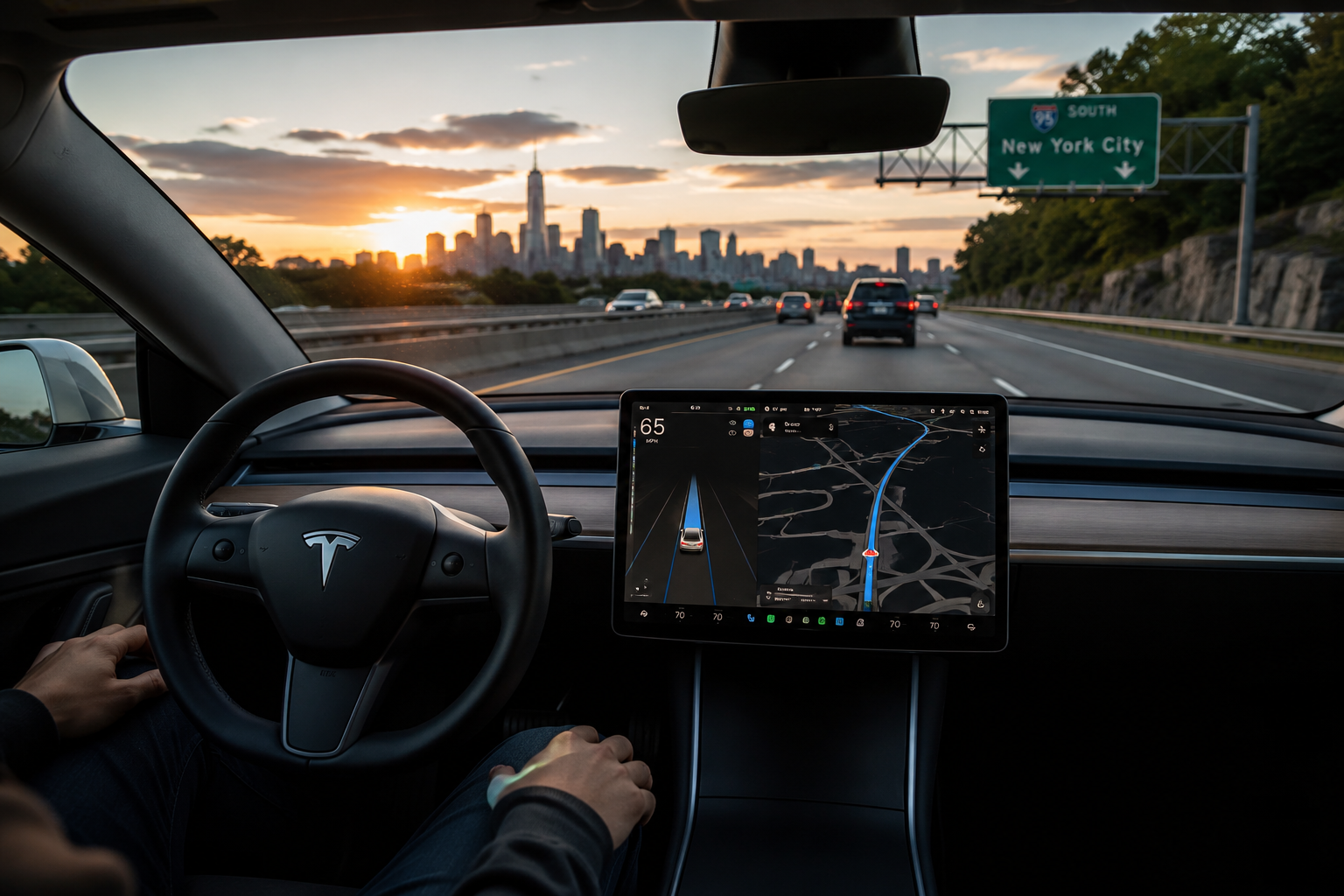
Sawyer Merritt recently described a Model Y completing a round trip from New Hampshire to New York City and back under FSD Supervised, reaching a 500-mile streak while the human remained in the driver’s seat and monitored the system.
The mileage is eye-catching, but the more useful point is continuity.
Short demonstrations can show whether a driver-assistance system handles a difficult turn, a construction zone, or an unusual intersection. A long interstate trip tests something broader. The system must remain coherent as road types, traffic density, lane geometry, speed, and driver expectations change over several hours.
That is closer to how normal people judge a product. They do not need FSD to perform one spectacular move for social media. They need it to work consistently enough that they keep it engaged.
A 500-mile streak therefore says less about one perfect decision and more about avoiding hundreds of small reasons for the driver to take over.
Continuity Changes the Driver’s Role
Tesla officially describes FSD as supervised driver assistance. The company says the currently enabled features do not make the vehicle autonomous and require a fully attentive driver who is prepared to take over at any moment.
That distinction remains essential. Yet the practical relationship between driver and vehicle changes as the software becomes more consistent.
In a conventional car, the driver continuously controls speed, steering, lane position, and navigation. In an advanced supervised system, the driver increasingly monitors a sequence of automated decisions. The work shifts from constant physical operation to sustained oversight.
That can reduce fatigue, particularly on long highway sections. But it creates a different challenge: monitoring a system that usually behaves well can be mentally difficult. Humans are not naturally good at maintaining perfect attention while automation handles most of the task.
The better FSD becomes, the more Tesla must manage this supervision paradox. Strong performance makes the feature useful, but it can also encourage overconfidence.
Why Route Diversity Matters
A trip between New Hampshire and New York City likely includes more than uninterrupted highway driving. It can involve smaller roads, urban traffic, highway merges, toll areas, lane changes, exits, and changing traffic behavior.
That variety is why long trips are valuable informal tests. A system that performs well on one familiar commute may rely on conditions that rarely change. A multi-state route introduces more transitions.
Transitions are often where automation becomes uncomfortable. The system may need to move from a fast highway into dense city traffic, respond to complicated lane markings, select the correct exit, or handle drivers who do not cooperate.
For owners, the question is not whether FSD is theoretically capable of each task. It is whether the handoffs between tasks feel smooth enough that intervention becomes unnecessary.
This is an area where Tesla’s broad approach differs from many competing systems. Numerous automakers offer capable highway assistance, but the feature may be limited to mapped roads or simpler lane-control functions. Tesla is trying to provide route-level assistance across a wider variety of environments.
A Streak Is Evidence, Not a Safety Verdict
An intervention-free streak is encouraging, but it should not be treated as proof that FSD is autonomous or universally safe.
One trip does not reveal fleet-wide performance. It does not measure how the system behaves across every weather condition, road layout, hardware generation, or driver. It also does not capture near misses, moments of discomfort, or situations where the driver chose not to intervene even though another driver might have.
Safety evaluation requires a denominator. How many miles are driven? How are interventions classified? What counts as critical? How does performance compare with human driving under similar conditions?
Tesla has a large real-world fleet and potentially valuable internal data, but outside analysis remains difficult without detailed methodology.
The responsible interpretation is straightforward: the trip demonstrates practical capability for one user under one set of conditions. It does not remove the need for supervision.
The Product Value Is Reduced Mental Load
The strongest consumer argument for FSD may not be the distant promise of a robotaxi. It may be making long-distance travel less tiring today.
If a supervised system can handle most lane changes, navigation choices, traffic flow, and highway operation, the driver may arrive with less physical and mental fatigue. That is useful even before unsupervised autonomy exists.
This is why long streaks matter. A feature that works for ten minutes can feel impressive. A feature that remains helpful for 500 miles can change how owners plan travel.
Tesla still has to prove safety, communicate supervision clearly, and improve edge-case behavior. But the product is moving into a stage where the discussion is no longer only about what FSD can do. It is about how long people are comfortable letting it do it.
That may be a more meaningful milestone than any single maneuver.
Share:
Why Electric Cars Dominate at 14,000 Feet
Starlink’s Real Moat Is the Rocket Launching It