
The Crash Was Labeled an FSD Failure Almost Immediately
When a Tesla is involved in a serious crash, the argument often starts before the basic facts are known. People debate "self-driving" before investigators confirm whether an assistance system was active, what the driver did, or who controlled the car in the seconds before impact.
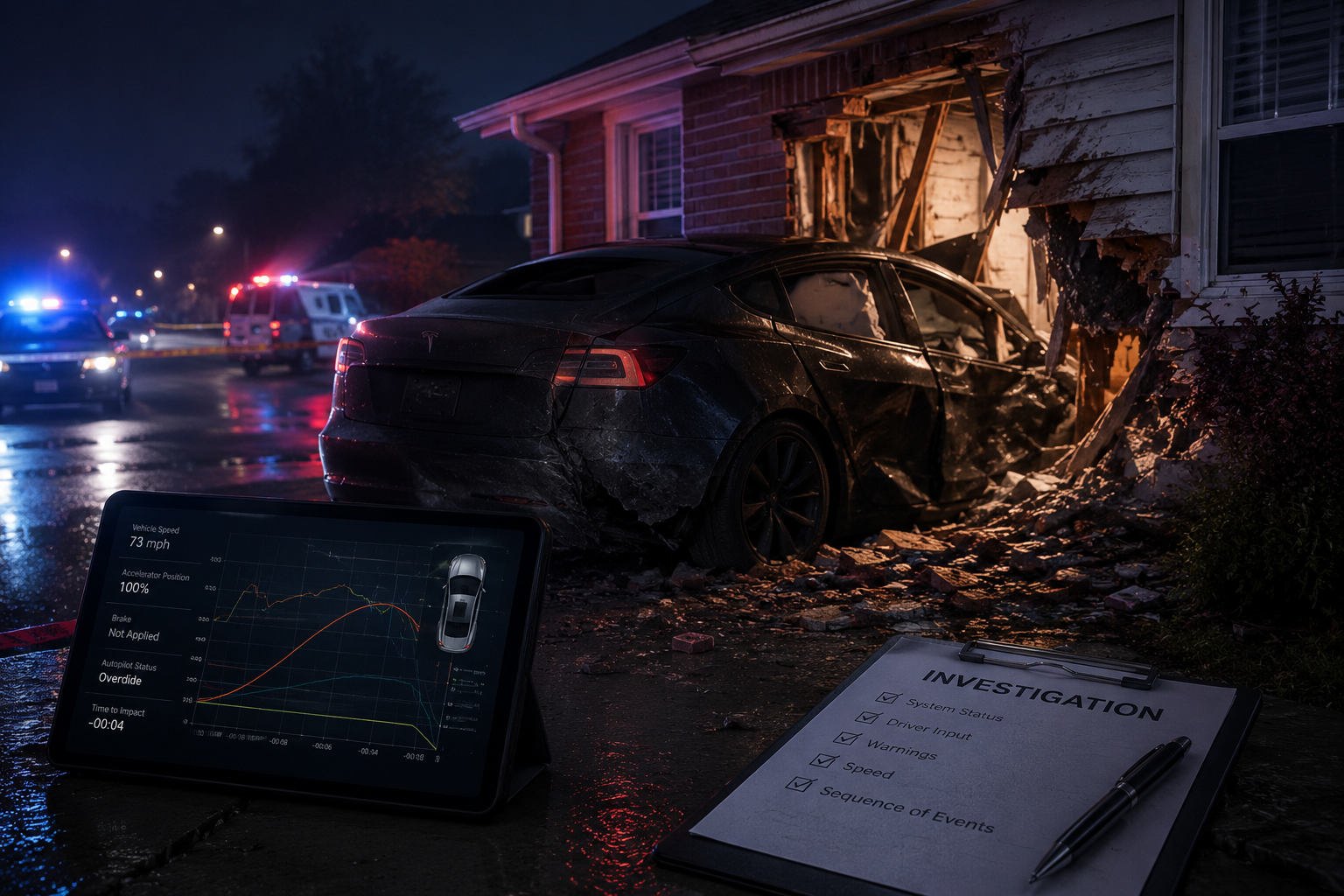
That happened again after a Model 3 reportedly struck a house in Texas at 73 mph. Early discussion treated the crash as another possible failure of Tesla's driver-assistance software. Tesla later said the driver pressed the accelerator and manually overrode the car's automated behavior.
The crash is no less tragic if that account is correct. It does mean investigators have more to examine than whether the software aimed the car at the house. They need to know why the accelerator was pressed, what the screen showed, when the system handed control back, and whether the driver understood that change.
Tesla calls the product Full Self-Driving (Supervised). The driver remains responsible and can override steering, braking, or acceleration. A car having FSD installed does not mean FSD was controlling it at the moment of a crash.
A Driver Override Changes the Investigation
Driver-assistance systems are supposed to give the human final control. Pressing the accelerator can make the car continue when the software would otherwise slow down. That can be useful during a merge, while clearing an intersection, or when the car is being overly cautious.
It also creates an awkward safety tradeoff. The car must respond when the driver gives a legitimate command, but the same input can be accidental or reckless. A system that constantly refuses the driver is not really under the driver's control. A system that always obeys cannot prevent every bad decision.
Investigators therefore need more than a record showing FSD was selected earlier in the drive. Accelerator position, speed, braking, steering input, system status, warnings, and disengagement timing can tell a very different story from the first social media post.
The First Headline Is Hard to Undo
The earliest explanation of a dramatic crash usually travels the farthest. "Tesla crashes while self-driving" is short and emotionally clear. A later account involving an accelerator override, a supervised system, and a timeline of driver inputs takes longer to explain.
Tesla helped create some of this confusion. Full Self-Driving is an ambitious name for a product that still requires active supervision. Owners familiar with the system may understand the qualification. A casual reader may reasonably take the name more literally.
Journalists still should not turn missing information into a conclusion. Until reliable data is available, reports should separate three claims: the car had FSD, FSD was used during the trip, and FSD controlled the car at impact.
Those claims are not interchangeable.
Tesla's Explanation Also Needs Context
Tesla should release enough information for its version of events to be checked. Saying the accelerator was pressed is useful, but a full timeline would show when it happened, what the system did next, and whether any warnings appeared. One favorable data point is not a complete reconstruction.
Regulators could reduce this confusion with standard reporting for serious crashes involving advanced driver assistance. Each investigation should establish the same basic record: system status, driver inputs, speed, warnings, road conditions, and the verified sequence before impact.
What a Better Crash Investigation Would Show
The goal is not to declare the driver or the software innocent before the evidence is available. The goal is to reconstruct how they interacted.
Every Tesla crash should not become a referendum on the company. The same standard should apply whether the data supports Tesla's explanation or contradicts it.
If the reported accelerator override occurred as described, claims that FSD alone commanded a 73-mph impact need to be corrected. The investigation should still continue. The useful answer is a second-by-second account of who or what controlled the car, not another round of instant certainty.
Share:
Giga Texas Flyover Shows Nine Cybercabs Preparing for Austin Testing
Can Tesla Build Robots That Actually Pay for Themselves?