
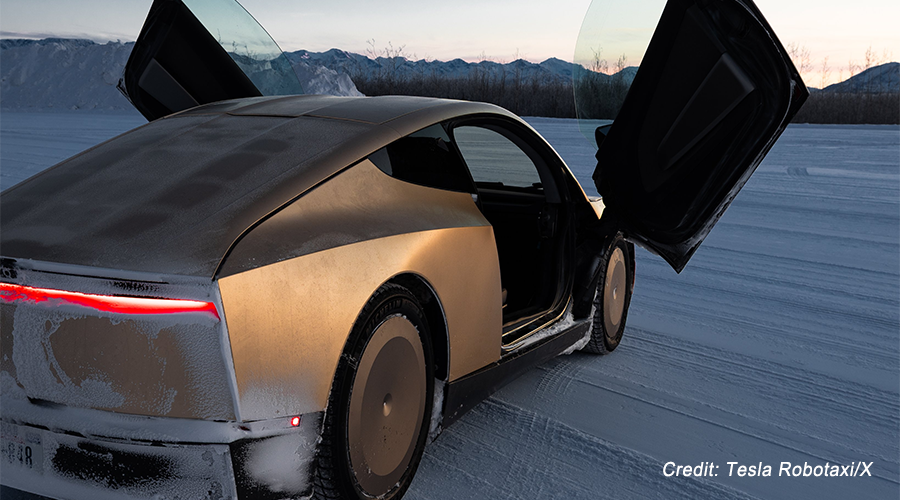
Tesla’s upcoming Cybercab robotaxi is drawing fresh attention after a display unit showcased several notable interior features that highlight the vehicle’s unique design philosophy.
The Cybercab is currently being displayed at the U.S. Department of Transportation in Washington, D.C., where observers have shared photos and videos of the production vehicle on social media platform X. The display has provided a closer look at how Tesla is approaching interior space and passenger experience in its upcoming autonomous vehicle.
One of the most surprising details noted by viewers is the amount of legroom inside the compact two-seater. Despite being Tesla’s smallest vehicle to date, the Cybercab appears to offer more passenger legroom than several of the company’s larger models, including the Model Y, Model X, and Cybertruck.
The @Tesla Cybercab is currently on display at the USDOT in Washington, D.C., and it's full of interesting details 😍
— Ming (@tslaming) March 11, 2026
🦿 Even though it’s the smallest Tesla yet, it actually offers more legroom than any other model in the lineup
📽️ The cabin features a massive screen that’s… https://t.co/NC9Btds8aj pic.twitter.com/StxcblTwBD
The spacious layout is largely made possible by the Cybercab’s fully autonomous design. Because the vehicle does not include a steering wheel or pedals, Tesla can dedicate nearly the entire cabin to passengers instead of driver controls.
Footage from the display also highlights the Cybercab’s large central touchscreen, which is positioned prominently in front of the passenger seating area. The screen is expected to provide trip information and entertainment for riders while the vehicle operates autonomously.
Images of the display vehicle have also revealed additional hardware details, including a camera integrated into the vehicle’s C-pillar. The extra camera could help expand the robotaxi’s field of view, supporting Tesla’s ongoing development of fully autonomous driving capabilities.
Tesla engineers have previously indicated that the Cybercab was designed with efficiency in mind, both in terms of manufacturing and operation. According to comments shared by a Tesla engineer in 2024, the robotaxi could be built with roughly half the number of parts used in a Model 3, thanks in part to its simplified two-seat design.
Despite its compact footprint, the Cybercab is also expected to provide practical cargo capacity. The vehicle’s trunk area has reportedly been designed to fit multiple golf bags, carry-on luggage, and full-size suitcases, highlighting Tesla’s effort to balance passenger comfort with real-world usability.
As Tesla continues testing and refining the Cybercab ahead of production, the latest display offers another glimpse into how the company plans to rethink vehicle interiors for a future centered on autonomous ride-hailing.
Tesla Cybercab on display at the USDOT in Washington, DC pic.twitter.com/BceYXr5P3b
— Moe (@moemoe889) March 10, 2026
Share:
Tesla Sweden Appeals After Grid Operator Refuses to Reconnect Supercharger Over Union Sympathy Strike
How Do Tesla Model 3 and Model Y Owners Keep Their Center Console Organized?