
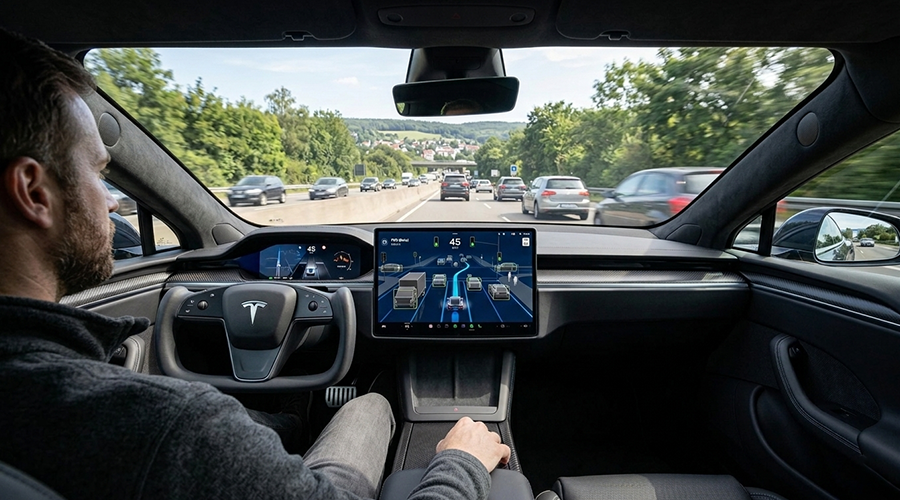
Tesla’s Full Self-Driving (FSD) system continues to make major strides in safety and capability, but CEO Elon Musk recently pointed out a difficult reality that comes with developing autonomous driving technology.
The comments came in response to a video showing Tesla’s FSD system successfully avoiding a potentially fatal accident. In the clip, a Tesla vehicle traveling at highway speed in poor weather conditions detects a pedestrian and reacts instantly, preventing a collision. Musk acknowledged the system’s performance but emphasized that the broader picture is more complicated.
“Tesla self-driving saves a lot of lives, the statistics are unequivocal,” Musk said, while also noting that the system is “not perfect.”
Tesla self-driving saves a lot of lives – the statistics are unequivocal.
— Elon Musk (@elonmusk) April 6, 2026
That doesn’t mean it’s perfect, of course.
Even when we improve safety 10X, saving 90% of the million lives lost in auto accidents every year, Tesla will still get sued for the 10% who did die. The 90%… https://t.co/OrNB1mO5eF
According to Musk, even if Tesla achieves a 10× improvement in safety compared to human drivers, the technology would still not eliminate all accidents. With roughly one million global road fatalities each year, a 90% reduction would still leave around 100,000 deaths annually.
This leads to what Musk described as an “unfortunate truth”: while autonomous driving could save a vast number of lives, the remaining incidents would likely receive disproportionate attention. The majority of prevented accidents would go largely unnoticed, while the smaller number of failures could result in legal challenges and public scrutiny.
Musk’s comments highlight a fundamental imbalance in how safety technology is perceived. Human drivers are responsible for the vast majority of accidents due to distraction, fatigue, and error, yet incidents involving automated systems tend to draw significantly more attention.
Despite these challenges, Tesla continues to position FSD as a long-term solution for improving road safety and enabling fully autonomous transportation. The system remains under active development, with ongoing updates aimed at improving reliability and real-world performance.
The discussion underscores both the promise and the complexity of autonomous driving: even with substantial safety improvements, achieving widespread acceptance may depend as much on public perception as on technological progress.
Share:
Tesla Removes Model S and Model X Custom Orders as “Honorable Discharge” Begins
Do You Really Need Mud Flaps for GMC Hummer EV Pickup?