
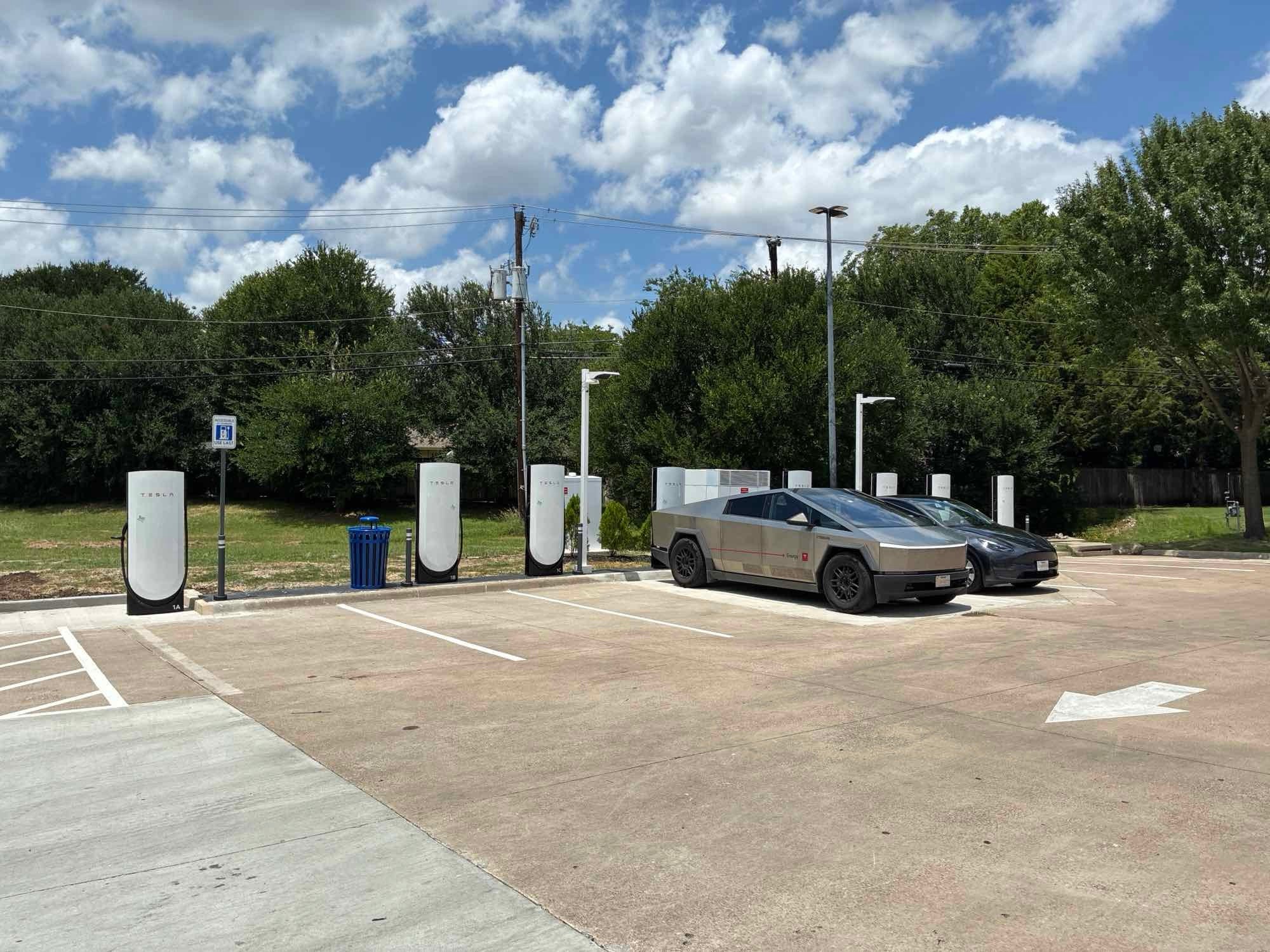
Eight Stalls Can Fill a Real Network Gap
Tesla Charging announced a new eight-stall Supercharger on West Arbrook Boulevard in Arlington, Texas. Compared with the large charging plazas that dominate headlines, eight stalls may sound modest.
But charging networks are not judged only by their largest sites. They are judged by whether a driver can find reliable power where it is needed.
Arlington sits within the Dallas-Fort Worth metropolitan area, a region shaped by highways, suburban travel, entertainment destinations, workplaces, and long cross-city drives. A charging location there can serve several kinds of users: road-trip traffic, apartment residents without home charging, rideshare drivers, local owners needing an occasional fast charge, and visitors moving through the metro area.
The value of the site depends less on being impressive and more on being useful.
Urban Charging Has Different Jobs
Highway Superchargers are built around travel corridors. Drivers arrive with a low battery, charge, and continue toward another city. Urban and suburban locations play a more complicated role.
Some drivers use them as a substitute for home charging. Others need a top-up between errands or before an airport trip. Rideshare and delivery drivers may value predictable access near demand. Visitors may charge while eating or shopping.
This creates different site requirements. Highway stations benefit from many stalls and amenities for travelers. Urban sites need convenient entrances, safe surroundings, nearby services, good lighting, and placement that fits normal routines.
An eight-stall site can work well if sessions are distributed and turnover remains healthy. It can also become frustrating quickly if local demand overwhelms capacity.
That is why network planning increasingly requires granular local data rather than simply placing the biggest possible station beside an interstate.
Location Quality Matters More Than Site Size
Charging is a land-use problem as much as an electrical problem.
A station needs sufficient grid capacity, available property, reasonable construction costs, accessible parking, and a host willing to support long-term operation. The most convenient consumer location may not be the easiest place to obtain power.
Tesla’s advantage comes partly from experience. The company has deployed charging sites across many property types and can use vehicle-routing data to identify demand patterns. It knows where Tesla drivers travel, where charging queues form, and where additional capacity can reduce network stress.
The Arlington site’s importance therefore may be as an infill location. Infill stations improve the spaces between major nodes. They give drivers more choice, reduce dependence on a single busy station, and make the network feel denser than the raw stall count suggests.
For EV adoption, that sense of density matters. Drivers become more confident when charging is not tied to one perfect plan.
Small Sites Also Need Reliability
A small location has little room for downtime.
If one charger at an eight-stall site is unavailable, capacity falls by 12.5%. If two are down, one quarter of the site disappears. At a large charging plaza, the same number of failures may be less disruptive.
This means maintenance, remote monitoring, payment reliability, and accurate in-car availability data are critical. Drivers need to know whether a stall is working before they arrive.
Tesla has historically benefited from integrating navigation and charging status into the vehicle. The car can route to Superchargers and prepare the battery for fast charging. That software connection makes each site more useful than a disconnected charger shown only in a third-party app.
As Tesla opens more of its network to other automakers, the user experience becomes more complex. Different vehicles have different charge-port locations, charging curves, and software integrations. Small sites must accommodate that diversity without creating awkward parking or blocked stalls.
The Mature Network Is Built Through Infill
The first phase of a charging network is about proving that long-distance EV travel is possible. The next phase is about making charging ordinary.
That requires large travel centers, but it also requires many less dramatic sites placed near daily activity. An eight-stall station can reduce a local charging desert, support drivers without garages, and create redundancy inside a metro area.
The challenge is keeping expansion ahead of demand. EV adoption, rideshare use, and access for non-Tesla vehicles can all increase station utilization. A site that is adequate today may need expansion later.
Tesla’s Arlington opening shows how infrastructure matures: not through one monumental project, but through repeated additions that make the map easier to trust.
The best charging station is often not the biggest. It is the one that appears exactly when a driver needs another option.
Share:
Why Electric Cars Dominate at 14,000 Feet
FSD’s Real Breakthrough Is Staying Useful for 500 Miles