
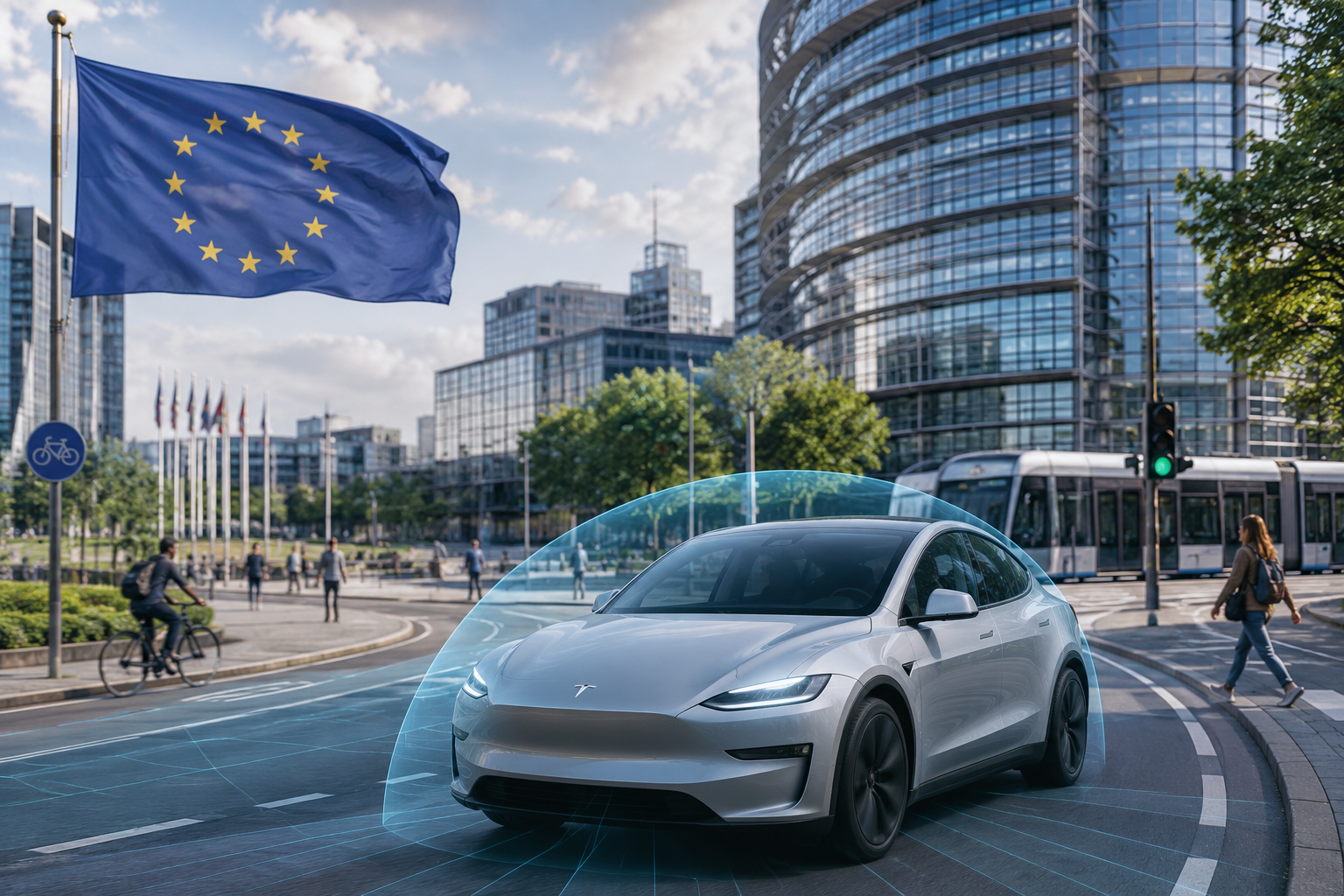
The European Commission is asking cities to join a program aimed at speeding up autonomous mobility in the EU. Autonomous Drive Ambition Cities, or ADACities, would use selected urban areas for deployments involving robotaxis, autonomous shuttles, car-sharing services and advanced driving systems.
The timing is relevant for Tesla. The company has developed Full Self-Driving (Supervised) mainly in North America, while European owners receive fewer driver-assistance functions. A coordinated EU program may create more opportunities for local trials, though a customer release would still depend on regulatory approval.
ADACities supports deployment, not product approval
The Commission describes ADACities as a flagship mobility project under its Apply AI Strategy. Participating cities would put autonomous vehicles into ordinary urban traffic instead of limiting work to private tracks and small demonstration zones.
Cities expose automated systems to difficult conditions, including cyclists, pedestrians, roadworks, narrow streets and unfamiliar junctions. A shared program could also help authorities compare results and develop more consistent rules for permits, infrastructure and safety data.
Participation would not automatically authorize any particular system. Tesla FSD would still have to meet EU and national type-approval requirements before Tesla could offer the same functions available in other markets to European customers.
The name FSD can blur an important distinction. FSD (Supervised) is a driver-assistance system, and the driver remains responsible for the vehicle. ADACities also covers vehicles designed to operate without continuous human control.
Why the program could help Tesla
Tesla develops FSD through repeated use on public roads. European streets differ from many U.S. test environments, with more roundabouts, tram lanes, variable signs and dense historic centers. Those conditions require local validation.
Coordinated access to city streets could help Tesla show regulators how FSD handles European road layouts and vulnerable road users. It may also reduce the need to run separate, loosely connected trials in each country.
ADACities follows another EU effort announced in June, when 18 member states backed large cross-border test areas for autonomous vehicles. That work includes common approval principles and coordinated permits. The city program brings similar cooperation into urban traffic, where driver-assistance systems and robotaxis face many of their hardest situations.
European FSD may behave differently
Even with wider approval, European FSD may not initially match the North American version in every detail. Local rules can affect lane changes, speed selection, parking, driver confirmation and the way steering assistance responds when a person intervenes.
Tesla may need region-specific software behavior, whether through a separate European branch or settings built into the same neural-network platform. Regulatory review could also lead to clearer driver monitoring, handover procedures and performance reporting.
Tesla will have to balance frequent software updates with the limits of an approved system. Over-the-air releases are central to the company's development process, but regulators need to know when an update changes vehicle behavior enough to require another review.
Trials and evidence come before a release
The Commission wants European cities and regulators to take part in autonomous-vehicle deployment rather than simply adopting technology developed elsewhere. ADACities gives them a structure for doing that.
For Tesla owners, the program is encouraging but provides no release date. More useful signs of progress would include Tesla joining an approved trial, publication of its operating conditions and confirmation that FSD (Supervised) can be offered consistently across EU markets.
ADACities may give Tesla a clearer route to demonstrate FSD in Europe. Whether that leads to a customer release will depend on the evidence Tesla produces and whether regulators are satisfied with its performance on European streets.
Sources
- European Commission, ADACities initiative post: https://x.com/EU_Commission/status/2073726840011694128
- European Commission, Autonomous Drive Ambition Cities initiative: https://digital-strategy.ec.europa.eu/en/news/autonomous-drive-ambition-cities-adacities-initiative-bring-autonomous-driving-technology-cities
- European Commission, EU ministers back cross-border autonomous vehicle testbeds: https://transport.ec.europa.eu/news-events/news/eu-ministers-back-cross-border-initiative-autonomous-vehicle-testbeds-2026-06-08_en
- Tesla, Full Self-Driving information: https://www.tesla.com/fsd
Share:
Tesla Adds Live FSD Route Tracking
How the Tesla Cybercab Could Work for Blind Riders