
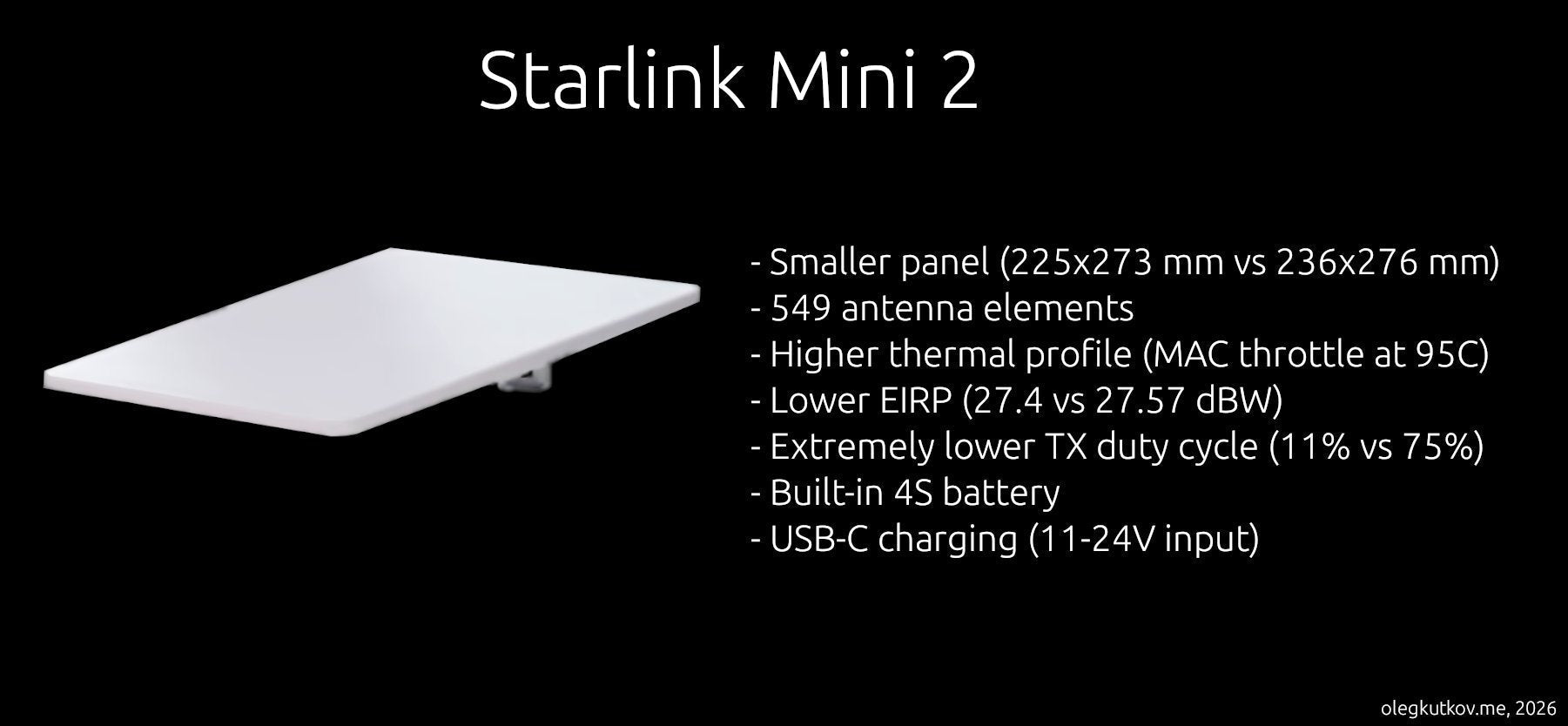
A new hardware analysis suggests Starlink Mini 2 is entering production with a built-in battery and native USB-C Power Delivery charging. Electronics engineer and Starlink researcher Oleg Kutkov identified a revision labeled “mini2_prod1” and published detailed dimensions, radio figures and thermal settings on July 19. The findings are credible technical evidence, but they are not an official SpaceX product announcement, and pricing, availability and final specifications remain unknown.
The built-in battery would change the Mini’s main compromise
The current Starlink Mini is portable, but it still needs an external power source. Starlink’s support documentation says the existing terminal typically consumes 20 to 40 watts and operates best from a 100-watt, 20V/5A USB Power Delivery source. Owners can use a compatible battery, yet that means carrying another device and cable. An internal pack would turn the terminal into a more self-contained tool for field work, camping, emergency communications and short stops away from fixed power.
Kutkov says the new hardware contains a four-cell lithium battery managed by a Texas Instruments BQ40Z-series battery-management system. He also reports an 11-24V USB-C input range. Battery capacity has not been identified, so runtime cannot be estimated responsibly. Firmware evidence reported earlier in 2026 had already pointed to battery monitoring and multiple power modes, making the new board-level findings a continuation of an existing trail rather than an isolated rumor.
A smaller terminal may trade uplink performance for power efficiency
The reported panel PCB measures 225 by 273 millimeters, compared with 236 by 276 millimeters for the original Mini. Kutkov also found a slightly lower average EIRP and a reduction in transmit duty cycle from 75 percent to 11 percent. He expects that change to reduce uplink speed, likely because of the tighter power budget. If confirmed, Mini 2 would appear optimized for portability and energy management rather than maximum upload performance.
Evidence boundary: The hardware revision, dimensions and configuration values come from independent technical analysis. SpaceX has not confirmed a Starlink Mini 2 name, launch date, battery capacity, runtime, retail price or final customer specifications.
Thermal limits and in-motion use raise practical questions
Kutkov reports higher internal thermal thresholds for the terminal and an 80 C battery shutdown threshold. Those figures describe configuration limits, not a recommendation to operate lithium batteries in extreme heat. A sealed portable terminal must balance weather resistance, heat dissipation, charging and battery longevity. Independent testing will be essential, particularly inside vehicles or in direct summer sun.
The reported GPS configuration also indicates support for in-motion use. That could make the device more convenient for approved mobile service plans, but hardware capability does not override plan terms, local rules or safe mounting requirements. Users should wait for official guidance before treating the leak as permission for any specific installation.
What happens next
The next confirmation should come from SpaceX through a product page, support document, regulatory filing or direct announcement. Until then, the strongest conclusion is narrow: production-labeled hardware appears to integrate the two features existing Mini users most often add externally - battery power and USB-C input. If the final product preserves useful connectivity while simplifying the power setup, Mini 2 could make satellite internet meaningfully easier to carry. The unanswered questions are runtime, heat management, upload speed, service eligibility and price.
Related EVBase reading
· Starlink V3 satellites add six 400Gbps space lasers
· SpaceX reaches a major Starlink deployment milestone
· EVBASE Tesla and technology news hub
Sources
· Oleg Kutkov - Starlink Mini 2 hardware findings on X
· Starlink Support - power requirements for the current Starlink Mini
· The Verge - earlier firmware evidence of a battery-powered Starlink Mini
Share:
SpaceX Targets July 23 for Starship Flight 13
Tesla Roadster Turns 20: The EV That Changed the Market