
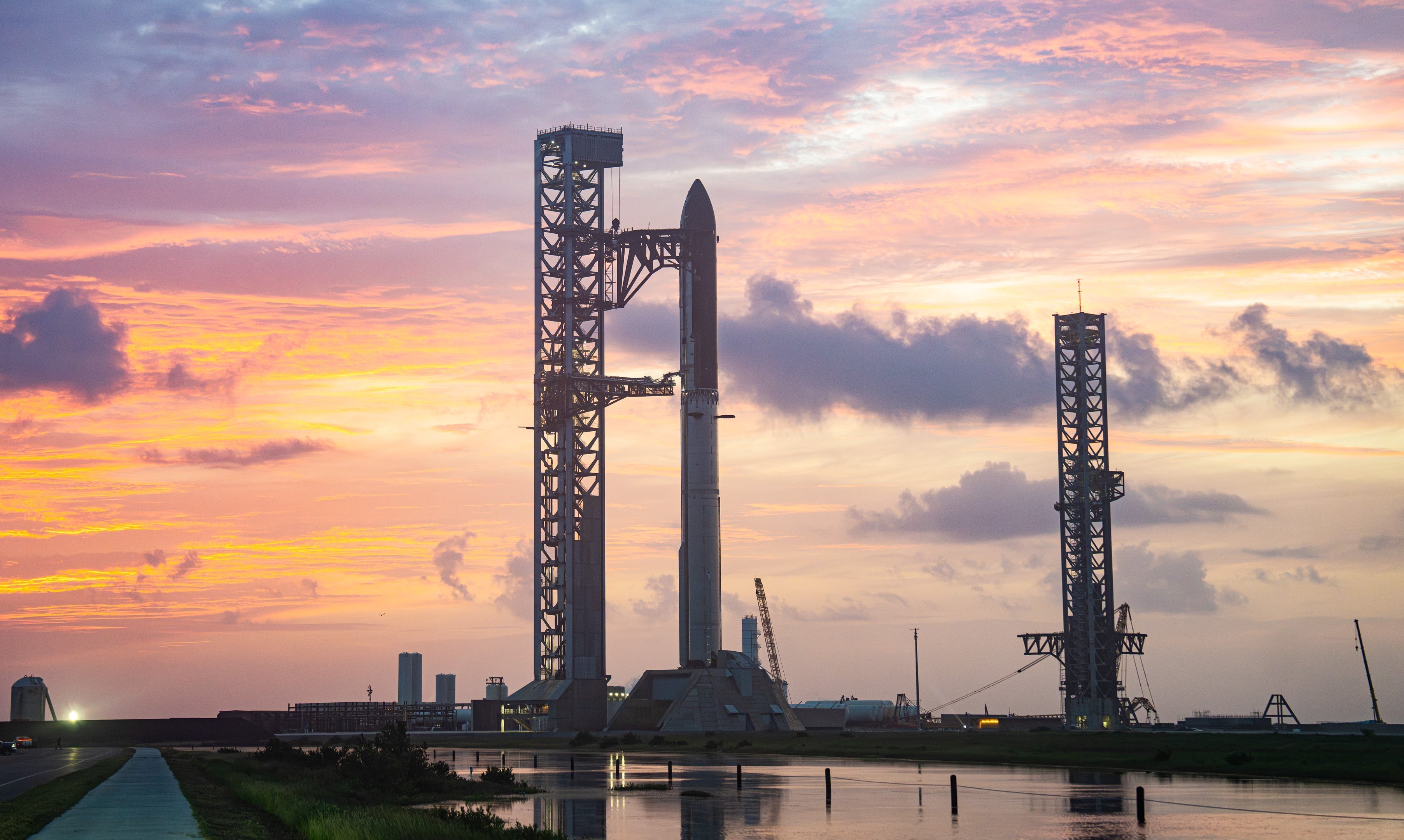
SpaceX is now targeting Thursday, July 23, for the thirteenth flight test of Starship, according to an official July 19 update. The date is explicitly “as early as,” meaning regulatory, technical and weather conditions can still move the schedule. The mission follows earlier attempts that did not proceed to launch and gives SpaceX another chance to test its newest Starship architecture with actual next-generation Starlink hardware aboard.
Flight 13 combines a rocket test with a network test
The mission is expected to carry 20 Starlink V3 satellites. Unlike simple mass simulators, these payloads are intended to extend solar arrays and antennas and attempt communications through SpaceX’s existing laser-linked constellation. That makes Flight 13 an early test of the relationship SpaceX ultimately wants between Starship and Starlink: a high-capacity launch vehicle deploying satellites that are too large and numerous for the company’s current Falcon 9 cadence to handle efficiently at the planned scale.
Six of the satellites are also equipped with cameras intended to observe Starship’s exterior and heat shield. The arrangement turns the payload into an inspection system, giving engineers views of the vehicle during flight that fixed onboard cameras cannot provide. SpaceX has modified tiles and attachment methods in several areas to collect data on how different configurations behave during ascent and reentry.
The mission still has fundamental vehicle objectives
Super Heavy is expected to perform ascent, stage separation, a boostback burn and a landing burn toward an offshore point rather than a tower catch. The upper stage is planned to deploy the satellites, attempt an in-space Raptor relight and make a controlled reentry before splashing down in the Indian Ocean. Each objective addresses a different requirement for reuse: propulsion reliability, payload operations, thermal protection, guidance and controlled return.
Schedule note: Starship test dates can change with little notice. Readers should use SpaceX’s official Flight 13 page and live X feed for the final launch window rather than relying on an earlier calendar listing.
Why another test flight matters
Starship remains a development program, so a launch is not the same as an operational mission. SpaceX is still learning how the V3 vehicle behaves across a complete flight profile. A successful satellite deployment would be important, but it would not by itself prove rapid reuse, orbital refueling or routine recovery - capabilities central to the company’s ambitions for Starlink, NASA lunar missions and eventual Mars transportation.
What to watch on July 23
The most meaningful signals will come in sequence: clean ascent and separation, reliable booster engine relights, successful Starlink release and communication attempts, an in-space Raptor relight, useful heat-shield imagery and a controlled ship splashdown. Even if one objective is missed, the flight can still return valuable engineering data. Flight 13 is therefore best understood as a tightly packed test campaign in a single launch, not a pass-or-fail demonstration of the entire Starship program.
Related EVBase reading
· SpaceX reaches a major Starlink deployment milestone
· Starlink V3 satellites add six 400Gbps space lasers
· EVBASE Tesla and technology news hub
Sources
· SpaceX - July 23 Flight 13 target announcement on X
· SpaceX - official Starship Flight 13 mission page
· Associated Press - report on the earlier Flight 13 pad abort
Share:
Tesla Giga Berlin Plans 2026 Production Expansion
Starlink Mini 2 Leak Points to a Built-In Battery