
LG Tesla battery output moves higher
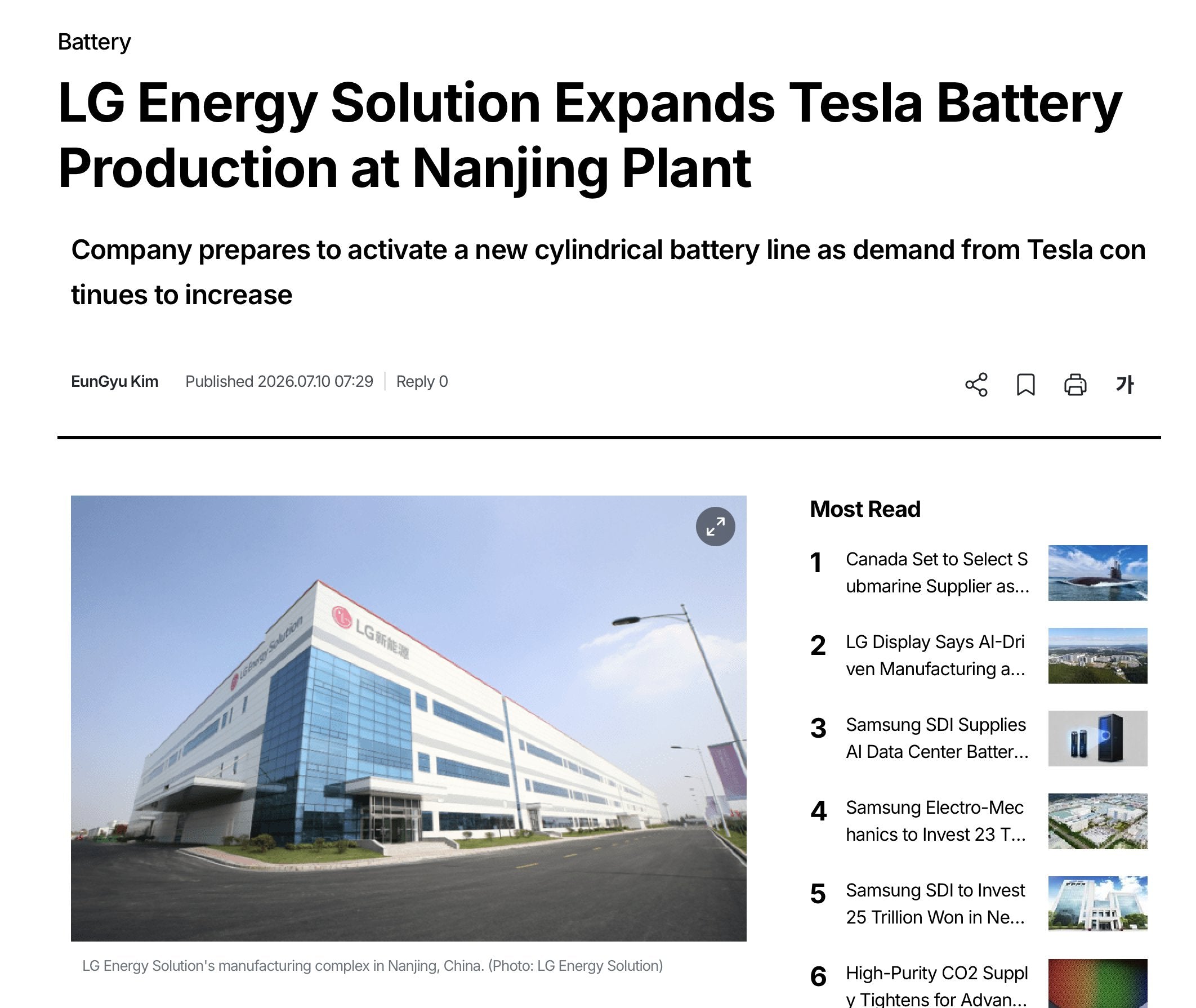
LG Energy Solution is expanding cylindrical battery production at its Nanjing, China factory because of rising demand for Tesla EVs, according to a July 9 post from Sawyer Merritt. The post says LG has already been running its existing cylindrical battery lines at full capacity after steadily raising utilization since late 2025.
That makes this more than a one-factory update. A Tesla battery supplier does not add capacity because of one strong month. It does so when it sees enough demand visibility to justify more equipment, labor, materials, and operating risk.
For Tesla, the signal is useful. Even as the wider EV market gets choppier, its best-selling vehicles still need huge cell supply. Batteries remain one of the main inputs behind growth and margins.
Model Y keeps driving cell demand
The Model Y is still the anchor. Merritt noted that the Model Y was China's best-selling passenger vehicle of any fuel type last month despite being priced higher than all other top-10 vehicles. That matters because it suggests demand is not only being driven by discounts.
When a high-volume vehicle keeps selling, every constraint moves upstream. Battery cells, modules, pack assembly, logistics, and supplier utilization all become part of the same demand chain. LG Tesla battery production in China is therefore not just about LG. It reflects pressure from Tesla's Shanghai-centered Model Y business.
If the Model Y stays near the top of the sales charts, cylindrical cell demand stays hard to ignore.
Energy storage adds another layer
Tesla battery demand is no longer only about EVs. Tesla's energy storage business, including Megapack, has become a major growth area. Stationary storage uses different products and supply chains, but it still competes for global battery industry capacity, materials, and manufacturing attention.
That is why supplier expansion matters. Tesla needs enough battery access to support vehicles while scaling grid storage, home storage, and future energy products. LG has also been linked to Tesla energy storage supply in the U.S., which shows the relationship is broader than one China EV line.
The battery market is becoming less about single contracts and more about who gets capacity when demand spikes.
Cybercab makes supplier planning harder
Cybercab adds uncertainty. Tesla's dedicated robotaxi could eventually require large-scale battery supply if production moves beyond validation units and early fleets. Even a small, efficient vehicle can create meaningful cell demand if Tesla builds it for high utilization and fleet deployment.
That is why suppliers have to plan early. Waiting until Cybercab demand is obvious would be too late. Battery factories take time to expand, qualify, and stabilize. If Tesla wants Model Y, storage, and Cybercab growth at the same time, suppliers such as LG need capacity before customers can see the constraint.
What this says about Tesla battery suppliers
The LG expansion report is a reminder that Tesla still depends on a supplier network even as it develops its own cells and manufacturing processes. Panasonic, CATL, LG Energy Solution, and Tesla's internal production all play different roles across regions and chemistries.
That is not automatically a weakness. It is how battery scale works. The risk is coordination: if demand rises faster than cell availability, production gets capped. If demand falls, suppliers are left with underused lines.
For now, LG's reported Nanjing expansion points to confidence. Model Y demand is still strong enough to push cell output higher, and Tesla's future product plans give suppliers a reason to keep adding capacity.
Share:
SpaceX Is Working on AI Infrastructure in Orbit
Giga Texas Looks Busy as Model Y Output and Cybercab Shipments Continue