
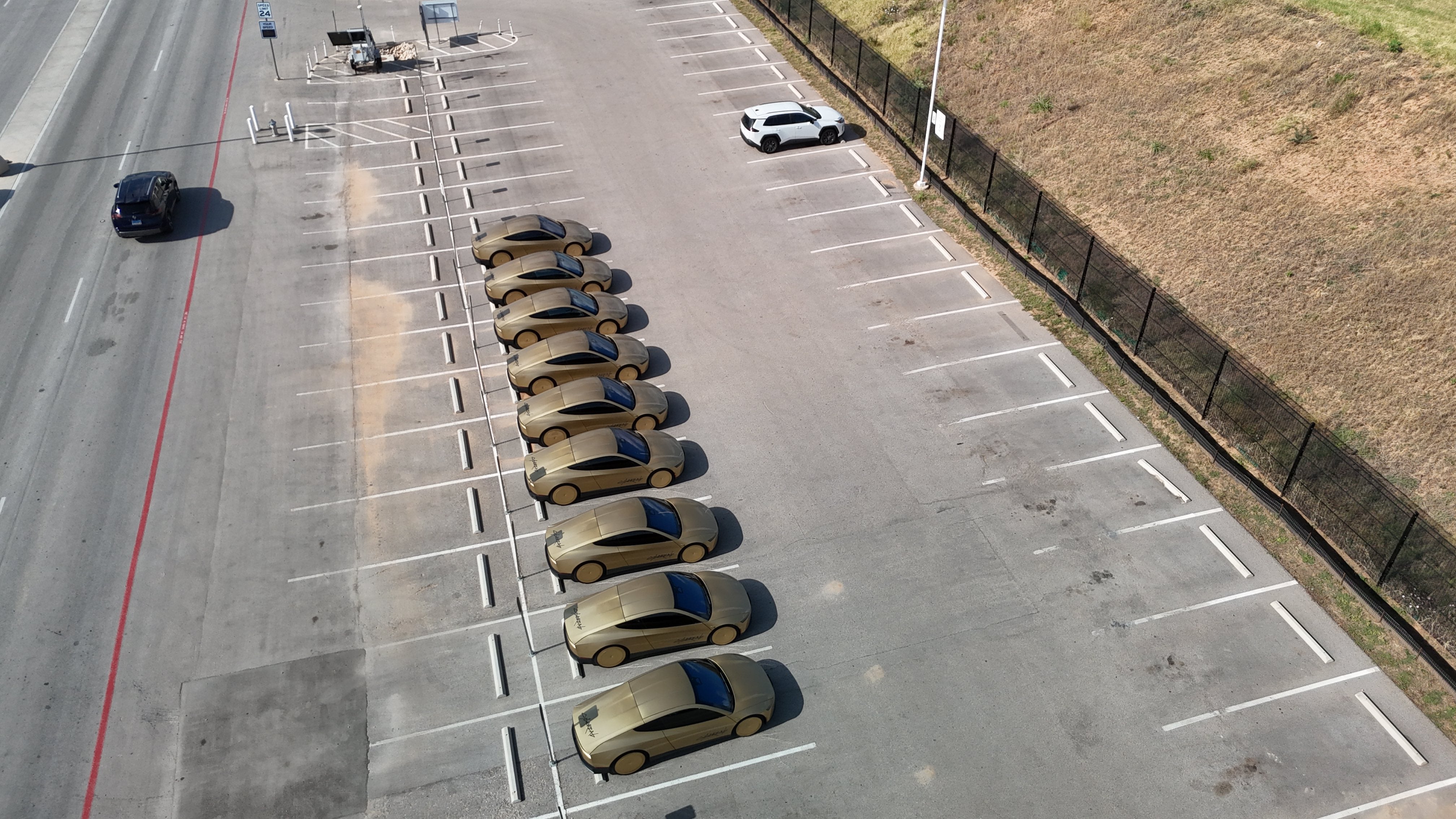
AUSTIN, Texas - New aerial footage from Giga Texas shows a group of nine Cybercabs staged together and apparently preparing to leave the factory for testing on Austin roads.
Drone operator Joe Tegtmeyer published video and photos Tuesday showing nine gold vehicles with Cybercab branding. The group is larger than a single prototype and appears intended for engineering validation.
The post confirms the vehicles and planned testing, but it does not reveal weekly output, total production or the routes and conditions Tesla will use.
Cybercab moves from factory staging to road tests
Tesla began producing Cybercab units at Giga Texas earlier in 2026. Unlike the Model Y vehicles currently used across much of Tesla's Robotaxi service, the purpose-built Cybercab has two passenger seats and is designed without a steering wheel or pedals in its production configuration.
Recent sightings have shown larger batches near the factory and production-style vehicles on public roads. The nine-unit group gives Tesla more cars for simultaneous testing, but it is not evidence that passenger service has begun.
Tesla must test more than autonomous driving. A commercial fleet also needs reliable charging, cleaning, climate control, remote support, passenger controls and durability under repeated use.
Optimus factory construction continues
The broader Giga Texas expansion extends beyond vehicles. Earlier flyovers documented steel erection and foundation activity at a dedicated Optimus factory on the site's North Campus.
Tesla has said it wants to manufacture Optimus robots at very high volume. Current construction prepares the site for that goal; it does not show that mass production is already underway.
Cybercab and Optimus create similar factory challenges: both depend on heavy automation, large quantities of custom electronics and manufacturing systems that must move from pilot output to repeatable volume.
Data-center and chip projects remain at earlier stages
Tesla is also expanding AI infrastructure around its Texas operations. The campus includes Cortex data-center capacity used for AI training, while proposed semiconductor work is intended to support future demand for inference hardware across vehicles and robots.
References to a chip fab should not be confused with completed production. Permits and construction show preparation. Equipment installation, qualification and commercial output would come later.
The same caution applies to Cybercab. More vehicles outside the factory show progress in hardware production, but autonomous software, regulatory approval and fleet operations may move on different schedules.
Several Tesla programs now share the same campus
Giga Texas opened with Model Y production and later added Cybertruck. Tesla is now adding work related to autonomous fleets, Optimus, AI computing and possible semiconductor production.
Keeping those teams close could speed up testing and troubleshooting. Cybercab data can feed software work, new hardware can be evaluated near the line, and factory problems can reach engineers quickly.
It also puts several expensive projects in one place. Cybercab, Optimus, new buildings and chip manufacturing each need capital, specialized equipment and suppliers. Construction progress alone does not guarantee that every program will meet its schedule or volume target.
The confirmed development is straightforward: nine branded Cybercabs were preparing for Austin tests. The rest of the campus shows how many other programs Tesla is trying to build alongside them.
Share:
How Reaction Injection Molding Could Change Tesla Cybercab Production
A 73-MPH Tesla Crash, but Who Was in Control?